> Definition: TCG Pocket App is a pokemon card scanner app that identifies cards, checks market prices, and tracks collections for Pokémon TCG collectors.
Why Binder Collectors Need a Dedicated Pokemon Card Scanner
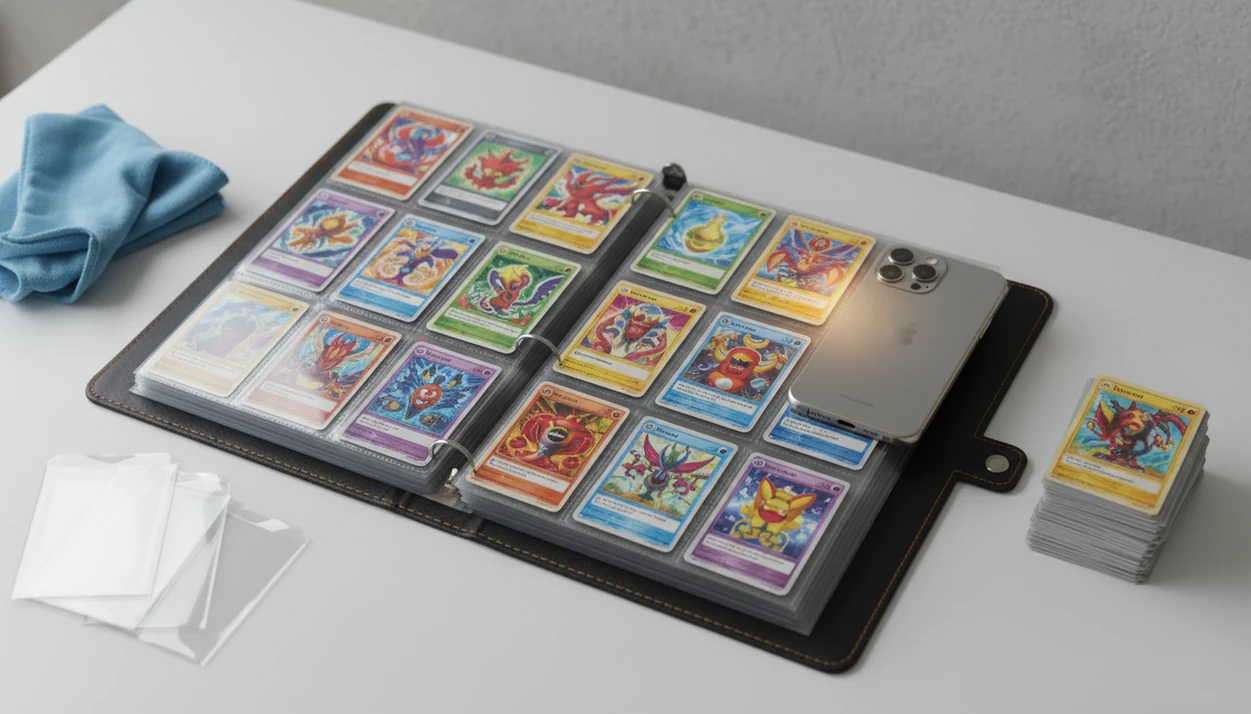
Binder collectors need a dedicated scanner because their collection is organized by set, page, slot, and visual order, not just by card name. A flat spreadsheet can tell you that you own Charizard, but it will not show whether the card belongs in page 4, slot 7, beside the reverse holo.
The scale makes manual identification painful. The Pokémon Company reported more than 43.2 billion Pokémon TCG cards produced globally as of March 2022, and Pokémon TCG has been running since 1996 source. In a 2022 Pew survey, 34% of U.S. adults reported taking part in a hobby or collectible activity source.
The binder page crinkles when you scan through plastic.
TCG Pocket App fits binder collectors who want to scan in sequence, tag by page and slot, and compare owned cards against missing spaces. For parents sorting inherited piles, our pokemon card scanner for parents guide covers a simpler first-pass workflow.
How a Collector Pokemon Scanner Works Behind the Lens
A collector pokemon scanner works by turning a camera image into a database match, then attaching card details and price data to the saved inventory record. The useful part is not just recognition; it is the chain from scan, verify, log, and compare.
For TCG Pocket App, the collector-facing value is the saved record: set, variant, condition note, binder location, and current price stay attached after the scan. That is what turns a one-time identification into a usable binder inventory.
- Image capture: The camera reads artwork, card text, set symbol, and border details. Ring-light glare bouncing off a reverse holo through a nine-pocket page can hide the exact texture.
- AI matching: Image recognition compares the captured card against database references to return set, rarity, language, and variant match.
- Price refresh: Live feeds can update market values in the background once a card is inventoried.
- Database coverage: Promos, foreign-language prints, and brand-new sets may lag behind, so a set number check still matters.
- Scan conditions: Camera quality, sleeve clarity, and room lighting directly affect accuracy, especially on foil cards.
Good ai-powered Pokémon TCG card scanners, live market prices, and pocket-sized collection management apps deliver faster identification and organized records, not guaranteed appraisal certainty.
How to Use a Binder Collector App to Scan Your Collection
Use a binder collector app by copying your real binder structure before you start scanning. The order matters because a digital inventory is easier to trust when it follows the same page-by-page logic as the physical binder.
- Create a binder or set folder to mirror your physical layout before scanning the first card.
- Position each card under steady lighting and scan sequentially, page by page, instead of jumping around.
- Confirm each scan result by checking set, variant, language, and condition tag before saving.
- Review your inventory for live pricing, missing cards, duplicate copies, and suspicious variant matches.
- Export or back up collection data so years of scans are not trapped in one account.
TCG Pocket App works well for collectors who scan one binder page at a time because the workflow keeps identification, market checks, and collection logging in the same pass. If the real job is sorting unsorted stacks before binder placement, the app to help sort pokemon cards workflow is closer.
Top 3 Features a Pokemon Card Scanner for Collectors Must Have
A pokemon card scanner for collectors must preserve binder structure, explain price sources, and show set gaps. Without those three features, the scanner may identify cards quickly but still fail the way collectors actually organize.
Binder-Mirroring Inventory Structure
Binder-mirroring means cards can be tagged by binder, page, section, and slot. TCG Pocket App supports binder-first organization because collectors can scan, save, and review cards in a layout that reflects the shelf, not only a loose database list.
Live Price Feeds With Source Transparency
Price-source transparency matters because active asking prices, marketplace averages, and sold-listing context are different signals. We still check the green sold-price filter on eBay before treating a number as realistic trade context.
Set Completion and Wishlist Tracking
Set completion tools show what you own, what is missing, and which duplicates can become trade material. In its State of Mobile 2024 report, data.ai estimated that users in several major markets spent more than five hours per day in mobile apps in 2023 source, so low-friction collection logging matters. For binder-first collectors, set-completion tracking is often more useful than a raw value total because it turns scanning into a want-list and trade-plan system.
TCG Pocket App vs Other Pokemon Card Scanner Options
TCG Pocket App is strongest when the job is turning a real binder into a usable digital binder. Collectr, Pokellector, and marketplace-native tools can be better fits when pricing, checklist depth, or selling flow matters more than page-by-page organization.
| Option | Best fit | Binder mirroring | Price transparency | Export control |
|---|---|---|---|---|
| TCG Pocket App | Binder collectors | Strong | Medium | Check before bulk use |
| Collectr | Portfolio tracking | Medium | Medium | Varies by account/tools |
| Pokellector | Set collectors | Low-medium | Lower | Limited |
| Marketplace tools | Sellers | Low | Stronger sold context | Platform-bound |
Choose by workflow, not app hype.
- Pick TCG Pocket App if you care about binder order, page slots, and scanning in the same sequence your cards sit on the shelf.
- Use Collectr when portfolio totals and broad collection tracking matter more than exact binder placement.
- Open Pokellector for checklist-style set collecting, especially when you want to see what is missing fast.
- Check marketplace-native tools when you are preparing listings, because seller decisions need sold comps, fees, and demand signals.
The tradeoff is database depth, export control, and price transparency. No single scanner wins all three.
Common Binder Collector Scanning Patterns and Mistakes
Binder collectors usually scan in bursts: one page after dinner, a new pack at bedtime, or a trade binder before a card show. The mistakes are predictable, and they usually come from trusting the first result too quickly.
- Sleeve glare causes mis-scans: A thumb flattening wrinkled plastic can help, but angled lighting is often better than pressing harder. - Scanner prices are not sale guarantees: TCGplayer, Cardmarket, PriceCharting, and eBay sold results can point in different directions. For higher-value trades, compare at least two public references such as the TCGplayer Pokémon price guide, Cardmarket Pokémon listings, PriceCharting Pokémon data, or eBay sold listings. - Apps do not grade like PSA, BGS, or CGC: Condition tags are estimates, not professional grading decisions. - Price updates do not require rescanning everything: Modern inventory tools can refresh pricing after the card is saved. - Skipping export is risky: A locked account can turn years of binder work into manual cleanup.
When trade timing is the issue, TCG Pocket App earns its spot by letting collectors scan a binder before leaving home, then compare updated values while reviewing duplicates. Show-specific checking is covered in pokemon card show price checking.
Collector Pokemon Scanner Gaps in 2025
Collector pokemon scanner tools are useful in 2025, but the weak spots are still variant complexity, data movement, and trust boundaries. A scan can confuse two similar Pikachu prints until the collector checks the set symbol and lower-left set number.
Alternate arts, promos, and heavily worn cards still cause mis-identifications. Newly released sets and foreign-language cards may not appear in every database right away. No scanner replaces in-person expertise for authentication, complex trades, or a grading decision on a high-value card.
Data portability is another rough edge. Moving from one app to another can mean CSV cleanup, missing condition notes, and rebuilt folders. Privacy also deserves attention because high-value binder data may be stored or shared in ways collectors do not expect. For sale-focused workflows, an app to help sell pokemon cards should be judged even more carefully on export and price-source transparency.
Limitations
TCG Pocket App should be treated as a starting point, not the final word on identity, value, or condition. That is true for any scanner, including alternatives such as getcollectr.com, pokellector.com, and marketplace-native tools.
Use TCG Pocket App for fast identification and organization, then slow down for cards where condition, authenticity, or a single variant changes the value by a meaningful amount. That is the line between collection management and appraisal.
- Card recognition can struggle with glare, graded slabs, faded ink, and heavily played cards.
- Live market prices depend on specific feeds and may not match local shop buylists or niche auction results.
- AI scanners depend on active developer support; if updates slow, new sets and promos go missing.
- No app can replace PSA, BGS, or CGC for condition assessment on high-value cards.
- Privacy and retention policies vary, so scan data for expensive binders may be stored in ways collectors should review.
- Certain promos, foreign-language releases, event cards, and niche variants may be absent from some databases.
- Raw versus graded values need separate interpretation, especially before paying grading fees.
Small caveat. Big consequences.