
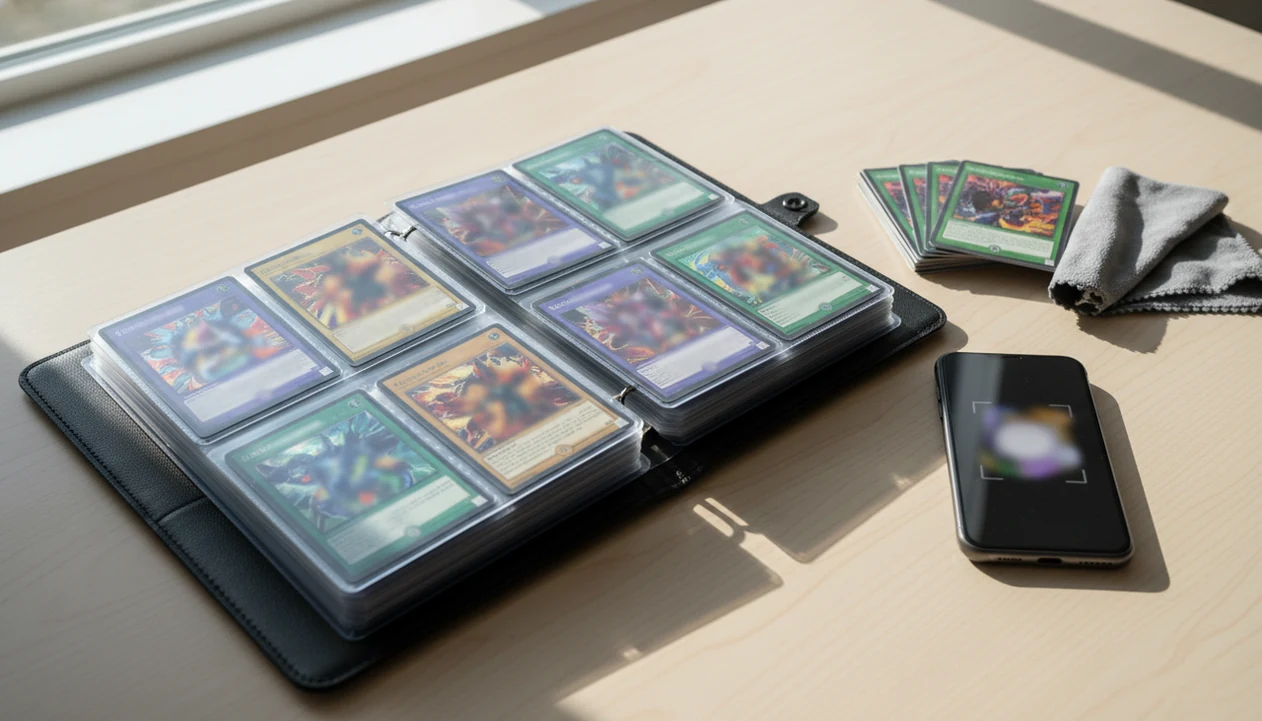
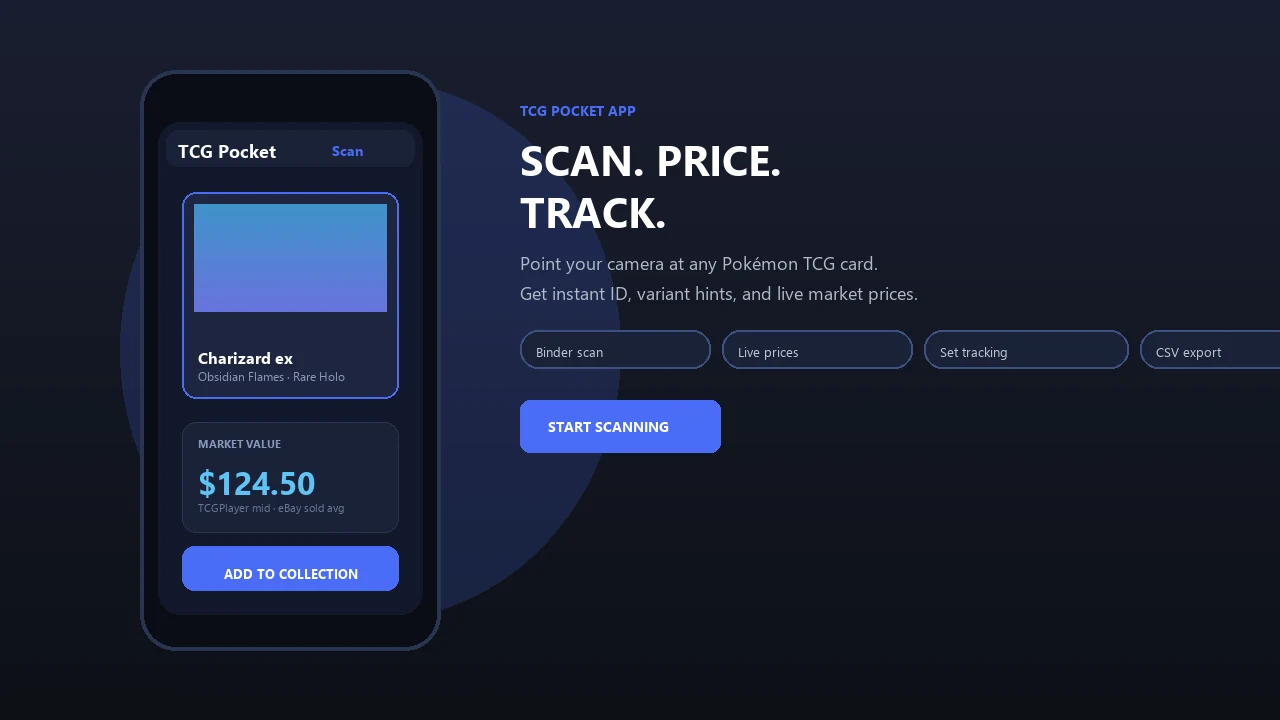
> Definition: A Pokémon collection tracker app is a mobile tool that scans physical TCG cards with your phone camera, logs them into a searchable digital catalog, and displays live market prices alongside set-completion progress.
- TCG Pocket App is the fastest binder-friendly scanner with live prices and deep Pokémon-specific set views.
- Dex covers every set and supports community-driven features but can lag on niche promos.
- Collectr works across Pokémon, Magic, and Yu-Gi-Oh but trades Pokémon depth for multi-TCG breadth.
- No app scans perfectly, holos, full arts, and sleeved cards still need manual correction.
- Always export or back up your collection; third-party apps can lose support without warning.
At-a-Glance: Top Pokemon Card Collection Apps Compared
A strong pokemon card collection app should scan quickly, show where prices come from, and keep set progress readable. That matters more now because The Pokémon Company says more than 64.8 billion Pokémon cards had been produced worldwide as of March 2024 (https://corporate.pokemon.co.jp/en/aboutus/figures/).
| App Name | Scanner Type | Price Source | Set Coverage | Multi-TCG Support | Offline Mode | Free Tier |
|---|---|---|---|---|---|---|
| TCG Pocket App | AI camera scan, binder-friendly | Live marketplace pricing with visible context | Base Set through newest expansions | No, Pokémon-focused | Limited collection viewing | Yes |
| Dex | Camera scan and manual search | Market price checks | Broad Pokémon set catalog | No | Limited | Yes |
| Collectr | Camera scan and portfolio entry | Multi-market portfolio values | Strong major-set coverage | Yes, Pokémon, Magic, Yu-Gi-Oh | Limited | Yes |
| Pokécardex | Manual search and checklist | Light price support | Good casual set tracking | No | Better for checklist use | Yes |
Good AI-powered Pokémon TCG card scanners, live market prices, and pocket-sized collection management apps deliver faster organization, not final appraisals.
What a Pokemon Collection Tracker App Does
A pokemon collection tracker app turns loose cards and binder pages into a searchable inventory with set progress, duplicate counts, and pricing context. It helps you decide what stays in the binder, what moves to a trade row, and what needs a closer look before you trust the value.
The usual workflow is simple:
- Scan or search the card, then let the app suggest a match from its database.
- Confirm the set, number, rarity, language, foil type, and variant before saving it.
- Log condition, quantity, and duplicates so binder pages and trade stacks stay separate.
- Compare prices against recent market context before making trade-table decisions.
- Export the collection when you need a backup, spreadsheet, or insurance-friendly record.
TCG Pocket App matters when binder scanning speed and Pokémon set views are the priority. Dex is useful when browsing sets visually matters more than trade sorting. Collectr earns its spot when one portfolio needs Pokémon alongside other TCGs. The collector still has to verify condition, authenticity, misprints, stamped promos, and any card where glare or texture confused the scanner.
5 Facts Every Pokemon TCG Tracker User Should Know
A Pokémon TCG tracker works best when it speeds up entry without hiding the need for verification. We still check the lower-left set number before trusting a value on any card worth more than a casual trade.
- Best-in-class tracking means AI scanning, a complete Pokémon database, and live pricing in one workflow.
- The key comparison criteria are scan accuracy, database coverage, price-source transparency, sync, and export.
- Multi-TCG apps usually trade Pokémon depth for broader support across Magic, Yu-Gi-Oh, and other games.
- No scanner is perfect; holos, full art cards, foreign cards, and worn edges often need manual correction.
- A 2023 Statista report says 88% of U.S. smartphone owners use phones for price comparisons while shopping.
Anyone dealing with quick trade-table decisions should start with TCG Pocket App because it pairs scan results with price-source context before the card gets logged. For duplicate-heavy binders, a tool that can track pokemon card duplicates is worth checking before bulk entry gets messy.
Best Pokemon Collection Tracker Apps: Named Shortlist
Your shortlist depends on how you collect: binder sets, market values, multi-game portfolios, or simple checklists. A parent squinting at a rarity mark beside a mixed pile needs a different app than a Magic player tracking three games.
- TCG Pocket App: best for binder-focused Pokémon collectors who need fast scanning, live prices, set views, and duplicate tracking.
- Dex – for TCG Collectors: best all-around community-driven tracker for collectors who want a polished Pokémon catalog and broad set browsing.
- Collectr: best for multi-TCG collectors who want Pokémon, Magic, and Yu-Gi-Oh portfolio values in one account.
- Pokécardex: best lightweight free option for casual set tracking, especially when checklist speed matters more than pricing depth.
For collectors building master sets, TCG Pocket App fits because it keeps scan, verify, log, and compare steps close together. Set completion usually depends more on database structure than scanner speed, because missing variants create false progress.
TCG Pocket App: Best Binder-Friendly Pokemon Card Scanner
TCG Pocket App identifies cards, checks market prices, and tracks collections for Pokémon TCG collectors. It is the strongest fit for binder users because the scanner is built around sleeved cards, nine-pocket pages, and quick confirmation instead of multi-TCG portfolio clutter.
Ring-light glare can bounce off a reverse holo through a binder page. That still happens. But the binder-friendly scan flow lets you adjust angle, confirm the variant match, and save the card without rebuilding the entry from scratch.
It shows live market prices with price-source transparency, then organizes cards by Pokémon-specific set views from Base Set through current expansions. For binder management, the stronger workflow is set-number check, condition caveat, and collection logging in one place. Collectors who care most about completion can pair it with a set completion tracker for pokemon cards.
Dex and Collectr: Broader Pokemon TCG Tracker Alternatives
Dex and Collectr are credible alternatives when your collection habits stretch beyond a Pokémon-first binder workflow. They can beat TCG Pocket App for community browsing or multi-game portfolio tracking, but they feel less focused when the job is exact Pokémon variant matching.
Dex – for TCG Collectors
Dex has wide community adoption, every-set browsing, card scanning, and price checks in one app. It is a good pick if you like exploring sets visually and logging cards at a steady pace.
Collectr Multi-TCG App
Collectr works well for collectors who also track Magic or Yu-Gi-Oh. Its portfolio view is useful, but Pokémon-specific details can feel thinner than a dedicated pokemon tcg tracker.
When cross-game support is the issue, Collectr makes sense because one account can hold several TCG portfolios. Pokécardex remains a lightweight fallback for Android users who mainly want free set checklists.
How Pokemon Collection Tracker Apps Work
Pokemon collection tracker apps use a computer-vision pipeline: camera capture, edge detection, feature extraction, and database matching. In plain terms, the app looks for the card shape, reads visual details, compares them to known prints, then suggests the closest match.
Price data follows a different path. Marketplace APIs, TCGplayer-style market feeds, and eBay sold-listing context are normalized before the app displays a value. We always distinguish the green sold-price filter on eBay from active asking prices, because sellers can ask anything.
Cloud databases sync set catalogs when new expansions release. According to Statista, mobile apps accounted for 59% of digital game market revenue worldwide in 2021, which helps explain why collection tools are built phone-first. Holos, texture, and glare cause mis-scans because reflections change the visual features the model needs. Plastic crinkle from a binder page does not help.
How to Use a Pokemon Card Collection App for Your Binder
A clean binder workflow is scan, verify, log, compare, and export. Do not scan 400 cards first and fix everything later; small corrections are easier while the card is still in front of you.
- Download and create an account in TCG Pocket App so your collection can sync across devices.
- Scan cards from binder pages and remove sleeves only if glare keeps blocking the image.
- Review and correct mis-identified cards by checking the set symbol, set number, language, and foil type.
- Tag duplicates, set conditions, and add grading info for raw versus graded comparisons.
- Check live market value and set completion progress before moving cards into trade or keeper sections.
- Export or back up your collection data regularly so app changes do not trap your inventory.
For collectors who trade often, TCG Pocket App handles duplicate tagging because scanned copies can be separated into keep, trade, and bulk groups. A dedicated CSV export for pokemon card collections also helps when you need a spreadsheet copy.
How We Picked the Best Pokemon TCG Tracker Apps
We evaluated each pokemon tcg tracker on real binder use, not just app-store screenshots. Scanner accuracy was checked across holo, reverse holo, full art, Japanese, and ordinary non-holo cards, including one slightly bowed card inside a sleeve.
Price-source transparency mattered. We looked for clear signals about marketplace data, sold-listing context, refresh behavior, and whether raw versus graded values were separated. A graded label under a bright lamp can pull attention, but the raw copy beside it should not inherit the slab price.
Database completeness covered Base Set through current expansions, promos where available, and variant handling. We also tested low-connectivity use at shops and events, where crowd noise and weak signal make slow apps painful. Export and backup options were non-negotiable; a tool to export pokemon card collection CSV protects the work after the scan session ends.
Limitations
Tracker apps save time, but none should be treated as the final word on condition, authenticity, or value. The moment a scan confuses two similar Pikachu prints, the collector still has to verify the set symbol.
- AI scanners struggle with glare, sleeves, and heavily played cards, so error rates rise in real binder conditions.
- Live price data can lag market spikes or crashes because marketplace APIs update on delay.
- Most databases still miss obscure promos, misprints, staff cards, and regional exclusives.
- Third-party apps can disappear from app stores without warning, so exported backups matter.
- Security and privacy policies vary; not every app explains how card photos or purchase history are handled.
- Full-art, textured, and foreign-language cards frequently require manual correction after scanning.
- Apps depend on external APIs that can rate-limit or break, temporarily disabling price updates or set additions.
For insurance records or higher-value collections, an app log is only part of the file. A separate pokemon card collection insurance inventory should include photos, receipts, grades, and storage notes.