
Pokemon Card Collection Insurance Inventory Guide
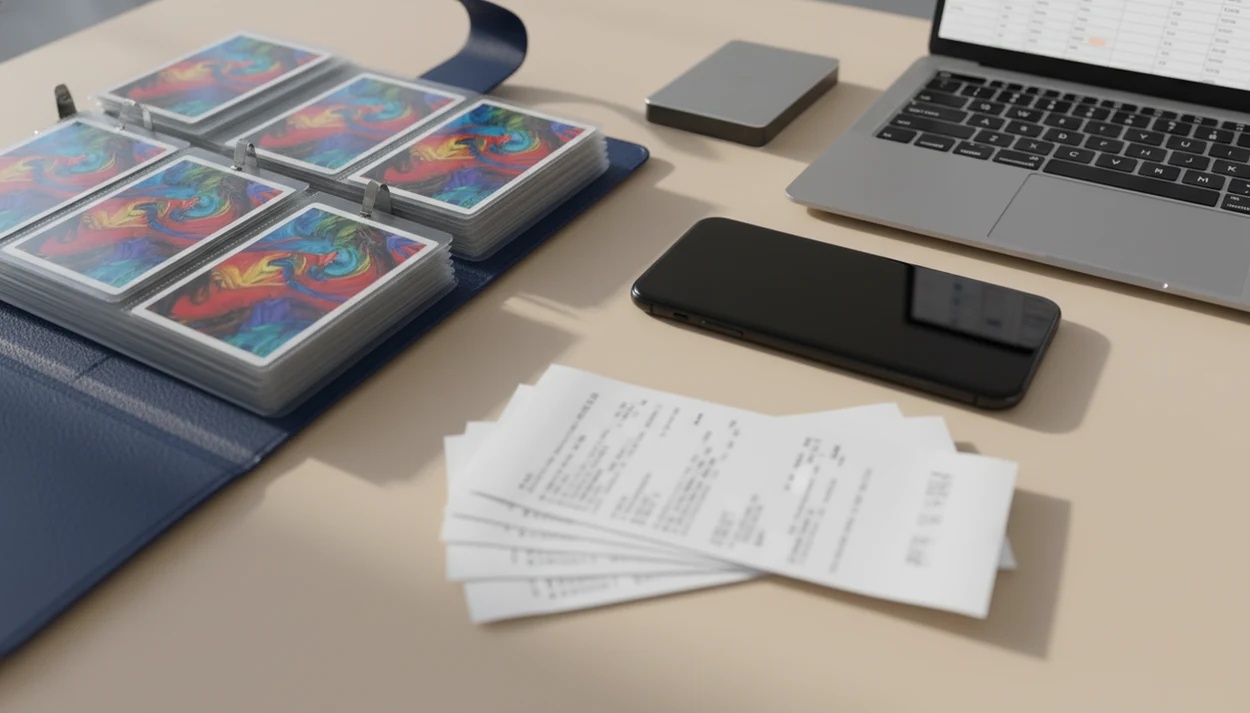
A pokemon card collection insurance inventory is a documented record of the cards you own, with scans, photos, set details, condition notes, quantities, and dated value snapshots that can support an insurance claim. Scanner exports from a card-identification app can make those records faster to create, but they are supporting documentation, not a formal appraisal.
- Scanner exports, photos, receipts, and condition notes create stronger Pokémon card insurance records than a price list alone.
- A CSV export with live market prices is useful claim support, but insurers may still require scheduled coverage or a formal appraisal for high-value collections.
- Back up collection documentation in cloud and local storage, then refresh value snapshots every 6–12 months.
Pokemon Card Collection Insurance Inventory Records At A Glance
A Pokémon card insurance inventory is proof of ownership and value context, not a guaranteed payout document. It helps show what you owned before theft, fire, water damage, or another covered loss.
Useful pokemon card insurance records should include card name, set, card number, rarity, language, variant, condition, quantity, timestamped value, clear photos, and receipts when available. For graded cards, add the grading company, grade, and certification number. Before trusting any price match, check the set number in the lower-left corner. Similar Pikachu prints can fool a quick scan until the set symbol is verified.
Scanner exports are useful because they make documentation faster and more consistent. A binder-friendly scan can turn a messy stack into sortable records, especially when paired with photos and notes. According to the Federal Reserve’s 2022 Survey of Consumer Finances, 40.8% of U.S. households owned collectibles, including categories such as art, antiques, and trading cards source.
Documentation is mainstream now.
Five Facts About Pokemon Card Insurance Records
- Scanner-based CSV exports are excellent supporting documentation for Pokémon card insurance records, but they are not formal appraisals.
- Useful collection documentation includes card name, set, rarity, condition, quantity, timestamped value, photos, receipts, and backup dates.
- Homeowners and renters policies may cover collectibles only under personal property limits, sub-limits, exclusions, or scheduled-item rules.
- Live market values fluctuate, so collectors should re-export inventory records every 6–12 months, or after major purchases, sales, or grading results.
- Off-site backups matter because theft, fire, and water damage can destroy both the cards and the laptop or phone holding the only file.
For most collectors, scanner exports are often easier than manual spreadsheets because the app captures identification fields before fatigue sets in. The weak point is not speed. It is verification. Ring-light glare bouncing off a reverse holo through a nine-pocket binder page can make two variants look closer than they are.
How Pokemon Card Collection Documentation Works
Pokemon card collection documentation works by turning each card into structured evidence: image capture, card identification, set and variant metadata, condition notes, quantity, market-price lookup, and exportable records. The technical terms are metadata and value snapshot; in plain English, that means “what card is this” and “what was it estimated to be worth on this date.”
A typical flow is scan, verify, log, compare, then export. The plastic crinkle of a binder page is normal when scanning sleeved cards without removing them, but the exported record still needs human review. Insurers evaluate proof of ownership, proof of value, policy limits, exclusions, deductibles, and the claim circumstances. A timestamped export creates value history, but it does not force an insurer to use that exact number.
A 2023 McKinsey report found that over 60% of personal-lines policyholders expect digital self-service options for policies and claims, which fits the move toward digital inventory packages source.
Scanner Export Fields For Collection Documentation
A useful Pokémon card inventory export should identify the exact card, show the condition basis, and preserve the date of the value estimate. CSV is the most useful format for sorting; PDF is easier for sharing; image folders provide visual proof.
Minimum CSV columns
| Field | Why it matters |
|---|---|
| Card name | Basic identification |
| Set | Separates similar prints |
| Card number | Confirms the exact release |
| Language | Affects value and replacement |
| Variant | Tracks holo, reverse holo, promo, or alternate art |
| Rarity | Adds set context |
| Quantity | Shows duplicates and totals |
| Condition | Supports raw card value |
| Estimated value | Gives a dated market reference |
| Price source | Shows where the estimate came from |
| Scan date | Creates the timestamp |
Collectors who need a dedicated export workflow can compare fields in a tool to export pokemon card collection CSV.
Extra fields for expensive cards
For expensive raw cards, add close-up photos of corners, edges, surface, and centering. For graded cards, add graded status, company, grade, certification number, slab photos, and purchase receipt.
Manually review alternate arts, first editions, shadowless cards, promos, language variants, and anything with a large price spread.
Pokemon Card Insurance Records Versus Formal Appraisals
Scanner exports are not formal appraisals. They are organized supporting records that may help prove what you owned and what market data showed at a point in time.
| Record type | What it supports | What it does not prove by itself |
|---|---|---|
| Scanner inventory | Card list, quantities, dated values | Qualified appraiser opinion |
| Receipts | Purchase history and cost | Current replacement value |
| Photos | Ownership and condition evidence | Policy coverage |
| Grading certificates | Identity and graded condition | Insurance payout amount |
| Written appraisal | Professional valuation basis | Automatic claim approval |
Insurers may request scheduled personal property coverage or specialty collectibles insurance when a collection exceeds normal limits. That is especially common when a few cards carry most of the value. A grading submission pile on a desk can look organized, but policy language still controls claim handling. Not the app value. Not the eBay asking price.
The safest assumption is simple: documentation supports the conversation, but the policy decides the claim.
Insurance Policy Questions For Pokemon Card Collections
Does homeowners or renters insurance cover a Pokémon card collection? It may, but coverage often depends on personal property limits, collectibles sub-limits, exclusions, deductibles, and whether valuable items are scheduled.
Ask your agent these questions before you rely on a standard policy:
| Question | Why to ask |
|---|---|
| What is the collectibles limit? | A collection may exceed a sub-limit quickly. |
| Is theft covered? | The Bureau of Justice Statistics reported that about 1.7% of U.S. households experienced completed burglary in 2022 source. |
| Are fire and water damage covered? | A 2023 Insurance Information Institute report noted that roughly 93% of homeowners claim payments are for property damage source. |
| Is mysterious disappearance covered? | Some losses are treated differently than theft. |
| Do I need scheduled items? | High-value cards may need separate listing. |
| How is value determined? | Replacement cost and actual cash value are different methods. |
This is general information, not insurance or legal advice. Bring sample records to a licensed agent and ask how your policy would treat them.
When To Contact An Insurance Agent Or Appraiser
Contact a licensed insurance agent before assuming a homeowners or renters policy protects a Pokémon card collection the way you expect. Use a qualified appraiser when the collection is high value, hard to replace, or top-heavy because a few cards carry most of the total.
A practical review can be simple:
- Ask your agent whether collectibles are covered under your current personal property terms, or whether scheduled personal property or specialty coverage is needed.
- Confirm the sub-limits, deductibles, valuation method, and loss types that are excluded or treated differently, such as water damage, theft, or mysterious disappearance.
- Identify cards that may need extra attention, especially graded cards, first editions, shadowless cards, trophy cards, or any small group with concentrated value.
- Bring sample CSV exports, dated photos, receipts, slab images, and grading certificates so the agent or appraiser can see the records you actually keep.
- Request written next steps, including preferred file formats, update frequency, and whether a formal appraisal is required before coverage can be scheduled.
Do this before a loss, not while sorting through damaged binders afterward.
Backup System For Pokemon Card Collection Documentation
A Pokémon card documentation backup system should keep at least three copies: one in the app account, one in cloud storage, and one on a local external drive. The point is boring redundancy. Boring works.
- App account: Keep the working inventory current after scans, trades, purchases, and sales.
- Cloud drive: Store dated exports such as `pokemon-card-inventory-2026-01-15.csv` and `binder-photos-2026-01.zip`.
- Local external backup: Keep a second copy away from your daily phone and laptop.
Update quarterly if you buy often. For slower collections, every 6–12 months may be enough. The U.S. Consumer Product Safety Commission and FEMA reported an estimated 364,300 residential building fires annually from 2018–2020, which is why off-site records matter source.
A monthly binder count on the couch, with a checklist marked by pen, is still useful. Just back it up digitally afterward.
Common Myths About Pokemon Card Insurance Inventory
- Myth: A scanner export must be accepted as an official appraisal. Correction: a scanner export can support documentation, but a formal appraisal is a written valuation by a qualified person.
- Myth: Standard homeowners insurance automatically covers the whole collection at market value. Correction: many policies use personal property limits, sub-limits, exclusions, deductibles, or scheduling requirements.
- Myth: Prices in an app are enough without photos or receipts. Correction: scans, close-up photos, receipts, grading certificates, and dated backups make a stronger documentation package.
- Myth: Live market values are always the claim settlement value. Correction: live prices may inform valuation, but the policy and adjuster review determine the settlement method.
An ai-powered pokémon tcg card scanner, live market prices, and a pocket-sized collection management app can deliver faster identification and dated records, not insurer approval or guaranteed replacement value.
If you want collection tracking beyond insurance records, a best pokemon collection tracker app guide can help compare everyday binder workflows.
Scanner App Insurance Inventory Workflows
A scanner app can help collectors create a faster, binder-friendly workflow for insurance documentation. The practical use is simple: scan cards, verify set and variant matches, add condition notes, save quantities, and export a dated record.
Those exports can become part of a documentation package with market value snapshots, photos, receipts, and grading details. They should not be treated as insurer-approved appraisals. A card show table check, with a seller waiting beside a card stack, is fine for quick price context. Insurance records need calmer review later.
For collectors building the first inventory, an app to scan pokemon card collection can reduce manual entry. High-value entries still deserve manual review, especially promos, shadowless cards, first editions, Japanese cards, and alternate arts.
Share records with your agent when appropriate. Ask what format they prefer before a loss happens.
Limitations
Scanner-based insurance documentation is useful, but it has real limits.
- Scanner exports can misidentify cards, variants, languages, editions, or similar artwork.
- Condition is subjective and may need manual notes, close-up photos, grading, or a formal appraisal.
- Live market prices can move quickly and may not match an insurer’s valuation method.
- Active asking prices are not the same as sold-listing context. The green sold-price filter on eBay tells a different story.
- CSV exports do not override policy exclusions, deductibles, sub-limits, or coverage gaps.
- Formal appraisals may still be required for scheduled high-value cards or collections.
- Records stored only on one phone may be lost in the same theft, fire, or water event.
- This article is informational and not legal, tax, appraisal, or insurance advice.
For high-value collections, collection documentation usually works best when paired with policy review, while scanner-only records fit lower-risk organization and routine updates.
A pokemon card identifier app can speed up card recognition, but the final record should still be checked by the collector.
FAQ
Can Pokémon cards be insured?
Pokémon cards may be covered by homeowners, renters, scheduled personal property, or specialty collectibles insurance. Coverage depends on the policy terms, limits, exclusions, and valuation method.
Do insurers accept scanner exports?
Scanner exports can support a claim by showing an organized inventory and dated value data. They may not replace receipts, photos, appraisals, or insurer-required documentation.
Is a CSV an appraisal?
A CSV inventory is not a formal appraisal. It is a data file, not a written valuation by a qualified appraiser.
What records prove card ownership?
Ownership evidence can include scans, photos, purchase receipts, graded card certificates, inventory exports, and dated backups. Strong records connect the card identity, condition, and possession history.
How often should I update values?
Update value snapshots every 6–12 months. Also update after major purchases, sales, grading results, or sharp market changes.
Should I photograph every card?
Photographing every card can help completeness, especially for valuable collections. High-value cards, graded cards, rare variants, and condition-sensitive cards deserve detailed photos.
Are graded cards easier to insure?
Graded cards can make identification and condition evidence easier because the slab includes a grade and certification number. Coverage still depends on the insurer and policy.
Where should I store inventory files?
Store inventory files in cloud storage, a local backup, and a separate image archive. This keeps records accessible if cards, phones, or computers are stolen or damaged.
Do market prices determine payouts?
Market prices may inform valuation, but they do not automatically determine payouts. Final payment depends on policy language, adjuster review, deductibles, and coverage limits.