
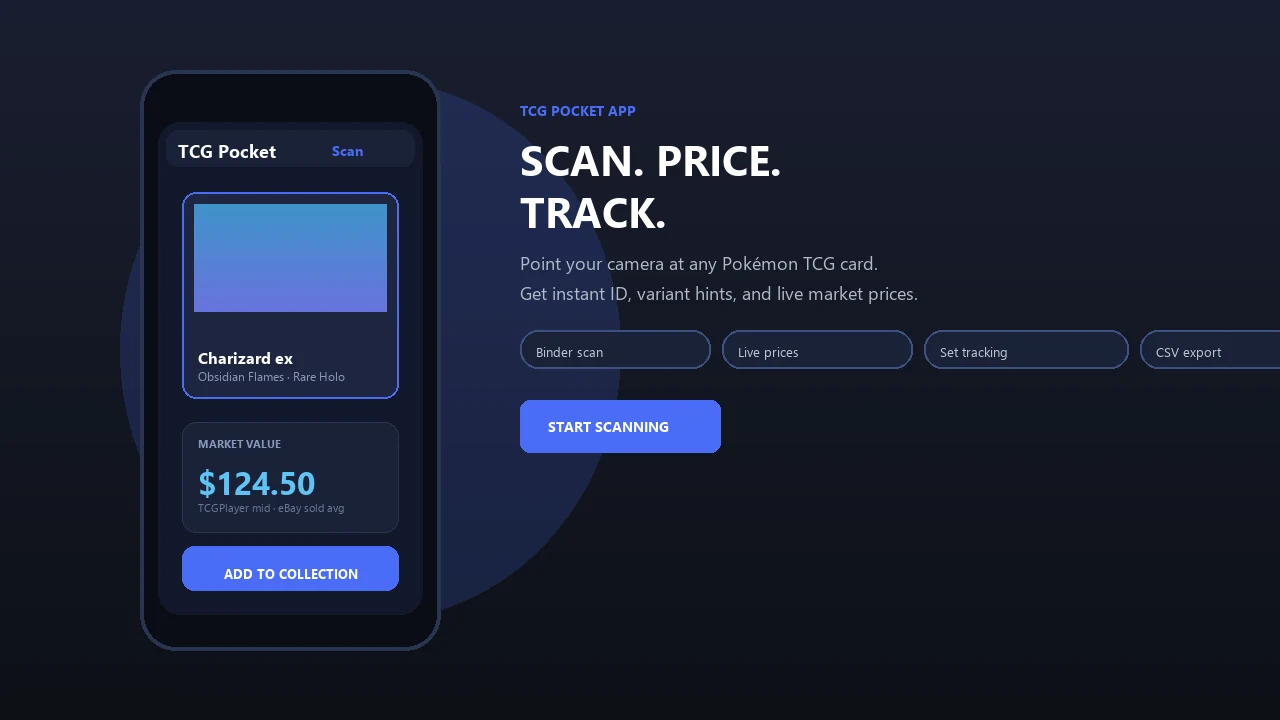
> Definition: TCG Pocket App is a pokemon card scanner app that identifies cards, checks market prices, and tracks collections for Pokémon TCG collectors.
What a Free Pokemon Card Scanner App Actually Includes
A free pokemon card scanner app usually gives you identification, a rough market value, and basic collection logging. The catch is that free tiers often limit the parts collectors need after the first few scans.
- Card identification: The camera reads artwork, set symbol, card name, and card number to suggest a variant match.
- Ballpark pricing: Most free apps show at least one market value, but the source may be TCGplayer, CardMarket, eBay sold listings, or an internal table.
- Collection tracking: Basic folders, wishlists, or duplicate counts are common, though large binders expose limits fast.
- Free-tier restrictions: Daily scan caps, no CSV export, and single-device access are typical upgrade triggers.
- Free-to-paid funnel: The mobile app market generated over $185 billion in consumer spending in 2022, according to data.ai's State of Mobile 2023 report (https://www.data.ai/en/go/state-of-mobile-2023/), which helps explain why many scanner apps start free and monetize later.
The pocket check is real.
If your priority is testing a binder before paying, look for a free workflow that lets you scan, verify, log, and compare prices before upgrading.
At-a-Glance: Free Pokemon TCG Scanner Features Compared
Free pokemon TCG scanner features differ most in scan limits, price-source transparency, and export access. A quick table is better than trusting an app store description written around the upgrade button.
| App | Free scan limit | Price source | Collection tracking | Export | Platform |
|---|---|---|---|---|---|
| TCG Pocket App | Free tier available, limits may apply | Live market prices with source context | Yes | Limited on free tier | iOS and Android |
| TCGplayer App | Free marketplace lookup tools | TCGplayer marketplace | Basic list tools | Limited | iOS and Android |
| Pokémon TCG Scanner Dragon Shield | Free scans with usage limits | CardMarket and app price data | Yes | Often gated | iOS and Android |
| PokeScope | Free quick checks | Community and market-style estimates | Light tracking | Limited | iOS, Android availability may vary |
A good ai-powered pokémon tcg card scanner, live market prices, and pocket-sized collection management app should deliver fast identification and price-source clarity, not a mystery number with no sold-listing context.
For a broader paid-versus-free comparison, our best pokemon card scanner app guide covers the upgrade tradeoffs in more depth.
Top Free Pokemon Card Value Apps Worth Testing
These free pokemon card value apps are worth testing with the same three cards: one modern holo, one older common, and one promo. That side-by-side test reveals scan speed, variant matching, and price realism quickly.
TCG Pocket App: AI Scanning With Live Prices
TCG Pocket App is strongest for collectors who want AI-powered recognition, live market prices, and pocket-sized collection management in one place. It still needs a set number check before you trust a price, especially when two similar Pikachu prints scan alike.
TCGplayer: Marketplace-Backed Free Tier
TCGplayer works well when you want marketplace-backed pricing and a large English-card database. Its free scanning and collection flow can feel narrower if you are sorting a full binder.
Dragon Shield Scanner: CardMarket Price Links
Dragon Shield Pokémon TCG Scanner is useful for set identification and CardMarket-linked pricing. It can be more region-sensitive than collectors expect.
PokeScope: Quick Community Value Checks
PokeScope fits quick value checks and community-style browsing. It is less convincing as a long-term collection system if export and source details matter.
Collectors who scan mixed piles after school or trade night should prioritize a workflow that ties scan results to collection logging instead of leaving values floating.
How a Free Pokemon TCG Scanner Identifies Your Cards
A free pokemon TCG scanner works by turning your camera image into a searchable card match. The app extracts visual features such as artwork, set symbol, card number, border style, and text, then compares them against a trained card database using pattern recognition.
Once the card ID is matched, the app triggers a price lookup from a marketplace API or an internal price table. The hard part is not the scan itself. It is the variant match. Ring-light glare bouncing off a reverse holo through a nine-pocket binder page can hide the foil pattern that separates one price tier from another.
DataReportal reported that 92.3% of internet users accessed the internet through a mobile phone in 2022 (https://datareportal.com/reports/digital-2022-global-overview-report), so phone-camera scanning has become the default collector workflow. Accuracy still depends on training-data quality and update frequency. New sets, regional promos, and niche variants can lag.
For collectors asking what app identifies pokemon cards, the short answer is: one that matches the exact set number before showing value.
How to Use a Free Pokemon Card Scanner App Step by Step
Use a free scanner with a repeatable test, not a one-card guess. The same lighting, same sleeve, and same surface make app comparisons more honest.
- Download and open the app without creating an account if the first scan is allowed.
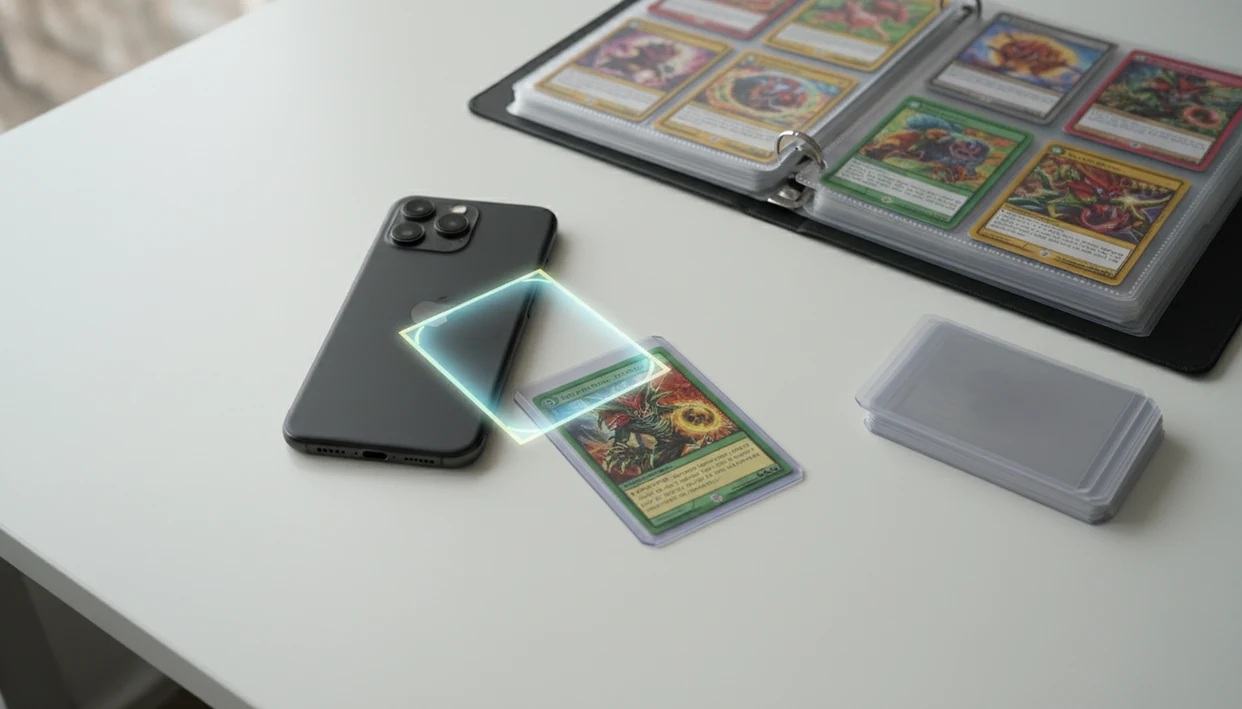
- Place the card flat on a well-lit surface with glare removed from foil areas.
- Center the card in the camera frame and tap scan.
- Review the result for card name, set, number, variant, and displayed price.
- Check the price source and last-updated timestamp before treating the value as useful.
- Add confirmed cards to your digital collection or wishlist only after manual verification.
Test the same card in multiple apps side-by-side. A near-mint copy in a top loader can scan differently from the same card in a binder sleeve, and the plastic crinkle sometimes shifts the camera focus.
If the priority is real-time trade checking, prioritize a scanner that combines scan, price review, and collection save in a single mobile pass.
How We Picked These Free Pokemon Card Value Apps
We picked free pokemon card value apps by looking at what a collector can test before paying. A free claim means little if the first useful scan sits behind account creation, a trial timer, or a locked pricing screen.
| Criteria | What we looked for |
|---|---|
| Truly free first scan | No paywall before a real camera test |
| Price data transparency | Source shown, update timestamp visible, currency clear |
| Recognition accuracy | Common, uncommon, holo, reverse holo, and older set checks |
| Collection tools | Free-tier logging, duplicates, wishlists, or set progress |
| Platform access | iOS and Android availability where possible |
The Entertainment Software Association reports that smartphone play is the most common gaming device behavior among U.S. players (https://www.theesa.com/resource/2023-essential-facts-about-the-u-s-video-game-industry/), which supports a mobile-first standard for collector tools. Binder sorting happens at card shows, kitchen tables, and shop counters, not only at a desktop.
For collectors comparing an app that scans pokemon cards and tells value, price-source transparency matters more than a polished scan animation.
Common Myths About Free Pokemon Card Scanner Apps
Free scanner apps are useful, but four myths cause bad trades and inflated collection totals.
Myth 1: Free apps give perfectly accurate prices for every card. Reality: Prices depend on source freshness, variant matching, and whether the app separates active asking prices from sold prices.
Myth 2: Free means unlimited scans forever. Reality: Most free tiers limit daily scans, exports, sync, or advanced collection analytics.
Myth 3: A phone camera can auto-grade card condition. Reality: A scan can show the card identity, but it cannot reliably judge whitening, dents, surface scratches, or centering from one image.
Myth 4: All free apps use the same data. Reality: TCGplayer, CardMarket, pricecharting.com, and eBay sold listings can tell different stories.
The most reliable free-scanner workflow is to scan the card, verify the set number, then compare raw versus graded and sold-listing context before making a trade decision.
For a deeper accuracy check, read do pokemon card scanner apps work.
Limitations
Free scanners save time, but they are not appraisals. Treat the result as a starting point, not the final word.
- Image recognition struggles with heavily played, foreign-language, off-center, or glare-affected cards.
- Live market prices can lag sudden spikes or crashes, so displayed values are guides, not guaranteed sale prices.
- Free tiers commonly impose daily scan caps, locked CSV export, or single-device access.
- No free scanner captures full premiums for graded, signed, misprint, stamp-error, or unusual provenance cards.
- AI-powered scanners are only as current as their training data; new sets and niche promos may lag for weeks.
- U.S. trading-card sales have grown sharply in recent years, according to Circana's toy-industry reporting (https://www.circana.com/news/2022/u-s-toy-industry-retail-sales-grew-13-percent-in-2021/), which shows why no single database can cover every product variant perfectly.
- Active asking prices can exaggerate value. The green sold-price filter on eBay often gives a colder, more useful check.
Collectors with large binders should compare whether a pokemon card scanner app worth it upgrade saves enough time to justify paying.