TCGplayer vs Cardmarket for Pokémon Card Prices
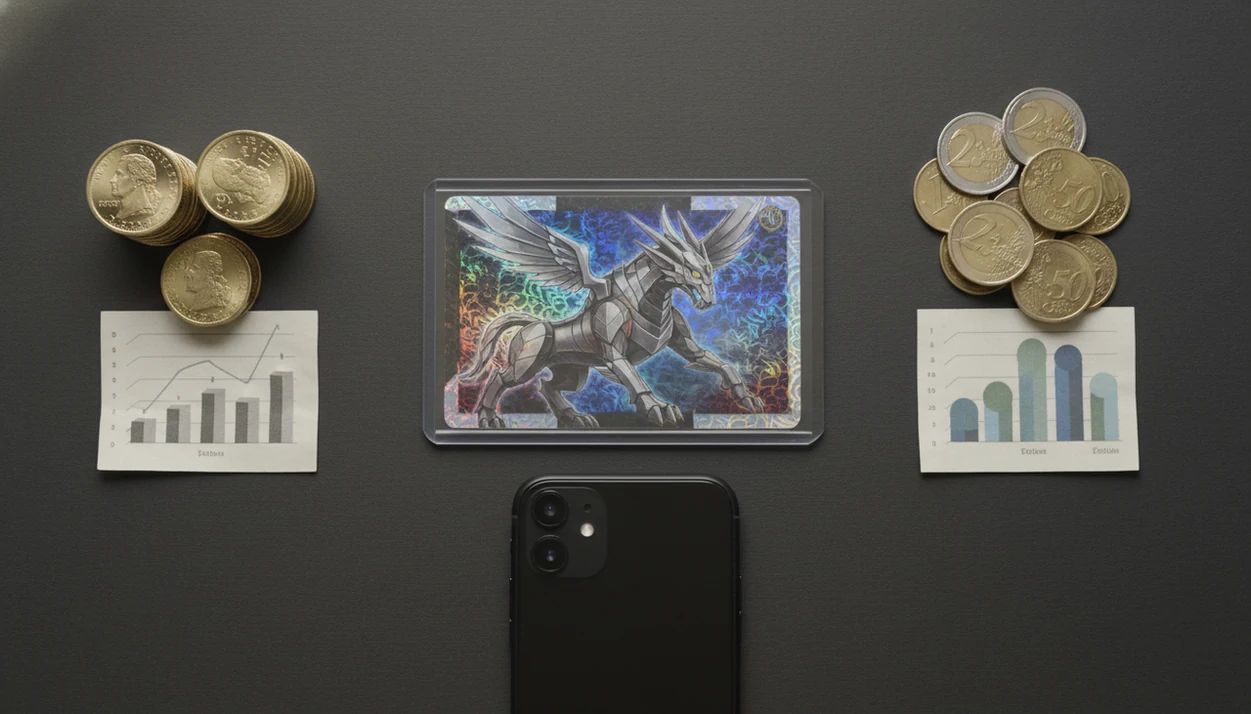
For most collectors, TCGplayer vs Cardmarket for pokemon prices comes down to region: use TCGplayer for U.S. market value and Cardmarket for European market value. The better price source is the marketplace with the most relevant buyers, sellers, language versions, currency, and recent sales for the card you are valuing. A scanner workflow helps support that comparison by identifying the card first, then treating the price as market context, not a final appraisal.
Definition: Pokemon Card Scanner is a pokemon card scanner app that identifies cards, checks market prices, and tracks collections for Pokémon TCG collectors.
TL;DR
- Use TCGplayer as the default Pokémon price source for U.S. raw singles, especially modern English cards with active sales.
- Use Cardmarket as the default Pokémon price source for European collectors, euro pricing, and EU-language card comparisons.
- For vintage, graded, low-volume, or unusual promos, cross-check both marketplaces with sold listings instead of trusting one number.
Tcgplayer vs cardmarket, side by side
Side-by-side captures of the compared products. Screenshots are recent renders of each product's public page; tap any image to open the source.
TCGplayer vs Cardmarket Pokémon Price Comparison Table
TCGplayer and Cardmarket answer different regional pricing questions, so neither source gives a universal global value. TCGplayer Market Price is strongest for U.S. sales context, while Cardmarket euro-based marketplace pricing is usually more useful for European collectors.
| Factor | TCGplayer | Cardmarket |
|---|---|---|
| Main region | United States and North America | Europe |
| Currency | USD | EUR |
| Liquidity strength | Modern English raw singles | EU listings, including English and European languages |
| Typical use case | Pricing for U.S. buyers or sellers | Pricing for EU buyers or sellers |
| Best-fit collector | U.S. collector checking raw singles | European collector comparing euro listings |
A Charizard ex price can look different before shipping, tax, and language are matched. We’ve seen that gap widen when a phone screen is cupped from convention glare and the seller wants a fast number.
Five Facts About TCGplayer and Cardmarket Pokémon Price Sources
These five facts explain how collectors should read both Pokémon card price sources before making a trade, sale, or binder valuation.
- TCGplayer is the main North American Pokémon pricing reference for many raw English singles.
- Cardmarket is the main European Pokémon pricing reference, especially for euro-market buying and selling.
- TCGplayer Market Price is based on recent sales on TCGplayer, not a universal Pokémon card value.
- Cardmarket reflects euro pricing, EU seller competition, language availability, and regional supply-demand conditions.
- Modern high-volume singles usually produce cleaner pricing signals than vintage, niche promos, or low-volume cards on either platform.
For collectors who need a mobile workflow, scanning first helps because the scan starts with card identification before price comparison. The set number check in the lower-left corner often matters more than the first price that appears.
Tiny print changes everything.
TCGplayer and Cardmarket Pokémon Pricing Mechanics
TCGplayer and Cardmarket are marketplace-derived price sources, not official Pokémon valuations. Their prices come from marketplace behavior, including recent sales, active listings, condition, language, seller geography, and buyer demand.
TCGplayer describes its price data as marketplace-derived pricing based on transactions and listings on its own platform, while Cardmarket explains its price guide as marketplace data from Cardmarket activity; both should be read as platform-specific signals, not official Pokémon valuations (https://help.tcgplayer.com/hc/en-us/articles/201307577-How-do-I-use-Price-Data-on-TCGplayer, https://help.cardmarket.com/en/CardmarketPrices).
How TCGplayer and Cardmarket pricing works: each platform reflects its own liquidity pool, meaning the number of buyers, sellers, and completed sales available for that exact card. In plain language, a card with hundreds of recent sales is easier to price than a regional promo with three stale listings.
Currency conversion can also hide real differences between USD and EUR markets. A euro price converted into dollars may still ignore VAT, shipping, payment fees, import friction, and local demand. For obscure cards, regional liquidity affects reliability more than the exchange rate. Good ai-powered pokémon tcg card scanner, live market prices, and pocket-sized collection management app workflows deliver fast identification and labeled market context, not one permanent global value.
TCGplayer Advantages for U.S. Pokémon Card Values
Does TCGplayer work better for U.S. Pokémon card prices? Usually yes, especially when the card is an English raw single with steady North American sales.
TCGplayer is useful because Market Price, recent sales context, and active listing depth all sit close to the U.S. buyer pool. That matters for modern cards from Scarlet & Violet, Sword & Shield, and recent special sets where many copies change hands. For U.S. sellers, TCGplayer is often easier than Cardmarket because buyer expectations, shipping assumptions, and currency all match the market.
For collectors pricing binders in the U.S., a scanner workflow helps because scanned cards can be logged with source-aware price context. The plastic crinkle of a binder page is familiar; the result still needs a set and condition check. For phone-based checks, our pokemon card price checker app guide covers the broader workflow.
Cardmarket Advantages for European Pokémon Card Prices
Is Cardmarket better for European Pokémon card prices? Usually yes, because Cardmarket reflects euro pricing, EU seller competition, and local availability more directly than TCGplayer.
European collectors often need to compare English, German, French, Italian, Spanish, and other language listings. Cardmarket is built around that reality. It also shows the friction that matters locally, such as shipping between countries and seller location. TCGplayer can still help as a cross-check, but it is less useful as the primary source for North American-style resale assumptions.
Anyone dealing with mixed-language binders should verify variants carefully because variant matching and collection logging reduce the chance of pricing a German reverse holo as an English copy. Ring-light glare bouncing off a reverse holo through a nine-pocket binder page can fool a quick glance.
TCGplayer Market Price, Cardmarket Currency, and Buyer Fees
A converted price is not always the real collector cost. TCGplayer Market Price, Cardmarket euro listings, shipping, taxes, and payment friction can all point to different totals.
For EU comparisons, VAT and cross-border delivery can change the buyer’s real total, so a simple EUR-to-USD conversion should not be treated as a landed cost estimate (https://taxation-customs.ec.europa.eu/taxation/vat_en).
| Price factor | Why it matters |
|---|---|
| TCGplayer Market Price | Sales-based platform signal, not the same as every active listing |
| Listed price | An asking price can sit unsold for weeks |
| Cardmarket EUR price | Useful for EU context, but conversion alone is incomplete |
| Shipping and taxes | Small orders can change value quickly |
| Platform and payment costs | Fees can affect seller net and buyer total |
| Import friction | Cross-border deals may add delay, risk, or cost |
For international trades, total landed cost usually matters more than the headline marketplace price because the buyer pays the full route, not just the card. A raw card beside a plastic slab also needs a separate check; the raw vs graded pokemon card value debate changes the price source.
Evidence and Source Notes for Pokémon Price Data
The evidence for these Pokémon price claims comes from marketplace documentation plus collector practice. TCGplayer and Cardmarket explain how their own platform prices work; collectors still have to judge condition, region, and whether a real buyer would pay that number.
- Start with the platform’s own documentation for the price label you are using.
- Separate documented mechanics from field practice, such as checking sold listings, binder condition, and local demand.
- Record the source, currency, condition assumption, and date beside any high-value card.
- Cross-check thin markets because private sales, conventions, and local stores are not fully captured by either marketplace.
| URL | Claim supported | Limitation |
|---|---|---|
| https://help.tcgplayer.com/hc/en-us/articles/201307577-How-do-I-use-Price-Data-on-TCGplayer | TCGplayer price data comes from its own marketplace pricing system. | It does not represent every private or offline Pokémon sale. |
| https://help.cardmarket.com/en/CardmarketPrices | Cardmarket price guide data reflects Cardmarket marketplace activity and methodology. | It is euro-market context, not a universal global value. |
| https://taxation-customs.ec.europa.eu/taxation/vat_en | VAT can affect EU buyer cost. | Taxes and shipping still vary by order and country. |
Six-Step Workflow for TCGplayer and Cardmarket Pokémon Prices
Use a repeatable workflow so TCGplayer and Cardmarket prices answer the right question. The goal is to scan, verify, log, compare, and then decide.
- Set your region and currency first. Use USD for U.S. buyer context and EUR for European buyer context.
- Identify the exact card. Check Pokémon name, set, number, rarity, language, foil type, and condition.
- Check the most relevant marketplace. Use TCGplayer for U.S. buyers and Cardmarket for EU buyers.
- Compare the other marketplace for outliers. Large gaps can point to language, supply, or demand differences.
- Review recent sales for thin markets. Use sold-listing context for vintage, graded, promos, and low-volume cards.
- Log the source and date. A price without currency and timestamp gets stale fast.
For collectors who need this on a phone, keep the workflow useful by making sure the scan, variant match, and collection entry stay tied to the card record. If you are starting from scratch, how to check pokemon card value with phone explains the beginner version.
TCGplayer or Cardmarket Decision Guide for Pokémon Collections
Use TCGplayer for U.S. buyer pools, Cardmarket for European euro pricing, and both when the collection crosses regions. Scanner apps should label source and currency clearly, especially when a binder valuation mixes English, Japanese, and European-language cards.
Choose TCGplayer for U.S. buyer pools
U.S. sellers who price English raw singles usually get the cleanest signal from TCGplayer. For U.S. collectors, TCGplayer is often more relevant than Cardmarket because it reflects the buyers most likely to purchase the card.
Choose Cardmarket for European euro pricing
European collectors should usually start with Cardmarket when buying, selling, or comparing euro listings. The language filter matters when two similar Pikachu prints scan close until the set symbol is verified.
Compare both for international trades
After a binder pull, when the card might move across borders, a logged card helps because a logged card can be compared against multiple price contexts instead of one isolated number. High-value binders deserve both regional checks.
Pokémon Card Scanner Apps and Regional Price Sources
Mobile card scanning only helps if identification and localized pricing work together. A scan that finds the wrong variant can make any TCGplayer or Cardmarket number misleading.
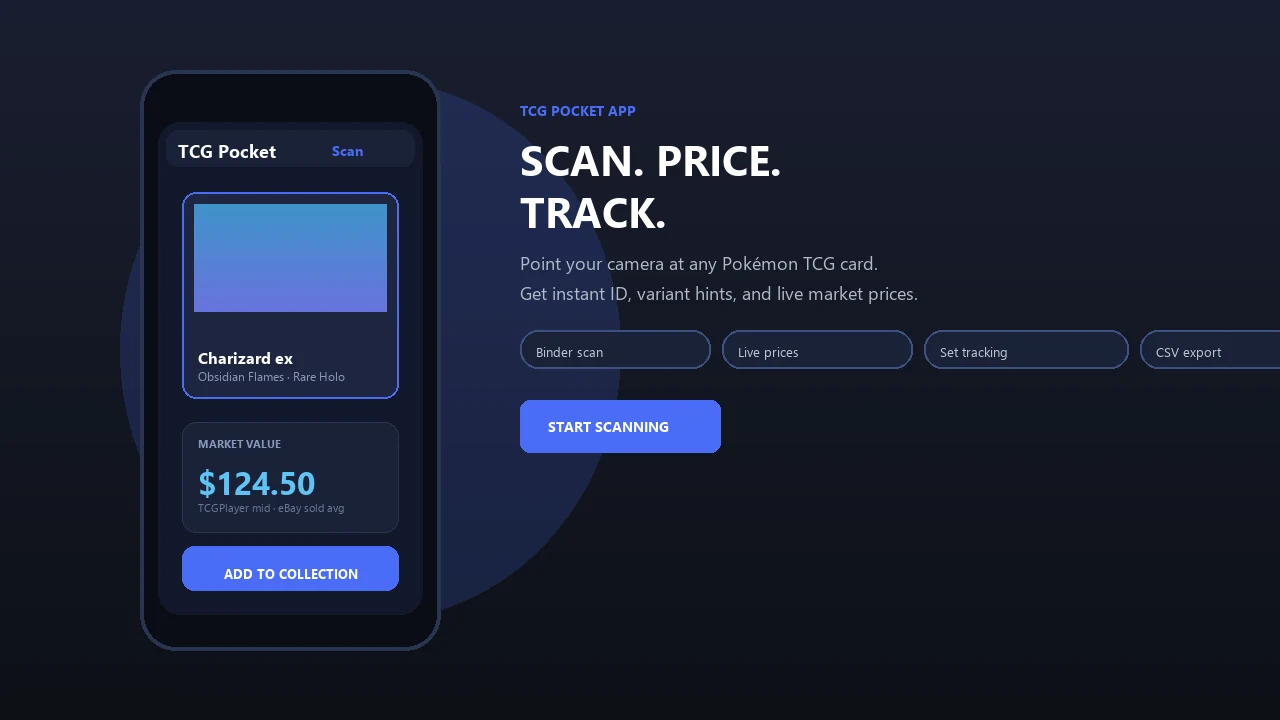
Pokemon Card Scanner is a pokemon card scanner app that identifies cards, checks market prices, and tracks collections for Pokémon TCG collectors. TCG Pocket App should be used with source, currency, condition assumption, and timestamp visible where possible, because those labels tell collectors what the number actually represents.
For collectors managing binders, mobile-friendly collection management is useful because duplicate counts, set completion, and portfolio value stay in one place. For set builders, TCG Pocket App also helps keep the empty pocket waiting for a rare card from being priced like the copy already owned. The broader tracking angle is covered in our best pokemon collection tracker app guide.
Limitations
TCGplayer and Cardmarket are useful, but they can mislead when the card, region, or condition does not match the price source. Treat the app result as a starting point, not the final word.
Neither marketplace publishes a single global Pokémon card value, and neither source fully captures private trades, convention-floor sales, local-store cash offers, or graded-card auction premiums. Use the displayed number as a dated comp, then verify the exact print, condition, language, and buyer market before making a high-value decision.
- Both platforms reflect their own marketplaces, not universal Pokémon card value.
- Low-volume, vintage, niche, and regional promo cards can show stale or noisy prices.
- Currency conversion does not include every fee, tax, shipping cost, or local demand difference.
- Condition, language, edition, and foil mismatches can create bad comparisons.
- Graded cards often need eBay sold listings or grading-specific comps beyond TCGplayer and Cardmarket.
- Buylist value, trade value, insurance value, retail asking price, and sold price are different numbers.
- Scanning and collection apps can support identification and logging, but collectors still need to verify condition and variant match.
- A bent common card in a junk pile may scan correctly and still be worth less than the displayed near-mint reference.
For graded or unusual cards, compare marketplace numbers with TCGplayer vs eBay sold prices pokemon.
FAQ
Is TCGplayer better than Cardmarket for Pokémon card prices?
TCGplayer is usually better for U.S. Pokémon pricing, especially English raw singles. Cardmarket is usually better for European pricing and euro-market decisions.
Is Cardmarket good for pricing Pokémon cards in Europe?
Yes, Cardmarket has a major Pokémon catalog and is widely used by European collectors. It is especially useful for euro pricing and European-language comparisons.
What is TCGplayer Market Price for Pokémon cards?
TCGplayer Market Price is a marketplace price based on recent TCGplayer sales. It is not a universal value for every buyer or region.
Why are Cardmarket Pokémon card prices sometimes lower?
Cardmarket prices can look lower because of currency, regional demand, supply, language, shipping, and fees. The total landed cost may be closer than the headline price suggests.
Should Americans use Cardmarket prices for Pokémon cards?
U.S. collectors can use Cardmarket as a cross-check. They should usually price cards for U.S. buyers with TCGplayer.
Should Europeans use TCGplayer prices for Pokémon cards?
European collectors can compare TCGplayer prices for context. They should usually rely on Cardmarket for local euro-market buying and selling decisions.
Which Pokémon card price source is most accurate?
The most accurate source is the one with recent sales and strong liquidity for that exact card in the collector’s market. Region, language, condition, and buyer pool matter.
Do graded Pokémon cards use TCGplayer prices?
TCGplayer and Cardmarket are strongest for raw card pricing. Graded Pokémon cards usually need graded sold comps, including PSA, BGS, CGC, or eBay sold-listing context.
Get started with TCGplayer Vs Cardmarket For Pokemon Prices on iOS.