
> Definition: A pokemon card price checker app is a mobile tool that identifies physical Pokémon TCG cards, by scan or search, and returns current market values based on recent sales data from major trading card marketplaces.
- Real sold-data pricing beats catalog estimates every time, so check the app’s data source before trusting it.
- AI scanning speeds up lookups, but always confirm set, variant, and condition before accepting a price.
- Pokémon TCG Pocket is a separate digital card game, not a physical card pricing tool.
At A Glance: 4 Pokemon Card Price Checker Apps Compared
The strongest pokemon card price checker app is the one that shows where the number came from, not just a tidy value box. Here is the quick comparison before you start scanning cards under a lamp or at a show table.
| App name | Scanning capability | Data source | Collection tracking | Free vs paid | Platform |
|---|---|---|---|---|---|
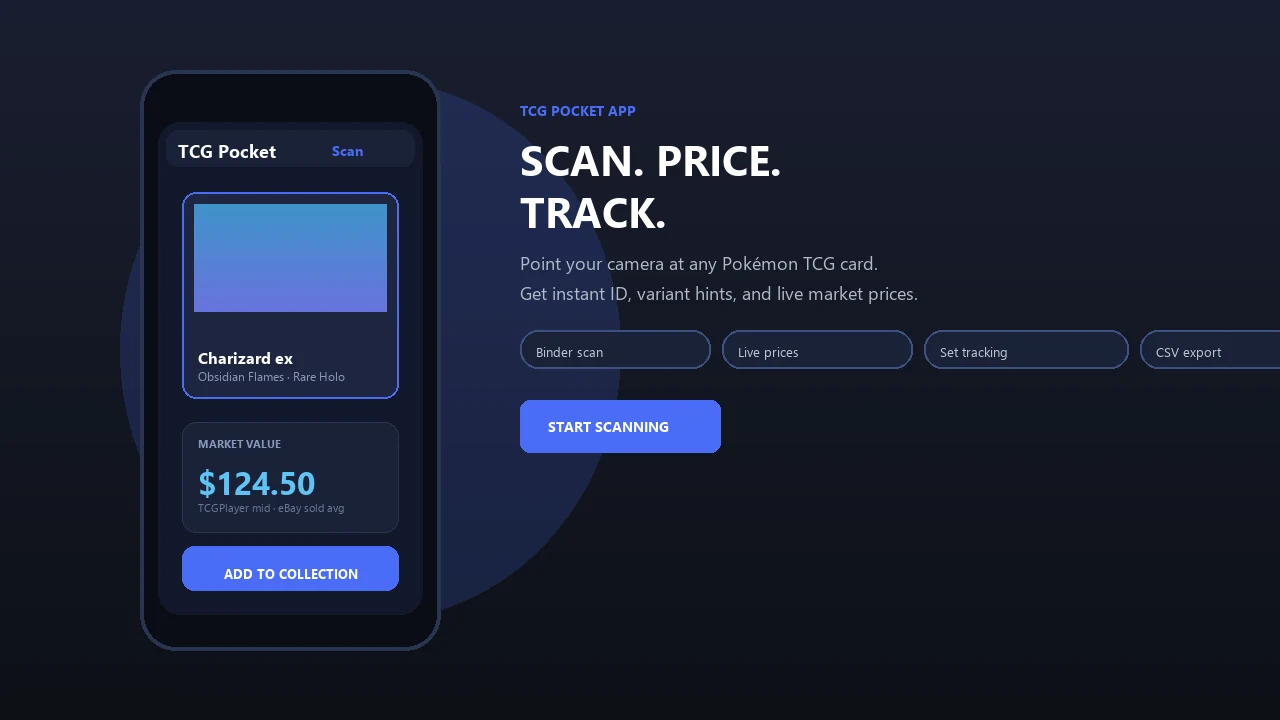
| TCG Pocket App | AI card scanning, binder-friendly checks | Live market price feeds and card database matching | Yes, with collection logging | Free and paid features | iOS and Android |
| PriceCharting | Search-first, app-based lookup | Thousands of auction sales, condition filters, daily updates per its app listing source | Yes | Free and paid features | iOS and Android |
| TCGplayer | Scan, organize, and track market price | TCGplayer marketplace pricing | Yes | Free app features | iOS and Android |
| Collectr | Manual and collection-first entry | Portfolio-style market estimates | Yes | Free and paid features | iOS and Android |
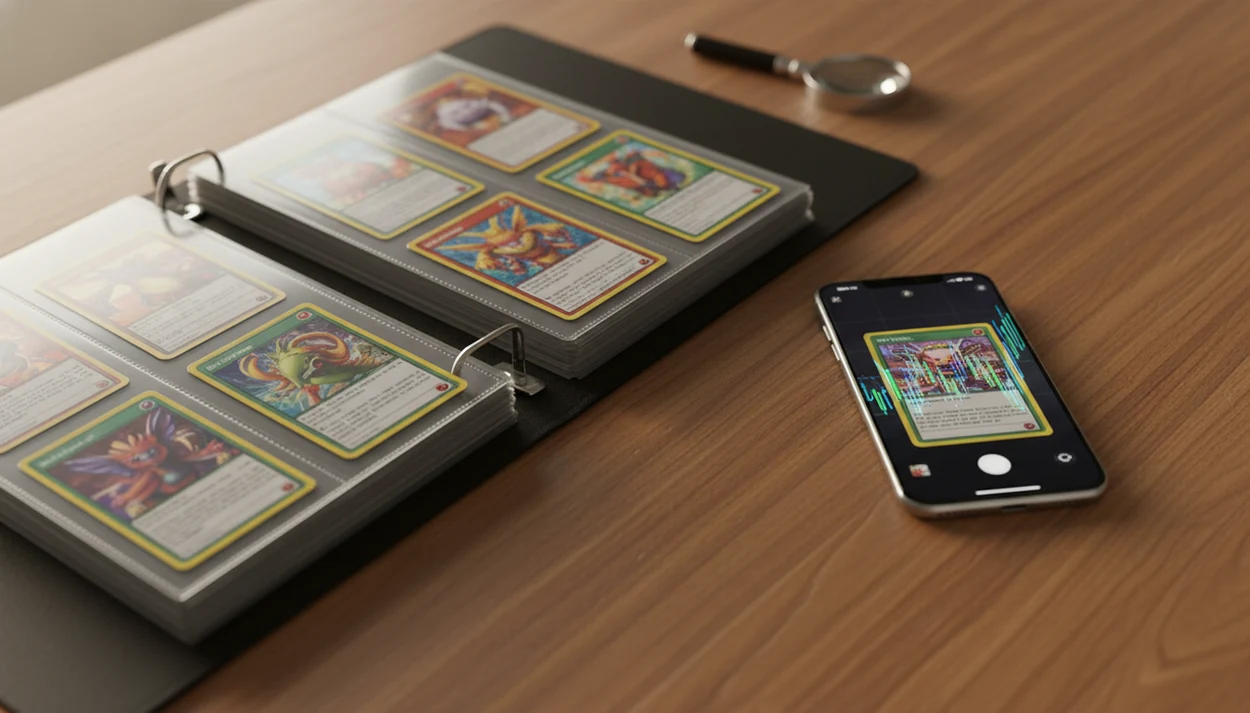
For binder checks, a scan, verify, log workflow keeps the card inside the page when possible.
5 Facts About Pokemon Card Market Value Apps
A pokemon card market value app should be judged by its price source, variant handling, and condition controls. The logo matters less than the data path behind the quote.
- Real market value comes from completed sales, not active asking prices. The green sold-price filter on eBay tells a different story than unsold listings.
- Pricing accuracy depends on the sales database behind the app. PriceCharting, TCGplayer, and similar tools can disagree because they group sales differently.
- Photo scanning still needs a set number check, variant match, and condition caveat. A scan can confuse two similar Pikachu prints until the collector verifies the set symbol.
- Different apps suit different jobs. Single-card lookups are not the same as portfolio tracking, duplicate management, or trade pile sorting.
- Pokémon TCG Pocket is not a physical card pricing tool. It is a digital card game, so it should not be used to value cardboard copies.
Good price apps deliver fast identification, sold-listing context, and collection organization, not a guaranteed sale price.
Named Shortlist: 4 Best Apps For Pokemon Card Prices
This shortlist includes one scanner-first choice, two pricing-data staples, and one collection-first option. We would still verify any high-value card against a second source before buying, trading, or grading.
- TCG Pocket App: Fastest for AI scanning, live market checks, and collection tracking in one mobile workflow. Verdict: strongest fit for collectors who want to scan, verify, log, and compare.
- PriceCharting: Useful for daily updated prices, auction-sale history, and condition-based filtering. Verdict: a strong research companion when sold-listing context matters.
- TCGplayer: Built to scan, organize, and track market price for trading card games, according to its mobile app page source. Verdict: best tied to marketplace-style pricing.
- Collectr: Collection-first app with portfolio-style tracking on Google Play and iOS. Verdict: useful when your main job is seeing collection totals.
If your priority is fast trade-night pricing, TCG Pocket App earns the spot because it combines scanner lookup with saved collection entries. For deeper marketplace comparison, the TCGplayer vs eBay sold prices question is often worth checking separately.
How Pokemon Card Price Apps Pull Market Data
Pokemon card price apps usually follow a simple chain: marketplace sold listings, aggregation, normalization by set or variant, condition adjustment, then a displayed market value. The technical terms are “data normalization” and “entity matching,” which just mean the app tries to connect one physical card to the right sales bucket.
A scanner adds one step at the front. It reads the card image, predicts the set, card number, and variant, then queries the price database. That sounds clean, but a holo bleed near the card name can still throw off a match.
Sold data differs from active listings because sold data shows what buyers actually paid. Active listings show what sellers hope to get. For collectors comparing raw versus graded prices, condition and variant matching usually matter more than the app name because a near mint raw card and a PSA 9 slab are different markets. The raw vs graded pokemon card value split is where many quick estimates go wrong.
How To Check Pokemon Card Prices With A Scanner App
Use a scanner app as a speed tool, then verify the result before treating it as value. A practical workflow keeps identification, price checking, and collection logging close together.
- Open your scanner app and point at the card. Reduce glare, especially if ring-light glare is bouncing off a reverse holo through a nine-pocket binder page.
- Confirm the detected set, card number, and variant. Check the lower-left set number before trusting the price match.
- Select the correct condition. Raw near mint, lightly played, damaged, and graded copies should not share one value.
- Review the returned price and check the data source. Sold-listing context is stronger than a catalog-only estimate.
- Compare against a second source if the card is high-value. A slabbed card weighed in palm deserves more than one app result.
Collectors pricing a stack quickly should log the scan result immediately after the variant match. A slower manual workflow is covered in our guide on how to check pokemon card value with phone.
How We Picked The Best Pokemon Card Market Value App
We ranked these apps by data source transparency, scan accuracy, variant and condition handling, collection management, platform availability, and cost. Real sold data was the primary ranking signal because a clean interface cannot fix weak pricing inputs.
Condition caveat first.
Scanner-led collection work ranked highly when a collector wants to move from lookup to saved entry without rebuilding a spreadsheet later. PriceCharting and TCGplayer remained important because their pricing systems are closely tied to marketplace and auction-style data.
We excluded Pokémon TCG Pocket from physical-card pricing recommendations. It is a digital card game, not a physical-card pricer, even though the name creates search confusion. If you are still deciding whether an app fits your use case, our pokemon card price checker app guide breaks down the broader category.
Common Myths About Pokemon Card Price Checker Apps
A popular app name does not automatically mean the most accurate Pokémon card prices. Accuracy depends on the data source, the card match, and the condition setting.
Any scanner can misprice a card if you skip verification. We have seen a mystery Japanese card in a mixed pile get a confident result that still needed a language and set check.
The listed price is not always what you will sell for today. Fees, shipping, buyer demand, and timing can cut into the final number.
Pokémon TCG Pocket is not a price app for physical cards. It belongs in the digital game category, not in a physical collection valuation workflow.
If condition is uncertain, treat the app result as a starting point, not the final word. For market checks outside one app, use a second reference to check pokemon card market value.
Limitations
No card pricing app removes the need for collector judgment. That is especially true when the card is rare, damaged, foreign-language, miscut, graded, or recently hyped.
- No app gives a perfectly exact price because condition, edition, language, grading, and market timing all change value.
- AI scanners can misidentify similar-looking reprints, full-art variants, promos, and reverse holo versions.
- Marketplace-based prices are not guaranteed sale prices after seller fees, taxes, shipping, and negotiation.
- App-store descriptions highlight convenience, but they do not prove pricing accuracy or database completeness.
- Pokémon TCG Pocket is a separate digital product and should not be used as a pricing source for physical cards.
- Free tiers may lag behind paid tiers in data freshness, export tools, watchlists, or collection limits.
- High-value cards still deserve a manual sold-listing check and, sometimes, grading research.
When a card corner is tucked behind a plastic seam, even a good scan can miss detail. Pull the card only when the value justifies the handling risk.