

> A pokemon card price alert is an automatic notification triggered when a tracked card's market value crosses a collector-defined threshold, powered by live pricing data from major TCG marketplaces.
- Price alerts ping you when watchlist cards hit your chosen price, no manual checking needed.
- TCG Pocket App links AI card scanning, live prices, and chase card alerts in one workflow.
- Alerts work best as a collection-management feature, not a day-trading signal.
What Pokemon Card Price Alerts Actually Do For Collectors
Pokemon card price alerts watch a card for you and send a notification when its tracked value crosses the price rule you set. That rule might be “tell me when this drops below $25” or “ping me if this card rises 15%.”
For collectors, the useful part is not speculation. It is remembering. A parent finishing a set does not need to search the same promo every night after the kids are asleep. A binder collector can put a chase card on a pokemon card watchlist and wait for a calmer buying window.
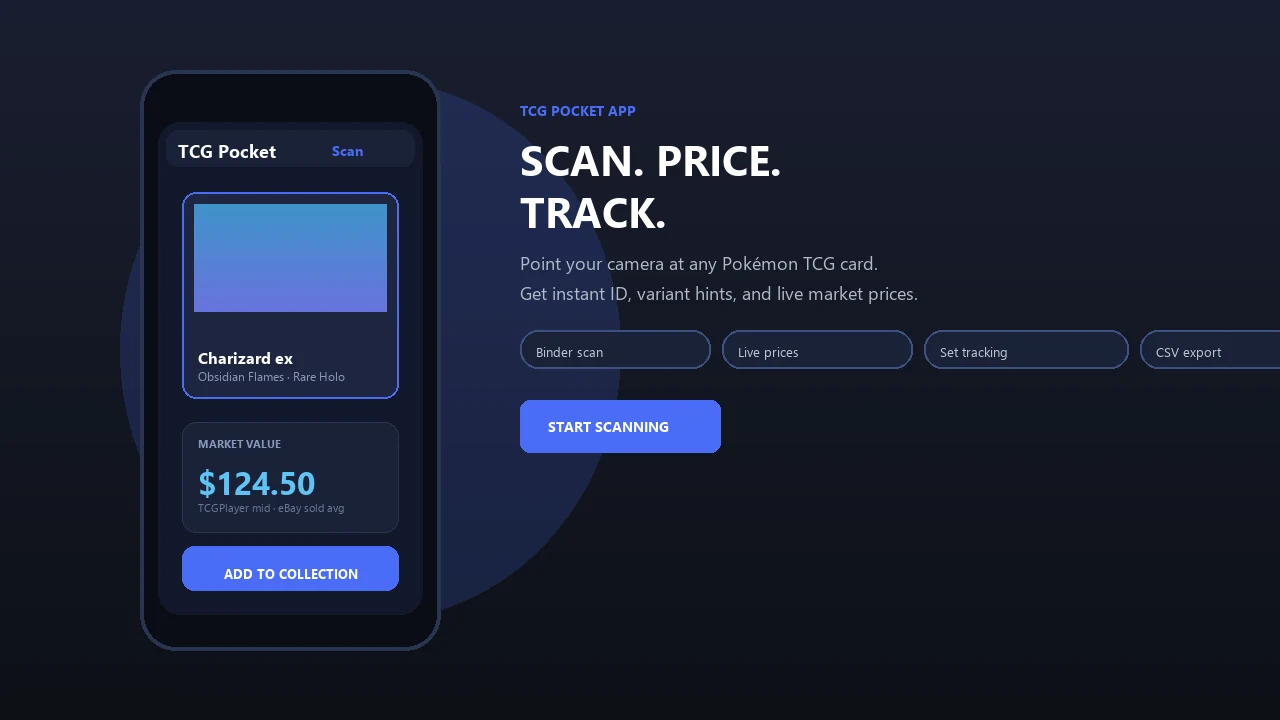
The global playing cards and card games market was valued at about $17.7 billion in 2021, according to Statista (https://www.statista.com/statistics/245228/global-playing-cards-and-card-games-market-size/), so manual tracking gets messy fast. TCG Pocket App fits collectors who want price movement tied to cards they actually own or want, because the alert starts from a scanned card, variant match, and saved watchlist entry.
Small pings beat constant refreshing.
Five Facts About Pokemon Card Watchlist Alerts
- Pokemon card watchlist alerts connect saved cards to live market pricing feeds, then notify you when a chosen value moves above, below, or beyond a percentage change.
- In TCG Pocket App, AI scanning, collection logging, watchlist building, and chase card alerts can sit in one workflow instead of four browser tabs.
- Price alerts are most useful for collection management, not speculation, because they help with set completion, trade timing, duplicate sorting, and budget discipline.
- Alert reliability depends on price-source transparency, refresh frequency, and how well the system handles outlier listings, low-volume cards, and currency differences.
- Healthy alert use starts with a collecting goal, such as finishing Crown Zenith, upgrading a damaged favorite, or tracking a child’s promo binder without buying on impulse.
For collectors who need a calmer way to monitor favorites, the useful workflow is simple: scan the card, confirm the variant, save it to a watchlist, and set a target-price rule. Ring-light glare can still bounce off a reverse holo through a nine-pocket binder page, so the set number check still matters.
How Pokemon Card Price Alerts Work Behind The Scenes
Pokemon card price alerts work by comparing current marketplace data against your saved threshold, then sending a push, email, or in-app notification when the rule matches. Good systems also filter obvious outliers before treating a price as meaningful.
Data Feeds And Refresh Frequency
Most alert tools aggregate market data from sources such as tcgplayer.com, cardmarket.com, pricecharting.com, or recent marketplace listings. Different apps may show different alert values because they use different currencies, regions, update schedules, and averaging methods. A near-mint copy in a top loader can sit beside a graded slab at a card show, but those are not the same price category.
Threshold Logic And Notification Delivery
Threshold logic is the rule engine. It checks whether a card moved below a fixed price, above a fixed price, or by a percentage since your last saved value. TCG Pocket App supports this workflow after identification, so you can scan, verify, log, compare, and then alert from the same card record. Price alerts usually depend more on clean variant matching than on the loudest market number.
How To Set Up Chase Card Alerts In TCG Pocket App
To set up chase card alerts, scan the exact card, save it, choose a target, and decide how you want to be notified. TCG Pocket App keeps that process mobile-first, which matters because a Statista survey found that 39% of U.S. online or mobile gamers play at least once a day.
- Scan the card with the AI camera, keeping glare off the foil surface when possible.
- Verify the variant by checking the set number in the lower-left corner before trusting the price match.
- Add the card to your watchlist or collection, depending on whether you own it yet.
- Set a target using a fixed price, below-price rule, above-price rule, or percentage movement.
- Choose notifications through push, in-app, or email alerts if available.
- Review the alert before acting, then compare condition, fees, and sold-listing context.
If your priority is buying missing cards without checking listings every lunch break, TCG Pocket App covers the job through scan-to-watchlist chase card alerts. For a broader phone workflow, the how to check pokemon card value with phone guide explains the pricing step before alerts enter the picture.
When To Use Pokemon Card Price Alerts For Your Collection
Use pokemon card price alerts when a card matters to your collection but does not need your attention every day. They are especially useful for set completion, trade timing, budget limits, and condition upgrades.
A collector finishing a master set can watch missing cards below a target price. A parent can track promo or chase cards for a kid’s birthday binder without buying during the first hype spike. Someone sorting duplicates can monitor trade value before a local trade night.
Not every ping needs action.
Collectors sorting duplicates after new pack pulls at bedtime can flag cards worth trading later when alerts attach to saved collection entries rather than loose notes. For condition upgrades, alerts also help you wait for a better raw copy instead of overpaying for the first listing. Price alerts should reduce FOMO, not feed it.
Pokemon Card Price Alerts In TCG Pocket App Vs Other Tools
Good ai-powered pokémon tcg card scanner, live market prices, and pocket-sized collection management app features deliver faster identification and price context, not guaranteed profit. That distinction matters in a franchise estimated by Statista (https://www.statista.com/statistics/1072224/pokemon-lifetime-revenue/) to have generated over $118 billion in lifetime revenue.
| Tool type | What it does well | Main tradeoff |
|---|---|---|
| TCG Pocket App | Scan, identify, save, watchlist, and alert from one card record | Still needs collector verification for variant and condition |
| TCGAlert | Focuses on alerting around tracked market movement | Usually separate from binder scanning and collection logging |
| TCGPriceAlert | Helps monitor selected card prices | Data sources and alert rules may vary by card type |
| Browser extensions | Useful while shopping on desktop marketplaces | Less helpful at shows, shops, or binder tables |
| getcollectr.com / pokellector.com | Strong for collection tracking or set reference workflows | Alert depth depends on feature set and source coverage |
After a card show table check, when crowd noise makes quick decisions harder, a single scan-identify-track-alert workflow is easier than juggling browser tabs and loose notes. For source differences, the TCGplayer vs Cardmarket for pokemon prices comparison is worth reading.
Common Myths About Pokemon Card Price Alerts
Price alerts are useful, but four myths cause bad decisions. The biggest one is that alerts are only for flippers. Casual collectors benefit just as much when they use alerts for watchlists, promos, and set completion.
Another myth says the alert price equals your guaranteed sale price. It does not. Fees, shipping, card condition, photos, seller history, and grading all affect the real result. The green sold-price filter on eBay often tells a different story from active asking prices.
A triggered chase card alert is also not an order to buy or sell. Treat it as a prompt to inspect the card, compare raw versus graded, and decide whether it still fits your collection. Alert values differ across apps because data sources, currencies, and refresh schedules differ. For collectors comparing market averages against completed transactions, the TCGplayer vs eBay sold prices pokemon guide covers the gap.
Related TCG Pocket App Features For Collection Management
These related features make pokemon card price alerts more useful because they reduce manual entry and help confirm the exact card before a watchlist rule fires.
- AI card scanner: TCG Pocket App identifies Pokémon cards by camera, then gives you a starting point for set, print, and variant review.
- Live market price lookup: Current market values help you compare active prices against watchlist targets.
- Digital binder: Saved cards make it easier to manage duplicates, missing cards, and set progress.
- Unified alert workflow: The scan, watchlist, and alert steps stay connected, so a card does not get lost between apps.
Collectors who want alerts tied to ownership records should compare this with a best pokemon collection tracker app workflow. The plastic crinkle of a binder page is normal; removing every sleeved card should not be required.
Limitations
Pokemon card price alerts are only as reliable as the data, card match, and collector judgment behind them. TCG Pocket App helps organize the workflow, but it cannot remove every condition caveat.
- Thinly traded, very new, or obscure promo cards may show unreliable prices because there are not enough recent market signals.
- Alerts cannot inspect your exact card’s centering, whitening, surface dents, creases, or grading potential.
- A scan can confuse two similar Pikachu prints until you verify the set symbol and set number.
- Over-reliance on chase card alerts can create FOMO, especially when notifications arrive during short hype cycles.
- Some apps cap watchlist size or place advanced alert rules behind paid tiers.
- No alert system can predict future price movement or guarantee a buy, sell, or trade outcome.
- Region-specific and Japanese cards may have delayed, missing, or marketplace-specific data.
- Raw and graded prices are different categories; the raw vs graded pokemon card value debate matters before acting on an alert.