Check Pokemon Card Market Value Without Guesswork
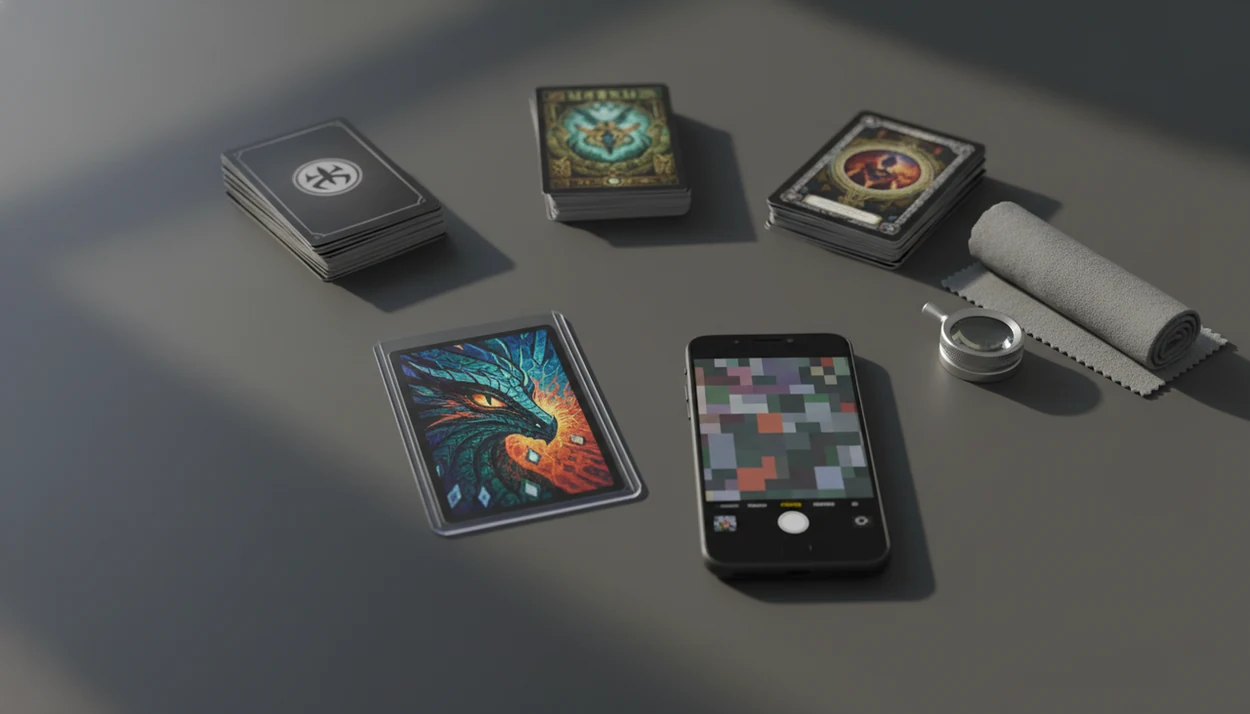
To check pokemon card market value realistically, confirm the exact card identity, variant, condition, and recent completed-sale data before trusting a number. A scanner app can speed up identification, but the final value still depends on matching the right version and comparing multiple current market sources.
Definition: TCG Pocket App is a pokemon card scanner app that identifies cards, checks market prices, and tracks collections for Pokémon TCG collectors.
TL;DR
- Use recent completed sales, not one active listing, to estimate realistic Pokémon card market value.
- Set, language, holo pattern, promo status, condition, and grading can change the value dramatically.
- A scanner app helps you see Pokémon card value faster, but you should still confirm the match before selling or trading.
At-a-glance Pokemon market price check for one card
A realistic Pokemon market price check estimates what a card is likely to sell for, not what one seller hopes to get. Start with recent completed transactions, then narrow the range by exact identity and condition.
The minimum inputs are card name, set, collector number, variant, language, condition, and raw versus graded status. A Charizard with the wrong set number is a different market.
Online marketplace data matters because visible price discovery now happens mostly through digital sales channels. Pew Research Center reported that 79% of U.S. adults had bought something online, which helps explain why completed online sales shape card-price expectations: https://www.pewresearch.org/short-reads/2016/12/19/online-shopping-and-e-commerce/
For a single card, completed sales usually beat active listings because they show confirmed buyer behavior.
How Pokemon card market value works behind the price
Pokemon card market value is the intersection of identity, scarcity, condition, demand, liquidity, and recent comparable sales.
Active listings show seller expectations. Sold listings show confirmed purchases. Accepted offers may be lower than the visible listing price. Auction-end prices can expose real demand when bidders compete. Graded-card sales belong in a separate lane from raw-card sales, because PSA, BGS, and CGC grades create their own buyer pools.
Liquidity is the quiet part. A modern chase card with dozens of weekly sales may have a tight range. A niche Japanese promo with three recent sales can swing hard from one transaction to the next. Pew’s representative gaming research found that 18% of U.S. adults played trading card games in the previous year, so the audience is real, but not every card trades often.
The green sold-price filter matters more than the loudest asking price.
How to use a Pokemon card value scanner app
Use a scanner app to identify faster, then verify the result before you price the card. Tools like [TCG Pocket App]() fit this binder-friendly scan workflow, especially when you want to log cards as you check them.
In TCG Pocket App, treat the scan result as the card-identification shortcut, then compare the displayed range against recent completed sales before you trade, sell, or insure the card.
Scan the card face
- Place the card in good light and scan the full front.
- Check the detected name, set, and card number before reading the value.
- Reduce glare if a reverse holo reflects through a nine-pocket binder page.
Confirm the exact print
- Confirm holo, reverse holo, promo stamp, first edition, language, artwork, and set symbol.
- Select raw or graded status, then choose a realistic condition tier.
Review the live value range
- Compare recent market data, not only one source.
- Save the card to your collection with condition notes for later tracking.
An AI-powered Pokémon TCG card scanner, live market prices, and a pocket-sized collection management app deliver faster matching and logging, not a guaranteed appraisal.
Five facts before you see Pokemon card value
- Completed sales are stronger evidence than current asking prices because they prove a buyer actually paid.
- Condition and grading can change value by a factor of 10 or more, especially on popular vintage or chase cards.
- Set, language, holo status, promo status, and print variation must match exactly before you trust a price.
- Multiple sources are safer than one marketplace or price guide, especially for cards with thin sales history.
- Market prices can move quickly, so collection values should be rechecked over time.
For phone-based workflows, our guide to how to check pokemon card value with phone covers camera angle, lighting, and lookup habits in more detail.
Tiny differences count.
Card identity details that change Pokemon market price check results
“Why isn’t the character name enough to check value?” Because different cards with the same Pokémon can sell in completely different ranges. Charizard is the easy example, but Pikachu, Umbreon, Mewtwo, and Lugia all have similar traps.
Check the set symbol, collector number, year, rarity mark, artwork, foil treatment, promo stamp, and language. I’ve seen a scan confuse two similar Pikachu prints until the collector checked the set symbol under the artwork. The price changed as soon as the variant match was corrected.
AI scanners can narrow the match quickly, but near-identical prints still need a visual check. Don’t mix raw and graded listings either. A raw card belongs against raw sales unless it has actually been graded.
Condition grades for checking Pokemon card market value
Condition is the biggest value lever after exact card identity. Whitening, dents, scratches, bends, centering, surface wear, and corner damage all affect what a buyer will pay.
| Condition tier | Practical meaning | Pricing note |
|---|---|---|
| Damaged | Creases, water damage, heavy bends, major surface issues | Often valued far below clean copies |
| Heavily played | Obvious wear, whitening, scratches, edge damage | Buyer pool is narrower |
| Moderately played | Noticeable wear but still presentable | Common for binder copies |
| Lightly played | Minor edge or surface wear | Often acceptable for collectors |
| Near mint | Clean front, minimal flaws | Usually the main raw-card benchmark |
| Mint | Extremely clean raw copy | Still not the same as PSA 10 |
Professional grades such as PSA or CGC create a separate market. A raw card should not be valued as gem-mint graded unless it has passed grading. The raw vs graded pokemon card value comparison is worth reading before pricing high-end cards.
Source data for a realistic Pokemon market price check
A stronger Pokemon market price check compares several data types because each source answers a different question. Active listings show expectations, but accepted offers and auction-end prices often reveal buyer behavior more clearly than buy-it-now asking prices.
| Source type | What it helps with | Main caveat |
|---|---|---|
| Recent completed marketplace sales | Real sale behavior | Needs exact variant matching |
| TCG platform market prices | Broad raw-card pricing context | May miss private or graded sales |
| Auction results | Demand under bidding pressure | One auction can be noisy |
| Graded-card databases | PSA, BGS, CGC sale context | Not useful for raw-card pricing |
| Local or private sales | Real-world trade conditions | Often less visible and less standardized |
The broader playing-cards and card-games market was valued at about $12.98 billion in 2020 and projected near $30.68 billion by 2026, according to Mordor Intelligence: https://www.mordorintelligence.com/industry-reports/playing-cards-and-board-games-market
Collection tracking after you see Pokemon card value
One price check is temporary. Demand, supply, social hype, liquidity, and reprint attention can change a card’s range within weeks.
Saving scanned cards into a digital collection lets you attach condition notes, purchase cost, value history, and duplicates. That helps with trade decisions, insurance estimates, sell timing, and binder organization. It also prevents the same card from being checked from scratch every month.
The phone propped against a card tin becomes useful when each scan lands in the right set list. Not glamorous. Useful.
The broader Games and Puzzles category reached $11.6 billion in U.S. sales in 2020, according to The Toy Association: https://www.toyassociation.org/PressRoom2/News/2021-news/toy-industry-sales-grew-16-percent-in-2020.aspx Portfolio-level tracking is covered further in our best pokemon collection tracker app guide.
Limitations
Any estimate is still an estimate. Treat the app result as a starting point, not the final word.
- Rare or thinly traded cards may have too few recent sales for a tight value range.
- AI scanners can misidentify similar artworks, promos, variants, or print runs if details are not confirmed.
- Condition is subjective unless evaluated by a professional grading company.
- Aggregated apps may lag behind private sales, local deals, niche auctions, or sudden hype cycles.
- Visible online market value is not the same as a guaranteed sale price.
- Fees, shipping, taxes, seller reputation, platform rules, and negotiation can change net proceeds.
- A market price range does not replace authentication for expensive or suspicious cards.
A scanner can help you move faster, but the lower-left set number and condition caveat still deserve a human look.
FAQ
How do I value Pokemon cards?
Identify the exact card, confirm its variant and condition, then compare recent completed sales for the same raw or graded version. Use multiple sources when possible.
Are Pokemon price checker apps accurate?
Pokemon price checker apps can be accurate when they match the correct card and use current market data. You should still confirm set, variant, language, and condition.
Do active listings show market value?
Active listings show what sellers are asking, not what buyers have paid. Completed sales are stronger evidence of market value.
Does card condition affect price?
Yes. Wear, dents, whitening, scratches, bends, and surface damage can significantly reduce value.
Are graded Pokemon cards worth more?
High professional grades can sell for premiums, especially on popular cards. The grading cost and actual grade still determine whether grading makes sense.
What is a raw Pokemon card?
A raw Pokemon card is ungraded. It should be compared with other raw-card sales, not PSA 10 or CGC 10 sales.
Which Pokemon cards sell fastest?
Cards with strong demand, recognizable characters, popular sets, clean condition, and fair pricing usually sell faster. Liquidity varies by card.
Can a scanner identify fake cards?
A scanner may flag mismatches or suspicious details, but authentication requires physical inspection. Expensive cards may need expert review.