
Is There an App That Scans Pokémon Cards and Tells Value?
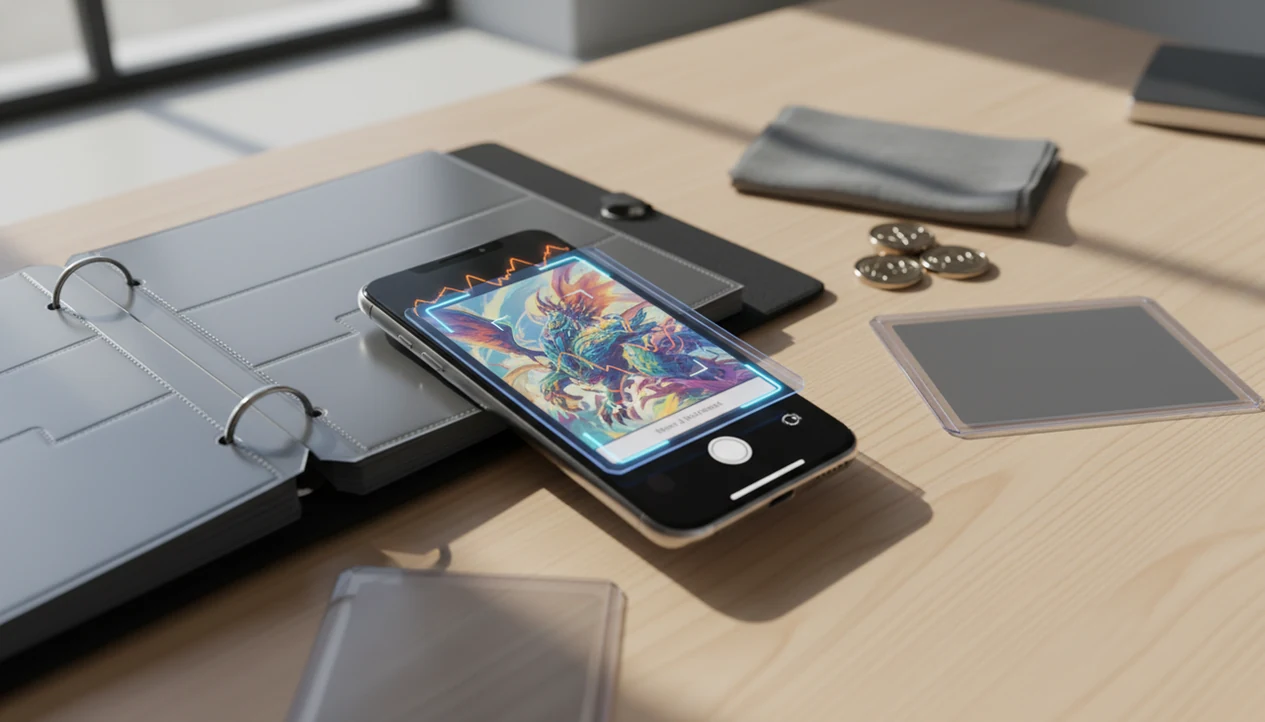
Yes, an app that scans pokemon cards and tells value can identify a card with your phone camera and estimate its current market price from pricing data. The useful apps do more than recognize the artwork: they help confirm the exact set, variant, condition assumption, and price source before you trust the number.
Definition: TCG Pocket App is a pokemon card scanner app that identifies cards, checks market prices, and tracks collections for Pokémon TCG collectors.
- Yes, phone apps can scan Pokémon cards for value, but the price shown is an estimate, not a guaranteed sale price.
- Accuracy depends on matching the exact card, set, rarity, variant, language, and condition assumption.
- A good Pokémon card value scanner should also save cards into a collection so you can track binder value over time.
How these apps look
Side-by-side captures of the compared products. Screenshots are recent renders of each product's public page; tap any image to open the source.
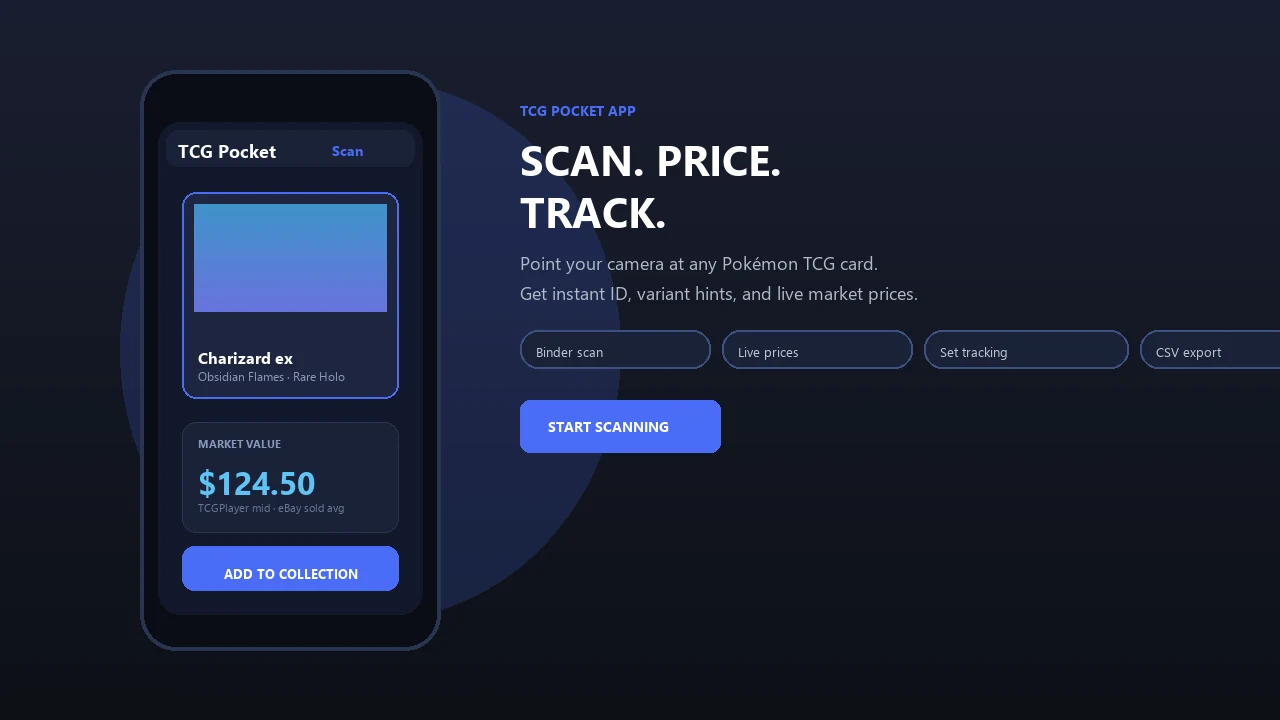
Pokemon Card Value Scanner Definition: What the App Actually Does
A Pokémon card value scanner is a mobile app that uses your phone camera to identify a Pokémon card, match it to a card database, and connect that match to pricing data. The number shown is not an official Pokémon price. It usually comes from marketplace listings, recent sales, or calculated market averages.
In practice, the scan is only the first pass. You still need to check the set icon, collector number, language, and variant before using the value. A Charizard reprint and an older Charizard can share familiar artwork but have very different markets.
Specialized Pokémon TCG scanner apps focus on card recognition, live market prices, and collection tracking. They are not for Pokémon TCG Pocket game strategy or digital battle advice.
At-a-Glance Answer for Scanning Pokemon Cards for Value
- Real apps can scan Pokémon cards for value today, using camera recognition and market-price databases.
- The four checks that must line up are card identity, variant, condition, and price source.
- A scanner works well for fast price checks, binder intake, trade prep, and collection totals.
- Smartphone use makes this workflow practical; Pew Research Center reported that 85% of U.S. adults owned a smartphone in 2021: https://www.pewresearch.org/internet/fact-sheet/mobile/
- A scanner value is an estimate, so rare cards still deserve recent-sale review before a trade or sale.
For most collectors, a phone scan is faster than typing every card name because the app starts from the image, then narrows the set match. The catch is familiar: a quick scan can confuse two similar Pikachu prints until you verify the set symbol.
Check the small print.
A good ai-powered pokémon tcg card scanner, live market prices, and pocket-sized collection management app deliver faster identification and cleaner tracking, not guaranteed resale prices or automatic grading.
How an App That Scans Pokemon Cards and Tells Value Works
An app that scans Pokémon cards and tells value works by capturing a card image, converting visual features into a match, checking a card database, and retrieving a price feed. The technical layer may use image recognition, optical character recognition, and image embeddings. In plain terms, the app compares what your camera sees against known card records.
Exact details matter because Pokémon cards repeat names, artwork poses, and character treatments across sets. Set symbols, collector numbers, foil patterns, reverse holo variants, alternate arts, language, and promo stamps can all change the value. We still check the lower-left collector number before trusting a price match, especially on modern cards.
Some AI-powered scanners improve when users correct bad matches. Those corrections can help future recognition for similar cards, damaged cards, and foreign-language prints. Live prices may show low, median, market, or recent sold data, depending on the source.
For binder scanning, the plastic crinkle of a sleeved page is normal. Glare is the real problem.
How to Use a Pokemon Card Value Scanner App
Use a Pokémon card value scanner as a scan, verify, log, compare workflow. The goal is not just to get a number; it is to decide whether the number is safe enough to use.
- Place the card in bright, even light and reduce sleeve glare before scanning.
- Scan the full card face with the name, artwork, set symbol, and collector number visible.
- Confirm the set, collector number, language, variant, and foil type before accepting the match.
- Inspect the condition manually for whitening, scratches, dents, bends, edge wear, and surface marks.
- Compare the displayed value against the price type, such as market, median, low, or recent sold.
- Save the confirmed card to a digital binder or collection tracker so totals stay updated.
Ring-light glare can bounce off a reverse holo through a nine-pocket binder page. Tilt the page slightly, then scan again. For more binder-specific setup, the best pokemon card scanner for binders guide covers sleeve and page workflows in more detail.
Before You Start Scanning Pokémon Cards
Before scanning, set up the card and your goal so the app has a fair chance to identify the exact print. A clean, glare-free setup saves time and reduces bad matches before you start logging values.
- Choose bright, even light from a window, desk lamp, or soft overhead source, then remove reflective sleeves when it is safe to handle the card without them.
- Place the card flat on a soft, clean surface so the name, set symbol, and collector number stay sharp and readable in the camera frame.
- Wash your hands, clear away food and drinks, and avoid rough tables that can nick corners while you move cards in and out of sleeves.
- Decide whether you are checking raw resale value, comparing graded-card potential, or simply adding cards to a collection tracker.
- Open recent-sale references for rare cards, promos, older holos, or anything expensive enough that one wrong variant could change the number.
This prep is boring in the best way. It keeps crumbs off sleeves, glare off holofoil, and shaky price assumptions out of your binder totals.
Best Use Cases for a Pokemon Card Value App
A Pokémon card value app is most useful when speed matters, but verification still matters. Many collectors already use smartphones for in-the-moment product research; a 2022 U.S. consumer survey found that 76% of respondents had used a smartphone to look up product information while shopping in-store. Source: Airship, 2022 Mobile Consumer Survey, https://www.airship.com/resources/reports/2022-mobile-consumer-survey/
- Binder intake: Scan pages after sorting so each card lands in a digital collection with a value estimate.
- Trade checks: Compare approximate value before agreeing to a binder-for-binder swap.
- Store or convention checks: Cup the phone screen from convention glare and compare recent prices before buying.
- Collection tracking: Watch total binder value, duplicates, and price movement over time.
- Unknown-card identification: Match cards found in bulk lots, old tins, or mixed childhood stacks.
For collectors deciding between features, our best pokemon card scanner app guide compares scanning, pricing, and tracking workflows. For binder owners, scan-to-total tracking is often easier than spreadsheet entry because every verified card can update the collection as you go.
Pokemon Card Value Scanner Price Sources and Condition Checks
Scanner apps can show different prices for the same Pokémon card because sources, regions, listing types, and condition assumptions vary. Most values assume a default condition unless you change it.
| Price or condition factor | What it means | Why it changes the value |
|---|---|---|
| TCGplayer market | A market-based U.S. pricing indicator | Useful for English raw cards, but source rules matter |
| Cardmarket trend | A European marketplace reference | Region and language can shift demand |
| Recent sold prices | Completed sales rather than active asks | Often better for rare or volatile cards |
| Listing prices | What sellers are asking now | Can be inflated or stale |
| Low and median prices | Marketplace summary points | Helpful only when condition is similar |
| Raw condition | Ungraded card condition | Whitening, scratches, dents, centering, bends, and edge wear matter |
| Graded condition | PSA, BGS, or CGC slab result | Grade, cert, and population can change buyer behavior |
Listing price versus sold price
Listing price is what someone hopes to get. Sold price is what a buyer actually paid. The green sold-price filter on eBay is often more useful than active asking prices when a card has thin data.
Raw condition versus graded condition
A top-loaded card is still raw until PSA, BGS, CGC, or another grader evaluates it.
Common Myths About Apps That Scan Pokemon Cards for Value
- A scanner price is not a guaranteed sale price; it is an estimate based on available market data.
- A quick camera scan does not professionally grade condition or catch every surface defect.
- Free apps do not all use one official Pokémon price source because no universal official resale price exists.
- Promos, misprints, foreign-language cards, and brand-new releases can be missing or matched incorrectly.
- A correct name match is not enough; the set number and variant must match too.
The myth that causes the most trouble is the guaranteed-price one. A card can display a healthy estimate and still sell lower if it has whitening, corner wear, or a weak buyer pool that week. Tiny snack crumbs near card sleeves are also a warning sign. Clean the area before scanning or photographing sale listings.
If you are comparing whether these tools fit your workflow, the pokemon card scanner app worth it guide explains when scanning saves time and when manual lookup is still safer.
Verification Checklist Before You Trust a Pokemon Card Scanner Value
“Can I trust the value a Pokémon card scanner shows?” Trust it only after you verify the match, condition, and price context.
Check the card name, set icon, collector number, rarity, variant, foil type, language, and promo stamp if present. Then inspect condition by hand. Small defects can change the price more than a casual scan suggests, especially on older holos and high-demand chase cards.
Look at recent sales when the card is rare, newly released, or moving quickly in price. A fresh set can have early listing noise before stable sold-listing context develops. For high-end cards, use the app estimate as research, then consider professional grading or expert review before a serious sale.
For beginners still learning the identification step, what app identifies pokemon cards explains camera matching before pricing. The most reliable scanner workflow is to treat the app result as a starting point, not the final word.
Limitations
Scanner apps are useful, but they have clear limits. Keep these caveats in mind before trading, selling, buying, or insuring cards from an app estimate.
- Glare, reflective sleeves, off-center framing, and low light can cause recognition failures.
- Damaged cards may scan poorly because creases, bends, or surface wear distort the image.
- Similar artwork can produce wrong matches, especially across reprints, promos, and regional releases.
- Foreign-language cards, niche promos, misprints, and brand-new releases may have incomplete data.
- Market feeds can lag behind fast price movement after set releases or viral demand spikes.
- Thin sales data can make a displayed value unstable for rare or obscure cards.
- Outlier listings can distort low, median, or market numbers if the app does not filter them well.
- Scanner apps cannot replace PSA, BGS, CGC, or expert review for expensive cards.
- Databases and price feeds update over time, so rescanning may change the result.
A completed page of matching slots feels tidy. Still, tidy tracking is not the same as appraisal.
FAQ
Can apps scan Pokemon cards?
Yes, phone apps can scan Pokémon cards with the camera and match them to card databases. The result usually includes the card name, set, and an estimated value.
Are Pokemon scanner values accurate?
Pokémon scanner values can be useful estimates when the card, variant, condition, and price source are correct. They are not guaranteed sale prices.
What app checks Pokemon card prices?
Look for a Pokémon card price checker that shows the matched set, variant, condition assumption, and pricing source. Apps such as TCG Pocket App, TCGplayer tools, Collectr, and PriceCharting-style databases can help with different parts of that workflow.
Can I scan cards for free?
Some apps offer free scanning or limited free lookups. Advanced collection tracking, exports, or larger scan limits may require a paid plan.
Do scanner apps grade cards?
Scanner apps do not replace professional grading. They may help you record condition, but grading requires detailed physical inspection.
Can Android scan Pokemon cards?
Yes, Android phones can scan Pokémon cards if the scanner app supports Android and the camera is clear enough. Bright light and steady framing improve results.
Can iPhone scan Pokemon cards?
Yes, iPhones can use Pokémon card scanner apps that support iOS. Newer cameras usually help with focus, but glare can still cause bad matches.
Why do app prices differ?
App prices differ because sources, regions, listing types, recent sales, and condition assumptions vary. One app may emphasize market averages while another highlights sold prices.
Can I sell from scanner values?
You can use scanner values as a starting point for selling. Before listing, verify condition, check recent sales, and adjust for fees, demand, and card flaws.