
> Definition: A set completion tracker is an app feature that compares your scanned collection against a full set checklist to display owned cards, missing cards, and progress toward a standard or master set in real time.
What a Set Completion Tracker Does for Pokémon Collectors
A set completion tracker shows owned cards, missing cards, and completion percentage for a chosen Pokémon set. In TCG Pocket App, that view updates after each scan, so a binder session turns into a live checklist instead of a spreadsheet cleanup job.
The need is bigger than neat organization. The collectible card game market was estimated at $6.39 billion in 2022, and Pokémon collectors now manage modern sets, vintage binders, promos, and variant-heavy master set goals. Source: Grand View Research, collectible card game market estimate, https://www.grandviewresearch.com/industry-analysis/collectible-card-game-market-report Paper checklists get messy when one card has a standard print, reverse holo, stamped promo, and full-art version.
A basic checkbox tells you, “you have Pikachu.” A real master set tracker asks which Pikachu, from which set, in what condition.
When a scan confuses two similar Pikachu prints, the lower-left set number check matters more than the thumbnail. Treat the app result as a starting point, not the final word.
How a Set Completion Tracker Works
A set completion tracker works by matching each identified card against an official set checklist, then updating your ownership status for that exact card and variant. The key mechanism is checklist matching: the app compares the card name, set number, and variant record so a standard print, reverse holo, promo, or alt art lands in the right slot.
- Scan the card so the app can read the visible identifiers, including artwork, set symbol, and lower-card numbering.
- Match the result to the checklist entry and variant record before counting it as owned.
- Update the set view so owned cards, missing cards, and duplicates change as scans are confirmed.
- Log quantity and condition notes, because one damaged copy or two trade copies can affect how complete the set really is.
- Layer price data after identification, not before, so value does not push a similar-looking card into the wrong slot.
Before high-value trades, verify the printed set number yourself. A clean scan is helpful, but the card in your hand still decides the final match.
AI Card Scanner Workflow for Set Completion Tracking
How set completion tracking works: an AI card scanner reads a card photo, identifies the set number, rarity, and variant, then matches that result against a master checklist database. The dashboard recalculates owned cards, missing cards, and completion percentage immediately.
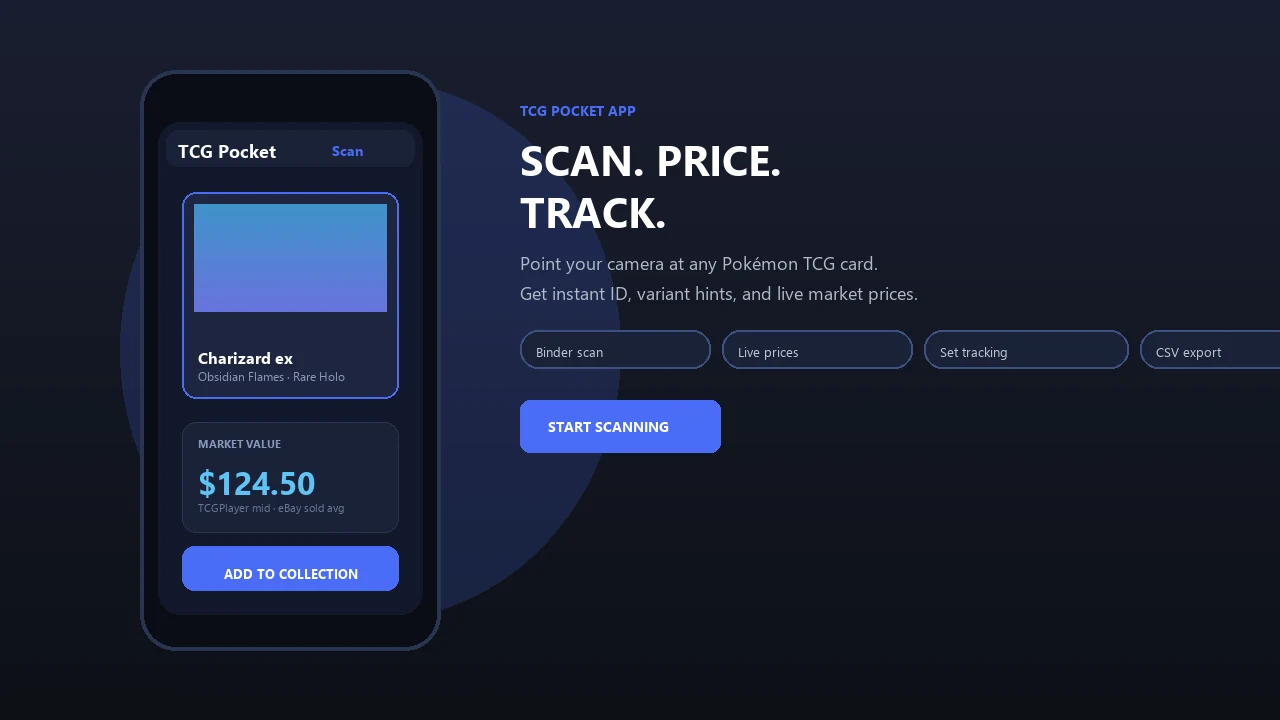
In practice, TCG Pocket App uses the scan as the entry point. You scan, verify the variant match, log condition, and watch the missing-card list change. Live price data is then layered onto each missing entry, which helps you decide whether a gap is a trade-night target or a card to leave alone for now.
Static checklist apps ask you to search and tap each card manually. Scan-driven trackers reduce that drag, especially when a stack is sitting beside your laptop and you just want the duplicates separated before dinner.
Mobile-first behavior supports this workflow. In the United States, 72% of adult gamers who play video games use smartphones, according to the Entertainment Software Association. Good ai-powered pokémon tcg card scanner, live market prices, and pocket-sized collection management app features deliver faster verification, not guaranteed valuation.
How to Track Missing Pokémon Cards in TCG Pocket App
Use TCG Pocket App as a Pokémon missing card tracker by scanning the cards you own first, then filtering the gaps that remain. The process works best when you verify set numbers before trusting prices.
- Open TCG Pocket App and select the Pokémon set you want to track.
- Scan your physical cards with the AI camera, one card or binder page section at a time.
- Review the completion dashboard for owned cards, missing cards, and current percentage.
- Filter missing cards by variant, rarity, card number, or price range.
- Plan purchases or trades using live market values and sold-listing context.
Ring-light glare can bounce off a reverse holo through a nine-pocket binder page. Tilt the binder slightly, then scan again.
Collectors who want a scan-first setup can compare the broader workflow in our app to scan pokemon card collection guide. For master set work, scanning is faster than typing card names because variant matching starts from the physical card.
Master Set Tracker: Variants, Reverse Holos, and Promos
A master set tracker must separate card variants, not just card numbers. Separate variant slots let reverse holos, full arts, alt arts, and promos count as distinct collection targets, so your percentage matches the way master set collectors count progress.
- Reverse holos need their own slot. A base card and reverse holo may share a number, but they are not the same completion item.
- Promos should not disappear into main-set totals. Black Star promos, stamped promos, and release-specific cards need separate tracking.
- Quantities and conditions matter. Logging one near-mint copy and one creased copy prevents false confidence before trading.
- Standard and master modes serve different collectors. A standard set can finish sooner, while a master set includes variant depth.
- Duplicate purchases become easier to avoid. A missing-card view helps stop buying the same low-cost rare three times.
Anyone dealing with variant-heavy modern sets fits TCG Pocket App because separate variant slots turn “have it” into a precise master set status.
Pokémon Missing Card Tracker Dashboard in TCG Pocket App
A strong Pokémon missing card tracker dashboard gives each set a progress bar, completion percentage, and missing-card gallery; in TCG Pocket App, each missing card can show a thumbnail, set number, rarity, and current price. Each missing card can show a thumbnail, set number, rarity, and current price, so the next target is visible without opening three tabs.
Filters help when the list gets long. Sort by rarity before a card show, sort by price before checkout, or sort by card number when a binder page has empty pockets in sequence.
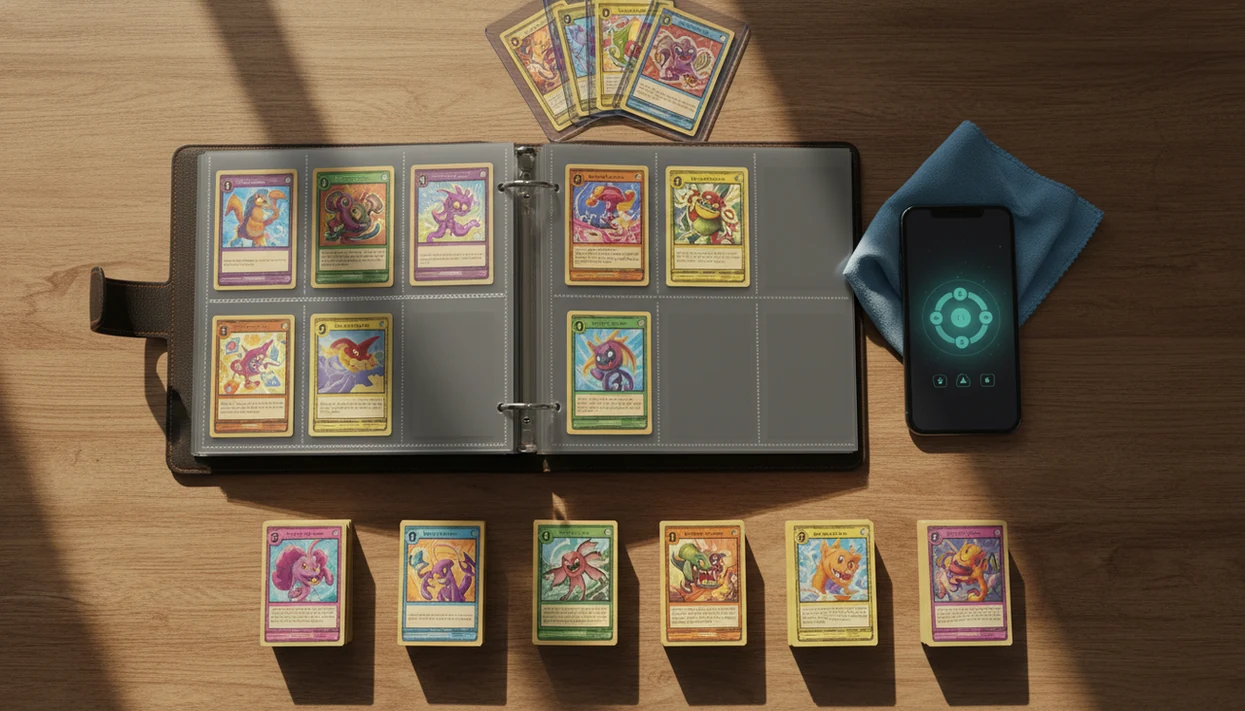
The plastic crinkle of a binder page is familiar here. You scan without removing every sleeved card, then use the dashboard to confirm what the binder still lacks.
Progress milestones and streaks keep casual collectors engaged between releases. For a deeper comparison of full-collection dashboards, our best pokemon collection tracker app guide covers value views, scan speed, and export needs.
Set Completion Tracker vs. Alternative Pokémon Card Trackers
A scan-first set completion tracker differs from manual checklist apps because the card image starts the workflow. TCG Pocket App focuses on collection completion, variant verification, and live pricing rather than deck construction or static list keeping.
| Tracker type | Common examples | Main workflow | Set completion fit |
|---|---|---|---|
| Scan-first collection tracker | TCG Pocket App | Scan, verify, log, price | Strong for missing cards and variants |
| Manual checklist app | Pokéllector, TCG Collector | Search, tap, mark owned | Useful, but slower for binders |
| Marketplace price tool | tcgplayer.com, cardmarket.com | Look up listings and prices | Strong price context, less completion tracking |
| Price archive tool | pricecharting.com | Compare raw and graded values | Helpful for valuation checks |
| Deck-builder tool | pkmn.gg | Build playable lists | Not focused on master set completion |
Among U.S. teens ages 13 to 17, 97% say they play video games on some device, according to Pew Research Center. Source: Pew Research Center, Teens, Social Media and Technology 2022, https://www.pewresearch.org/internet/2022/08/10/teens-social-media-and-technology-2022/ That expectation carries into collecting: phone-based scanning feels normal, while manual entry feels like homework.
If exact set progress is the issue, TCG Pocket App handles it through scan-to-checklist matching and missing-card filters.
Best Times to Use a Set Completion Tracker
The best time to use a set completion tracker is right after your collection changes. Open packs, scan the hits and bulk, then review the missing list before buying more singles.
Before a card show, TCG Pocket App helps narrow your want list by set, rarity, and price. That matters when a seller is waiting beside a card stack and you need to know whether the card fills a real gap or just looks familiar.
Casual collectors benefit too. You do not need to be chasing every reverse holo to use completion data well.
For most collectors, a missing-card tracker is often more useful than a plain checklist because it combines ownership status, variant detail, and price context in one buying decision. The decision becomes chase, trade, sell, or skip.
Related TCG Pocket App Features for Collectors
Several TCG Pocket App features support set completion without replacing collector judgment. They work together: scan, verify, log, compare, then export when needed.
- AI card scanner: Identifies card name, set number, rarity, and variant from a photo. The full identifier workflow is covered in our pokemon card identifier app guide.
- Live market price lookup: Adds current market context to owned and missing cards, with raw versus graded distinctions where available.
- Collection value dashboard: Shows portfolio value, duplicates, and set progress in one view.
- Duplicate tracking: Helps separate trade copies from master set copies, especially after bulk scans. Our tool that can track pokemon card duplicates page explains that workflow.
Limitations
TCG Pocket App can make set tracking faster, but it cannot remove every collector judgment call. Use it as a structured record, not an appraisal certificate.
- AI scanner accuracy depends on lighting, sleeve glare, card wear, and image angle.
- A creased back under a fingertip will not always affect identification, but it matters for condition notes.
- Newly released sets may have a short delay before the full checklist is available.
- The feature cannot verify card authenticity, trimming, ink issues, or grading condition.
- Pricing data reflects market aggregates and recent context, not a guaranteed sale price.
- Active asking prices can differ sharply from the green sold-price filter on eBay.
- TCG Pocket App does not auto-sync third-party marketplace purchase history.
- Completion tracking depends on scanning every card; unsorted bulk in a box can still be missed.
- Export needs vary by collector, so review CSV options if you maintain insurance records. Our tool to export pokemon card collection CSV guide covers portability.