
Is There an App That Tracks Pokémon Set Completion?
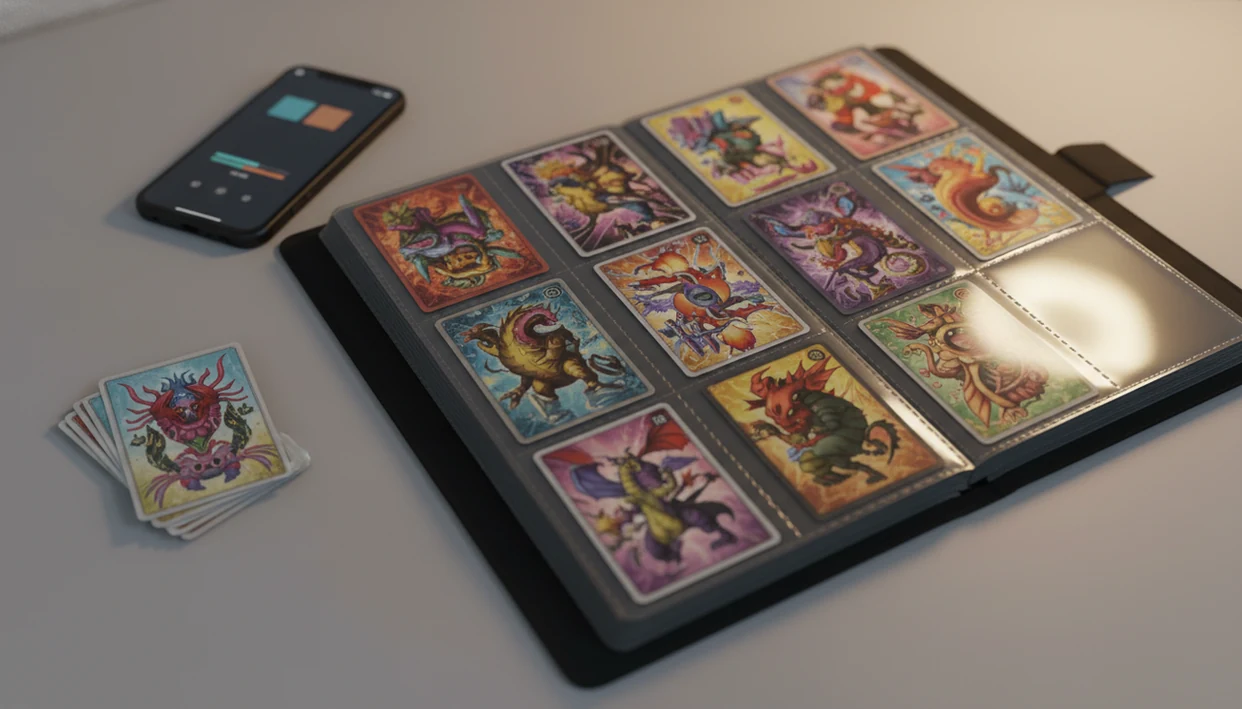
Yes, an app that tracks pokemon set completion lets you scan or log cards, then see missing cards, variants, reverse holos, promos, and master set progress in one checklist. TCG Pocket App is built for physical Pokémon TCG collectors who want fast binder scanning, live market context, and set-by-set completion tracking without maintaining a spreadsheet.
Definition: TCG Pocket App is a Pokémon card scanner app that identifies cards, checks market prices, and tracks collections for Pokémon TCG collectors.
TL;DR
- A Pokémon set completion app should show owned cards, missing cards, duplicates, variants, and set completion percentage.
- A master set tracker should clarify whether reverse holos, promos, alternate arts, secret rares, and stamped versions count toward completion.
- A reliable workflow is to scan binder pages, review uncertain matches, assign cards to sets, then use the missing-card list to plan buys or trades.
How these apps look
Side-by-side captures of the compared products. Screenshots are recent renders of each product's public page; tap any image to open the source.
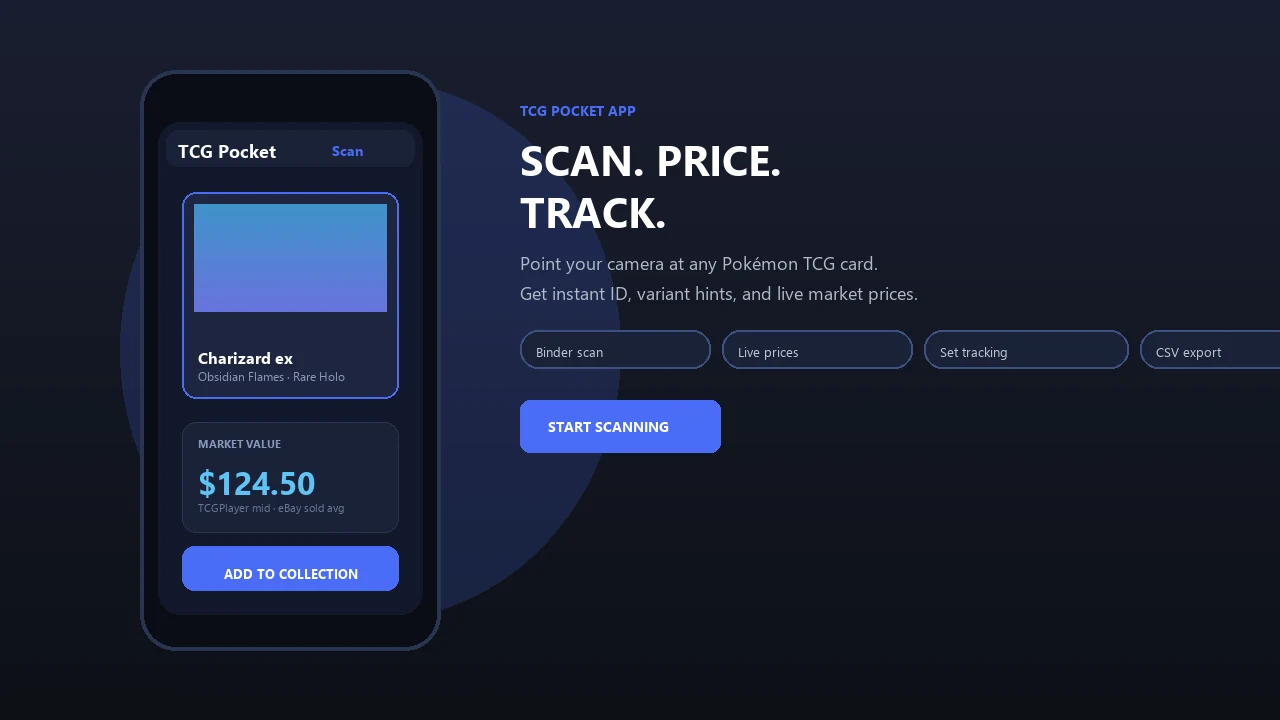
Pokémon Set Completion App Checklist at a Glance
- Set completion tracking is more than a card count because variants, printings, and holo types can change whether a binder is actually complete.
- A useful Pokémon set completion app should include a card scanner, set checklist, missing-card list, duplicate counts, variant support, reverse holo tracking, promo handling, and export or backup.
- Duplicate counts matter because most collectors find the same uncommon three times before finding the last reverse holo.
- Missing-card lists help plan trades, avoid duplicate purchases, and finish binders with fewer “I already had that one” moments.
- This workflow fits physical Pokémon TCG collectors because it combines binder-friendly scanning with collection management, not Pokémon TCG Pocket game strategy. Anyone dealing with half-finished binders and scattered bulk needs a tracker that turns scanned cards into set progress, missing-card lists, and duplicate counts. The plastic crinkle of a binder page is normal here.
Pokémon Card Database Logic Behind Set Completion Apps
A Pokémon set completion app works by matching a scan or manual search to a card database, then assigning that card to a set, number, rarity, variant, and quantity. The completion percentage depends on the checklist the app uses as the target.
How set completion apps work: the scanner creates an image match, often using visual similarity and card text cues, then the database resolves it into a specific print. In plain terms, the app guesses the card, and the collector verifies the exact version. Ring-light glare bouncing off a reverse holo through a nine-pocket page can still confuse a match.
Price data usually comes from marketplace signals, not a guaranteed appraisal. Good ai-powered Pokémon TCG card scanner, live market prices, and pocket-sized collection management apps deliver faster identification and context, not a final ruling on condition, variant, or sale price.
If your priority is exact set progress, TCG Pocket App earns the spot because the workflow pushes you to scan, verify, log, and compare before trusting a completion number.
Master Set Tracker Workflow for Pokémon Card Binders
The best workflow for a master set tracker is to scan first, verify variants second, then use the missing-card list for buying or trading. That order keeps casual set completion and master set completion from getting mixed together.
- Choose the set you want to complete, then decide whether you are tracking a regular set or a master set.
- Scan or log cards from binder pages, bulk stacks, or top loaders, and keep duplicates enabled.
- Confirm variants by checking set number, language, holo type, reverse holo status, promos, and stamped versions.
- Review missing cards after each binder section, especially secret rares, alternate arts, and reverse holos.
- Plan purchases or trades from the missing-card list instead of buying from memory at shows or shops.
- Export or back up data after major updates, especially before selling, trading, or reorganizing.
For casual collectors, a set checklist may be enough; for master set builders, variant rules usually matter more than total card count. For export planning, our tool to export pokemon card collection CSV guide covers the backup side in more detail.
Pokémon Set Completion App vs Spreadsheet for Binder Tracking
A set completion app is usually better than memory or paper when a collection includes duplicates, multiple sets, variants, and market-value decisions. Spreadsheets still work well as backups or for custom master set rules.
| Tracking method | Best for | Weak spot |
|---|---|---|
| Set completion app | Scanning, missing cards, duplicates, variants, quick price context | Depends on database freshness and scan accuracy |
| Spreadsheet | Custom rules, backups, insurance notes, unusual master set definitions | Manual entry gets slow across many sets |
| Paper checklist | Simple binder projects and kids’ collections | Easy to lose, hard to update, no price context |
A phone propped against a card tin is faster than typing card names into rows. However, a spreadsheet can capture personal rules that most apps won’t know, like “do not count prize pack stamps.” TCG Pocket App is strongest when the goal is quick binder logging plus set progress, because scan results flow into collection tracking.
For collectors comparing wider options, the best pokemon collection tracker app guide looks at broader collection needs beyond set completion.
TCG Pocket App Set Completion Tracking for Physical Pokémon Cards
TCG Pocket App is a Pokémon card scanner app for physical Pokémon TCG collectors who want to identify cards, save them to a collection, and see set progress without hand-building every checklist. It should be treated as a collector workflow tool, not an official Pokémon product or Pokémon TCG Pocket mobile game guide.
The practical flow is simple: scan binder pages, identify cards, save confirmed matches, view set progress, then check missing cards. A set number check in the lower-left corner still matters before trusting a price match, especially when two similar Pikachu prints appear close in search results.
The right fit for binder-first set building is a scan-verify-log workflow that connects card identification, set completion tracking, and live market context. Value helps decide which missing cards to chase now, but completion tracking is the main job. For scanner-specific use, our app to scan pokemon card collection guide goes deeper.
Master Set Tracker Rules for Variants, Promos, and Reverse Holos
Does a master set tracker count reverse holos, promos, and alternate arts? It depends on the app’s rules and the collector’s goal, so the tracker should let those categories be toggled or separated.
Regular set vs master set
A regular set usually means one of each numbered card in the main checklist. A complete set may include secret rares and alternate arts if they share the set numbering. A master set often adds reverse holos, promos, stamped cards, regional variants, special releases, and sometimes related products outside the main pack checklist.
Variant toggles that change progress
Two apps can show different completion percentages for the same binder if one includes reverse holos and the other does not. The moment a scan confuses two similar Pikachu prints, the collector has to verify the set symbol and variant before accepting the match.
Master set completion usually depends more on variant rules than scanner speed, because reverse holos, promos, and stamped releases can change the target checklist. For a narrower checklist workflow, use a set completion tracker for pokemon cards that makes the target list visible.
Pokémon Collection Value Signals Inside a Set Completion App
Collection value signals help decide which missing cards to buy now, trade for, or ignore until prices cool. They should support set completion, not replace condition grading or sold-listing research.
Five value facts for set completion apps:
- Pokémon generated about $11.6 billion in global licensed merchandise retail sales in 2022, with trading cards as a key product category, according to Statista: https://www.statista.com/statistics/1072224/pokemon-global-licensed-merchandise-retail-sales/.
- TCGplayer reported that the trading card industry, including Pokémon, reached an estimated $6 billion in U.S. hobby channel sales in 2021: https://seller.tcgplayer.com/articles/2021-tcg-marketplace-report/.
- A 2023 Statista survey found that 24% of U.S. adults aged 18–34 had bought sports cards or TCGs in the previous 12 months: https://www.statista.com/statistics/1418473/us-consumers-purchasing-trading-cards-age/.
- In-app prices are usually built from third-party marketplace signals, so niche promos and low-volume cards may lag.
- High-value trades should be checked against recent sold listings, not just active asking prices.
The green sold-price filter on eBay tells a different story than a hopeful listing that has sat for three weeks. TCG Pocket App gives market context beside collection progress, but raw versus graded value still needs careful review.
For expensive binders, a pokemon card collection insurance inventory may need photos, exports, and condition notes beyond everyday set tracking.
Limitations
TCG Pocket App can make set completion faster, but collectors should still verify important cards and keep their own backup. Treat the app result as a starting point, not the final word.
- Card databases can lag after new set releases, prerelease promos, and special products.
- AI scanner errors can happen on damaged cards, reflective holos, foreign-language cards, unusual stamps, or cards inside cloudy sleeves.
- Market prices can lag, vary by region, or miss low-volume promos.
- Unofficial marketplace or database integrations can change, break, or lose detail over time.
- Completion percentages may differ from pokellector.com, getcollectr.com, pricecharting.com, tcgplayer.com, or cardmarket.com because each source defines variants differently.
- A backup export or spreadsheet is still smart for important collection data.
- Condition is not solved by a scan; a soft corner visible through plastic can change value more than the card name does.
- Graded card values need label, grade, cert context, and recent sales, not just raw-card estimates.
Small errors compound. One wrong reverse holo can throw off an entire master set chase.
FAQ
Can I export or back up my Pokémon collection data?
Collectors should look for export, backup, or spreadsheet options before relying on one tracker. Backups are useful for insurance records, app changes, and large binder reorganizations.
Can an app track a Pokémon master set?
Yes, an app can track a Pokémon master set if it supports variants, promos, reverse holos, secret rares, and alternate arts. The key is whether those categories can be included or separated.
Do reverse holos count toward Pokémon set completion?
Reverse holos count only if the collector or app’s master set rules include them. A regular set checklist may exclude reverse holo duplicates.
Is there a free Pokémon card set tracker?
Yes, free Pokémon card set tracker options exist, but they may include ads, manual entry, limited exports, or incomplete variant support. Free tiers are usually fine for testing a workflow.
Can I scan Pokémon binder pages?
Yes, scanner apps can speed up binder logging, especially for visible cards in nine-pocket pages. Manual confirmation is still needed for variants, glare, language, and set number errors.
Does a Pokémon set tracker work on iPhone?
Many Pokémon set trackers work on iPhone, but users should check iOS availability, camera scanning, account backup, and export options. Evaluate those needs before moving a full collection.
Does a Pokémon set tracker work on Android?
Many Pokémon set trackers work on Android, but users should confirm device compatibility, camera quality, sync behavior, and backup options. Older Android phones may scan slower under poor lighting.
Are Pokémon card prices accurate in tracking apps?
Pokémon card prices in tracking apps are estimates based on marketplace data and may lag current demand. High-value buying, selling, or trading should be cross-checked with recent sold listings and condition details.