
Pokemon Card Show Price Checking With Your Phone
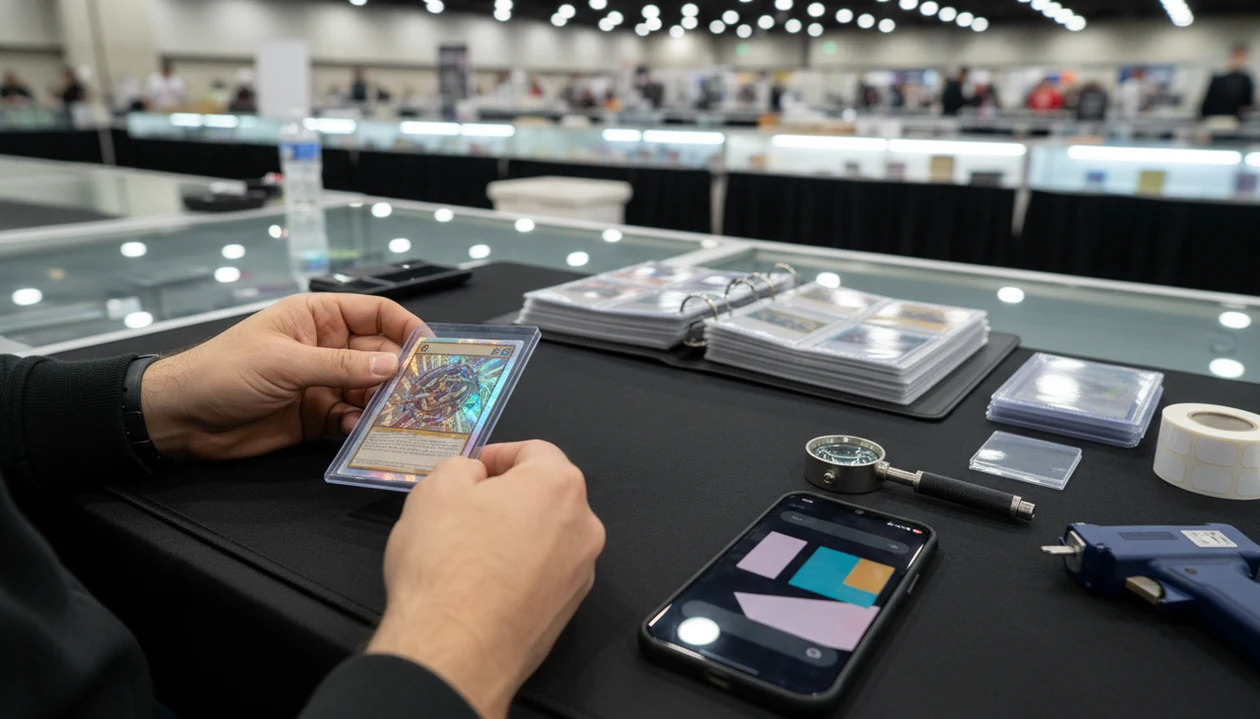
Pokemon card show price checking works best when you scan the card, confirm the exact version, compare recent sold comps, adjust for condition, and make a polite offer based on real evidence. Your phone should speed up the table-side decision, not replace your judgment about condition, liquidity, and the person you are trading with.
> Pokemon Card Scanner is a pokemon card scanner app that identifies cards, checks market prices, and tracks collections for Pokémon TCG collectors.
- Use a scanner app first, then verify the set, number, variant, language, and condition before trusting any price.
- Compare at least two sources, especially recent sold listings and marketplace prices, because listed prices are not the same as sales.
- At card shows and LGS trade nights, be quick, polite, and clear about whether you are buying, selling, or trading at cash value.
Pokemon Card Show Price Checking Facts Collectors Should Know
- Multiple pricing sources beat a single app or website because Pokémon prices move across eBay, TCGplayer, shops, and local demand at different speeds.
- Condition, language, edition, grading status, and variant can change value dramatically. A reverse holo, promo stamp, or Japanese print may not share the same comp.
- Sold listings matter more than active listings. The green sold-price filter on eBay shows what buyers paid, not what sellers hoped to get.
- LGS price checking and card show comps can lag online swings, especially during new set weekends, influencer hype, or sudden buyouts.
- Phone research at a table is normal when done politely. Pew Research Center reported that 76% of U.S. adults who shop online use smartphones to check prices or reviews in physical stores, according to its 2021 survey source.
A fast scan is useful. A verified comp is better.
How Pokemon Card Show Price Checking Works Behind the Table
Pokemon card show price checking is the process of identifying the exact card, pulling market data, comparing recent sales, and adjusting for condition, fees, and liquidity.
The same card can show different numbers because each source answers a different question. eBay sold listings show recent buyer behavior. TCGplayer market price reflects marketplace transactions and listings. Shop stickers include overhead and margin. Dealer buy prices reflect what someone can pay and still resell.
Liquidity matters too. A clean chase Charizard may move near market before lunch. A niche staff promo might need a discount because fewer buyers are walking the aisle. Price transparency changes buyer behavior; FTC research found shoppers were 34% more likely to choose a product when real-time price comparison information was accessible source.
Good comps make negotiation less personal.
Phone Setup for Faster Card Show Comps
Set up your phone before you enter the hall. Install and test a Pokémon card scanner app at home, preferably under the same awkward lighting you expect near vendor tables. Ring-light glare bouncing off a reverse holo through a nine-pocket binder page can fool even a quick scan.
Create a watchlist for chase cards, binder needs, and anything you plan to sell or trade. Save tabs for eBay sold listings, TCGplayer, Cardmarket if relevant, and shop listings you trust. If you want a show-specific workflow, our pokemon card scanner for card shows guide covers table speed in more detail.
Charge the phone, pack a battery bank, and assume the venue signal will fade near the back wall. Preload collection notes before the show so new scans can be compared against owned cards quickly. A scanner, live market prices, and collection notes speed up lookup; they do not guarantee accurate valuation or teach negotiation on the spot.
How to Use Pokemon Card Show Price Checking at a Table
Use the same short workflow every time, so the interaction stays friendly and fast. A simple script helps: “Mind if I scan this and check recent comps for a second?”
- Ask before scanning or handling the card, especially if it is in a case, slab, or dealer display.
- Scan the card, then confirm the set symbol, card number, language, holo pattern, and variant by eye.
- Check recent comps from sold listings and at least one marketplace source.
- Adjust for corners, whitening, surface scratches, dents, print lines, centering, bends, and back condition.
- Offer clearly, or decline quickly: “I’m seeing recent LP sales around $42. Would you be near $38 cash?”
- Move on politely if the seller says no.
For table-side decisions, matched recent sold comps are usually stronger than active asking prices because they show completed buyer behavior.
LGS Price Checking Sources Compared for Pokémon Cards
Different sources fit different decisions. Active listings and high asking prices should not be treated as card show comps unless they are supported by completed sales.
| Source | Strongest use | Watch for |
|---|---|---|
| Scanner app market price | Speed and first-pass identification | Wrong variant matches, stale averages |
| eBay sold listings | Negotiation and cash sale estimates | Outliers, shipping effects, poor condition matches |
| TCGplayer market price | Trade value and raw English cards | Condition mismatch, thin sales history |
| Major shop listings | Retail replacement cost | Asking price, not necessarily sold price |
| LGS buylist pricing | Store buyback expectations | Lower cash offers due to overhead and risk |
Completed-sale data is more reliable when there are multiple bidders and enough transaction volume. If one odd sale is all you can find, treat it as a clue, not a number. Collectors doing deeper pricing work may prefer a pokemon card scanner for collectors workflow that saves notes beyond the first comp.
Condition Checks That Change Card Show Comps
Condition checking means matching the comp to the physical card in hand, not the cleanest copy online. The print line crossing a shiny border can matter, even when the front looks bright at first glance.
- Raw near mint: Expect clean corners, minimal whitening, smooth surface, and no dents. Centering still affects high-end cards.
- Lightly played: Small whitening or minor surface wear may be acceptable, but the comp should say LP.
- Moderately or heavily played: Bends, scratches, edge wear, and back damage can push the card far below market.
- Damaged: Creases, water marks, peeling, ink, or major dents need separate damaged comps.
- Graded: PSA, BGS, and CGC prices should be compared by grade, not blended with raw values.
Also confirm language, edition, set stamp, promo status, reverse holo, full art, secret rare, and other variant details. We have seen a scan confuse two similar Pikachu prints until the collector checked the lower-left set number.
Polite Negotiation Scripts for Card Show Price Checking
Can I show comps without annoying the dealer? Yes, if your goal is to align on a fair number, not prove someone wrong.
Try these short scripts:
- Ask to scan: “Is it okay if I scan this and check recent solds?”
- Ask about firmness: “Are your sticker prices firm, or do you have room on cash?”
- Show a sold comp: “I’m seeing a few recent NM sales around $70. This one has some back whitening, so I’m closer to $60.”
- Make a bundle offer: “If I take these three together, would $120 cash work?”
Dealers have table fees, card fees, travel costs, inventory risk, and margin needs. Cash offers are not the same as trade value conversations. Say which one you mean. If the answer is no, thank them and move on.
No lecture needed.
Deal Logging After LGS Price Checking
Log the deal right after the interaction, while the table and price source are still fresh. Record card name, set, variant, condition, price paid or received, trade partner type, and the source used for the comp. The plastic crinkle of a binder page is easy to remember; the exact LP discount is not.
Post-show review exposes patterns. You may find that you overpaid for raw versus graded cards, bought too many low-liquidity promos, or traded well on playable singles. A collection tracker can save scans, notes, photos, and market context so you can audit the deal later instead of relying on memory.
After each event, review five numbers: total spend, total estimated market value, cards added, cards moved, and lessons learned. Resellers can add margin and sell-through notes; our pokemon card scanner for resellers guide focuses on that workflow.
Common Mistakes in Pokemon Card Show Price Checking
The most common mistake is treating a fast phone result as a finished price. At a show table, every number still needs a match for sold history, exact version, condition, and real cash-out costs.
- Filter for completed sold prices before you quote a comp. Active listings show what someone wants, not what a buyer already paid.
- Confirm the set number, language, holo pattern, promo stamp, and variant after the scan. Similar artwork can hide a very different card.
- Inspect both sides under decent light. Whitening, dents, print lines, scratches, bends, and back-surface damage can move a card from NM to LP or worse.
- Separate graded and raw values. A PSA 9 sale should not become the table value for an ungraded copy unless you are deliberately pricing a grading gamble.
- Subtract the selling friction before making a cash offer. Platform fees, shipping, taxes, time to sell, and weak liquidity all affect what a buyer can responsibly pay.
A good check is not slow; it is just complete enough to avoid paying for the cleanest online copy when the card in hand is not that copy.
Limitations
Phone-based price checking is useful, but it cannot solve every show-floor pricing problem.
- Live pricing APIs and marketplace data can lag during hype cycles, new releases, and buyout behavior.
- AI scanners can misread foreign-language cards, older sets, damaged cards, promos, miscuts, and similar artwork.
- Venue lighting, glare, sleeves, top loaders, and weak internet can slow or distort scans.
- A market price is not the same as cash in hand after platform fees, shipping, taxes, and time to sell.
- LGS buy prices may differ sharply from online comps because stores account for overhead, inventory risk, and local demand.
- Some cards have too few recent sales to produce a reliable comp.
- Condition calls are subjective, and small flaws can change the accepted price.
Treat the app result as a starting point, not the final word. Parents sorting a kid's stack beside a cereal bowl may need a simpler approach, and our pokemon card scanner for parents guide is built for that slower home setting.
FAQ
Is it okay to scan Pokémon cards at a card show table?
Yes, scanning is usually acceptable if you ask first, handle the card carefully, and do not block the table. Keep the check brief and move aside if you need more research.
Which Pokémon card comps matter most when I am buying or trading?
Recent sold listings and matched-condition marketplace data matter most. They are stronger than active listings because they show what buyers actually paid.
Are listed Pokémon card prices reliable at a show?
Listed prices can be useful starting points, but they are not proof of value. High asking prices should not be treated as actual comps unless similar cards have sold.
How recent should Pokémon card sold comps be?
Use recent sales when possible, often the last 7 to 30 days for volatile cards. Older comps can still help for low-volume cards, but they need more caution.
Do LGS Pokémon card prices usually match online prices?
Not always. Local stores account for rent, payroll, inventory risk, fees, and local demand, so sticker prices and buylists may differ from online market data.
Can card condition change the price that much?
Yes, condition can significantly change a Pokémon card’s value. Wear, dents, whitening, grading status, language, and variant details can all move the price.
What should I do if a Pokémon card scanner identifies the wrong card?
Manually verify the set icon, card number, variant, language, and holo pattern. Correct the match inside the scanner before saving or pricing the card.
Should I show sold comps when negotiating for Pokémon cards?
Yes, but show them respectfully and give the other person room to decline. Saved scans can help organize evidence, but negotiation still depends on tone, condition, cash versus trade value, and the deal context.
Get started with Pokemon Card Show Price Checking on iOS.