
Pokemon Card Scanner For Resellers Checking Bulk Lots
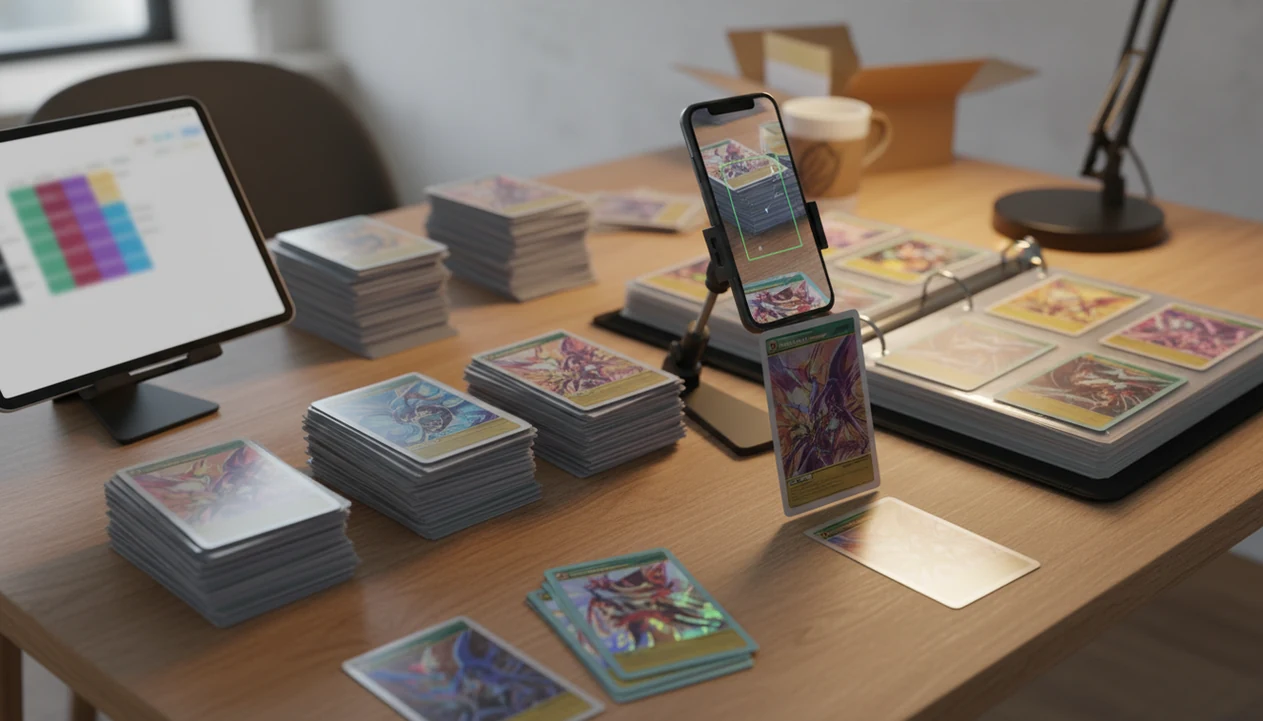
A pokemon card scanner for resellers should help you scan bulk lots quickly, identify exact Pokémon TCG printings, check current market prices, separate duplicates, and export clean inventory without pretending every comp is a guaranteed sale price. TCG Pocket App is built for fast, binder-friendly Pokémon card scanning, live price checks, and collection tracking for sellers who still want to verify condition and edge cases manually.
Definition: TCG Pocket App is a pokemon card scanner app that identifies cards, checks market prices, and tracks collections for Pokémon TCG collectors.
- Use a Pokémon reseller scanner to turn loose bulk, binders, and collections into searchable inventory faster than manual entry.
- The best reseller workflow combines AI card recognition, live market prices, duplicate tracking, and CSV-style exports.
- A scanner helps with pricing and cataloging, but it does not grade condition, authenticate cards, or guarantee realized sale prices.
Bulk lot economics for Pokémon card resellers
Bulk lot review is a speed, accuracy, and margin problem, not just a collecting task. A reseller needs to know which cards are worth listing, which belong in bulk, and which need a second look before money changes hands.
The hard part is the input. Binders arrive half-sorted. Shoeboxes mix damaged cards, duplicates, old reverses, promos, and partial collections. One mystery Japanese card in a pile can slow down a whole table if every lookup is manual.
Mobile buying matters too. Pew reported that 76% of U.S. adults bought things online using a smartphone in 2021, up from 51% in 2015 source. For sellers, fast phone-based inventory is now part of the resale workflow.
If the priority is moving from messy collection intake to defensible offer math, TCG Pocket App fits because it combines scan, verify, log, compare, and export into one Pokémon TCG workflow.
How a Pokemon Card Scanner for Resellers Works
A pokemon card scanner for resellers works by turning a phone photo into a likely card match, then connecting that match to set data and price references. It is fastest when the scan captures the full card face clearly enough for the app to compare artwork, text, and small print details.
The process usually starts with image capture, then visual recognition, which means the app compares the picture against known card images. OCR, or text reading, can help confirm the card name, collector number, set code, and sometimes language. Set matching is the important reseller step because two cards with the same Pokémon and artwork may not share the same value. Variant, language, foil type, promo stamp, and collector number can separate a bulk card from a card worth listing on its own.
Scanner confidence is still a prompt for human review, not permission to skip it. Glare from holos, cards inside sleeves, damaged corners, warped surfaces, and partial images can all push the scanner toward the wrong match. For edge cases, verify the set symbol, number, language, and foil treatment before trusting the price.
How to Use a Pokemon Card Scanner for Reseller Bulk Lots
Use a pokemon card scanner for reseller bulk lots by turning a messy intake pile into organized, verified, saveable inventory before you make an offer. The scanner speeds up identification, but the margin comes from clean prep and careful review.
- Sort the cards into obvious groups before scanning, such as holos, reverse holos, promos, vintage, foreign-language cards, damaged cards, and ordinary bulk. This keeps one weird card from slowing down the whole table.
- Scan clean, flat cards under steady lighting with as little glare as possible. If a sleeve, binder page, or warped foil throws reflection across the set number, adjust the angle and scan again.
- Verify the set number, rarity, language, and variant before trusting the price shown in the app. Similar artwork, reprints, and promo versions can produce very different resale values.
- Flag cards that appear higher value, unusual, or condition-sensitive for sold-listing checks and a closer look at corners, whitening, dents, scratches, and surface wear.
- Save or export the scanned inventory before calculating your purchase offer, so duplicates, quantities, and review notes are visible when you start the math.
Bulk lot price checker checklist for resellers
A bulk lot price checker should help a reseller build a defensible inventory list, then leave room for human judgment. Current reference prices are useful, but blind automation can turn one wrong variant match into a bad offer.
| Feature | Why it matters | Reseller warning |
|---|---|---|
| AI recognition | Speeds up large stacks versus typing names | Recheck blurry scans and similar artworks |
| Set matching | Separates reprints, promos, and languages | Always inspect the set number check |
| Live prices | Gives current reference values | Listed prices are not sold prices |
| Duplicate handling | Shows quantity and repeat printings | Bulk duplicates still need cleanup |
| Condition notes | Helps discount played cards | It is not grading |
| Export formats | Supports inventory-ready lists | Confirm the export fits your process |
| Manual override | Fixes bad matches | Needed for variants and odd cards |
For resellers who need quick Pokémon-only intake, TCG Pocket App focuses on card identification and collection management without claiming it can grade like PSA, BGS, or CGC. Good ai-powered pokémon tcg card scanner, live market prices, and pocket-sized collection management app deliver faster sorting, not a guaranteed appraisal.
For price verification, compare scanner output against at least one sold-listing or marketplace reference before making a large offer. Active listings can show seller expectations, while sold listings better reflect what buyers actually paid.
Five facts about a pokemon card scanner for resellers
- AI-powered recognition is faster than typing Pokémon card names manually, especially when reviewing hundreds of commons, rares, holos, and promos.
- Live market prices are reference points, not guaranteed sale prices after fees, shipping, returns, taxes, or buyer negotiation.
- Bulk scanning is most valuable when it creates sortable lists, duplicate counts, and export-ready inventory.
- Accuracy depends on lighting, set recognition, image clarity, and whether the card face is visible enough through sleeves.
- Scanners cannot grade condition, prove authenticity, or replace professional grading for high-value cards.
A phone hovering over binder rings can still catch glare from a reverse holo. Adjust the lamp, scan again, and verify the lower-left set number before trusting the price match.
For sellers, scan accuracy usually depends more on exact variant matching than on the card name alone because many Pokémon cards share artwork, character names, and reprint histories.
Camera workflow behind a pokemon reseller scanner
A pokemon reseller scanner works by capturing a card image, cleaning the visual input, matching artwork and text clues, checking set data, then retrieving price references from card databases or marketplaces.
In practical terms, the camera sees the card first. Recognition compares visual features, then text, set symbol, collector number, rarity, language, and variant. That matters because a regular holo, reverse holo, stamped promo, Japanese print, and alternate reprint can carry very different resale prices.
AI creates efficiency when it sits inside a real workflow. McKinsey has reported that organizations using AI in workflows can capture measurable value from specific use cases, but that is broad workflow evidence, not a Pokémon-specific pricing guarantee source. The database still matters. So does the user.
Resellers who scan mixed binders benefit when identification, price context, and saved inventory stay in one mobile workflow. The plastic crinkle of a binder page is normal; the set symbol still needs a human glance.
Bulk lot price checker workflow before buying
Pre-sorting by set, rarity, and condition reduces scan errors and cleanup time before you make an offer. Do not pay full market price for unverified bulk, especially when the lot includes played cards or unclear variants.
- Sort obvious groups first, including holos, promos, vintage, bulk commons, foreign-language cards, and damaged cards.
- Scan representative stacks instead of every low-value common when time is limited.
- Flag hits that show meaningful value, unusual variants, or confusing set matches.
- Check duplicates so repeated cards do not inflate the offer by accident.
- Apply condition discounts for whitening, bends, scratches, ink, dents, and heavy play.
- Save or export the list before negotiating, so your offer math is visible.
For sellers comparing broader listing tools, an app to help sell pokemon cards should support pricing review, not replace it. TCG Pocket App works best when you treat the app result as a starting point, not the final word.
TCG Pocket App reseller features for Pokémon inventory
TCG Pocket App maps reseller work into three core jobs: identify cards quickly, compare market references, and turn scans into inventory-ready lists. That matters when a trade binder is balanced on your forearm and a lot box is sitting under a folding table.
Fast Pokémon card identification
Fast identification helps sellers move through binders, loose stacks, and partial collections without typing every card name. TCG Pocket App is useful here because the scan flow is built around Pokémon TCG recognition and variant review.
Live market price checks
Live market checks give sellers a pricing reference before buying, listing, or separating higher-value cards. Still, compare raw versus graded when needed, and remember that the green sold-price filter on eBay is different from active asking prices.
Inventory lists and duplicate review
Inventory lists help sellers find duplicate quantities, repeated printings, and cards that belong in separate listing groups. For larger sorting projects, an app to help sort pokemon cards can support the same scan-first discipline.
Six reseller patterns a pokemon reseller scanner should support
Does a pokemon reseller scanner help with real resale work? Yes, if it supports collection buys, binder flipping, bulk rare sorting, eBay listing prep, card show intake, and duplicate cleanup.
Collection buys need fast offer math. Binder flipping needs price confidence and set matching. Bulk rare sorting needs speed, but low-value commons may be handled by count or category instead of one-by-one scans. eBay listing prep needs notes and exportability. Card show intake needs quick checks while standing at a table. Duplicate cleanup needs quantity tracking.
The broader U.S. toy and game market reached $38.2 billion in 2021, according to Census reporting source. That scale does not make every card valuable, but it explains why efficient pricing workflows matter.
On days a seller is moving between tables, the scanner earns its spot when scan results, price checks, and saved collection rows stay in the same mobile workflow.
Pricing gaps in any bulk lot price checker
Every bulk lot price checker has pricing gaps. Market references can lag sudden spikes, crashes, buyouts, local demand, and platform-specific behavior.
A low market price does not always mean a card is worthless. Variants, sealed promos, staff stamps, regional demand, niche playable cards, and condition outliers can all change the story. The reverse is also true. A high asking price can sit unsold for months.
Scanner prices are inputs, not net proceeds. Seller fees, shipping, returns, taxes, supplies, and time all reduce realized profit. That is why sold-listing context matters before making a large purchase offer.
For resellers handling high-value cards, manual review is often safer than automated pricing because exact printing, condition, and raw versus graded context drive the final number. A near-mint copy in a top loader deserves more care than a bulk holo with edge whitening.
Limitations
Scanner output is useful, but it has boundaries. Treat TCG Pocket App and any pokemon reseller scanner as an inventory and pricing aid, not an appraisal certificate.
- AI scanners can misidentify damaged, sleeved, foreign-language, off-center, or heavily foiled cards.
- Ring-light glare can hide reverse holo texture, set symbols, or small print details.
- No scanner can objectively grade condition like PSA, BGS, CGC, or a trained human grader.
- Live market values may lag rapid marketplace changes or use different sources than tcgplayer.com, cardmarket.com, pricecharting.com, or getcollectr.com.
- Wrong set recognition can create large pricing errors for cards with many reprints.
- Bulk scans still require manual cleanup for duplicates, variants, promos, and played cards.
- Scanner output does not prove authenticity, ownership, or future resale value.
For a non-resale view of scanning, a pokemon card scanner for collectors may be a better fit than a margin-focused workflow.
FAQ
What is a pokemon reseller scanner?
A pokemon reseller scanner is a mobile app that identifies Pokémon cards with a phone camera, checks price references, and saves cards into inventory lists. It helps sellers process bulk lots faster than manual lookup.
Can a scanner estimate the value of a bulk Pokémon card lot?
Yes, a scanner can estimate a rough bulk lot value by identifying cards and pulling reference prices. The estimate still needs condition, variant, duplicate, and sold-listing review.
Do Pokémon card scanners grade condition?
No, Pokémon card scanners do not provide professional condition grades. They cannot replace PSA, BGS, CGC, or an experienced human condition review.
Which Pokémon cards need manual review after scanning?
High-value, damaged, vintage, promo, foreign-language, misprint, and heavily foiled cards need manual review. Similar Pikachu prints and cards with many reprints should also get a set number check.
Are scanner prices always accurate for resale?
No, scanner prices can lag market changes and may differ by data source. Listed prices, market averages, and sold prices can produce different resale expectations.
Can I export scanned Pokémon cards for reseller inventory?
Exportable lists are important for reseller inventory because they help with sorting, listing prep, and duplicate review. Check export options before committing to any scanning workflow.
How do I scan Pokémon cards faster?
Sort cards first, improve lighting, remove glare, scan flat cards, and verify set symbols. Clean stacks scan faster than mixed piles with sleeves, bends, and foil glare.
Can scanners find duplicate Pokémon cards?
Yes, scanned inventory lists can reveal duplicate cards, quantities, and repeat printings. TCG Pocket App supports duplicate review as part of saved Pokémon card inventory.
Is a free Pokémon card scanner enough for reselling?
A free scanner can be enough for small lots or occasional checks. Serious resale volume usually needs better list management, duplicate review, export-ready inventory, and more consistent price-source transparency.