
App To Help Know Cards Worth Grading Before Submission
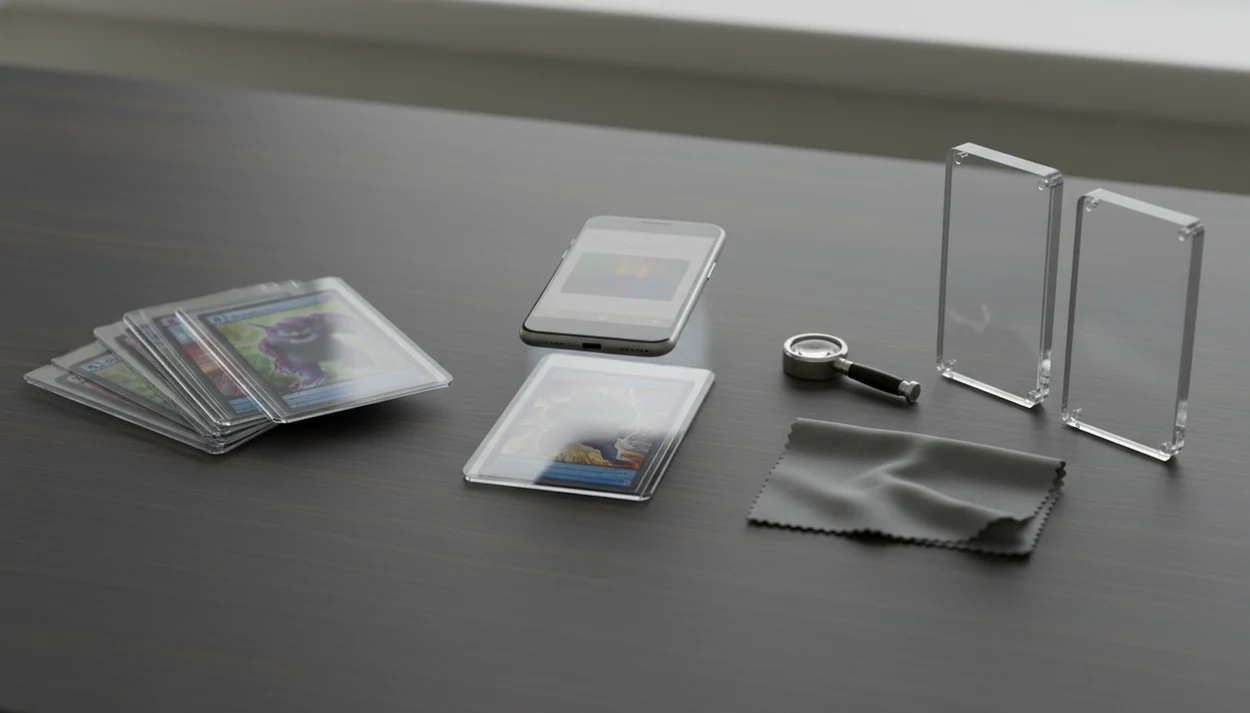
An app to help know cards worth grading can pre-screen Pokémon cards by identifying the card, showing raw versus graded market context, and helping you decide whether a professional submission may be worth the fee. It cannot issue a real PSA, BGS, or CGC grade, authenticate the card, or reliably catch every surface defect from a phone scan.
A Pokémon card scanner app can identify cards, check market prices, and track collections for collectors without claiming to grade or authenticate the card.
- Use a grading candidate checker as a first filter, not as a substitute for professional grading.
- A safer pre-screening workflow compares card identity, raw value, graded comps, expected grade, and submission costs.
- Manual inspection still matters because centering, corners, edges, surface flaws, and authenticity determine the final grade.
How these apps look
Side-by-side captures of the compared products. Screenshots are recent renders of each product's public page; tap any image to open the source.
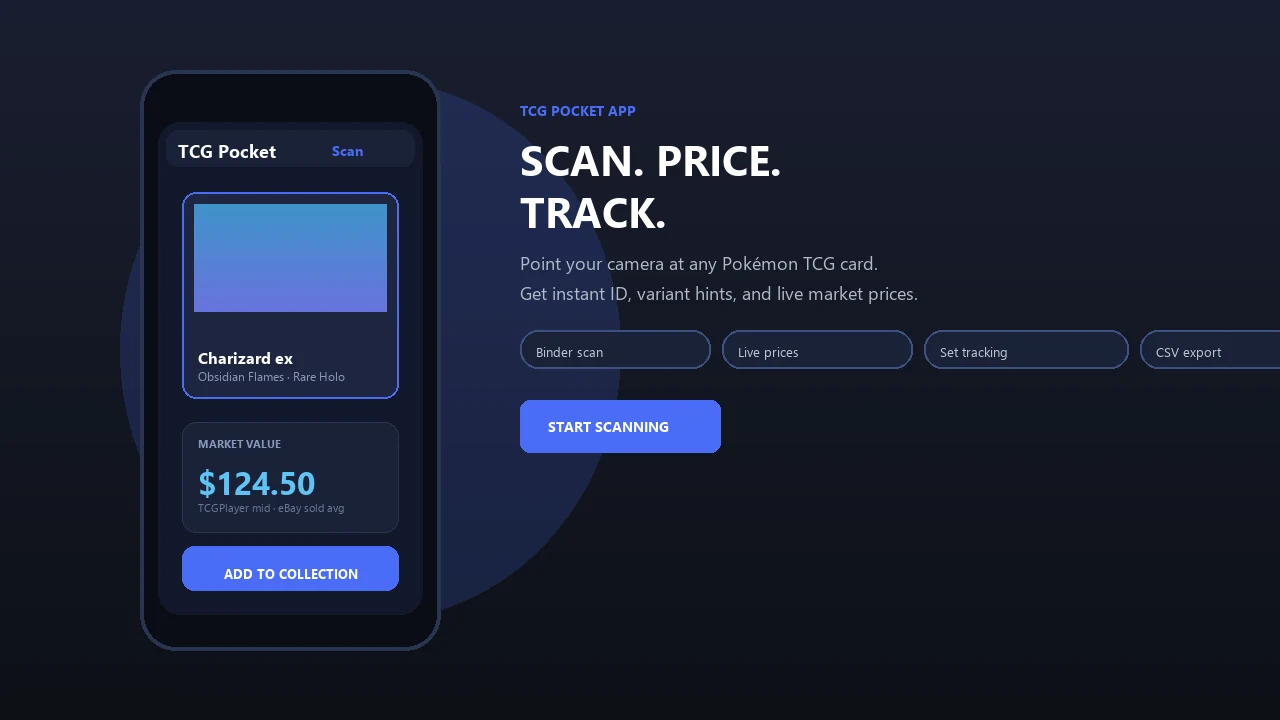
At-a-glance grading candidate checker for Pokémon cards
A grading candidate checker is useful for pre-screening Pokémon cards, not for making the final grading call. The quick decision comes from six inputs: exact card, raw price, graded price, visible condition, grading costs, and current demand.
Start with the set number check in the lower-left corner before trusting any price match. A similar Pikachu print can scan correctly at first glance, then fall apart when the set symbol is verified.
Scanner apps can help with binder-friendly scanning and collection tracking, especially when you are sorting a stack before deciding what deserves closer inspection. That is collector workflow, not Pokémon TCG Pocket game strategy.
An ai-powered pokémon tcg card scanner, live market prices, and pocket-sized collection management app can speed up card lookup and comparison, not replace grading-room inspection.
Five facts about an app to help know cards worth grading
- Scanner apps are pre-screening tools, not professional grading services, so they can flag possible candidates but cannot assign a PSA, BGS, or CGC grade.
- AI card recognition speeds up exact set, card number, language, and variant lookup, especially when a mixed pile has duplicate cards lined in rows.
- Market value is not the same as grade potential; a valuable raw card can still grade poorly because of whitening, dents, or surface wear.
- Lighting, sleeves, glare, print lines, and edge damage can reduce reliability, especially when ring-light glare bounces off a reverse holo through a nine-pocket page.
- Manual verification against grading-company criteria is required before paying submission fees.
For most collectors, app-based pre-screening is often faster than manual search because the scan narrows the card identity before the condition review begins. Still, the final call happens under light, not inside the estimate.
How a Pokémon cards worth grading app works
A Pokémon cards worth grading app works by capturing a phone-camera image, matching visual features to a card database, then showing set, print, variant, and market context. The technical layer usually relies on image recognition and variant matching, which means the app compares the scan against known card images and metadata.
Price data may come from marketplace feeds, recent sales records, grading references, or internal collection records. That helps separate raw versus graded value, but it does not prove condition or authenticity.
Think of collectible inspection like U.S. Mint quality control. The Mint notes that modern proof coin sets can require inspection across thousands of pieces to meet quality standards. A phone scan is faster, but the problem is similar: tiny flaws matter.
Plastic crinkle from a binder page can also change the capture. Simple, but real.
A pokemon card scanner for collectors is strongest when it identifies the card first, then sends you into a separate manual grading review.
How to use an app to help know cards worth grading
Use the app as a fast sorter, then make the grading decision with your eyes, recent sales, and full cost math. The goal is to move from “interesting card” to “real submission candidate” without letting a clean scan do too much work.
- Scan the card outside the sleeve or binder page so glare, plastic texture, and curved reflections do not confuse the image match.
- Verify the exact set number, rarity, language, and holo or reverse-holo version before trusting any price range.
- Compare recent raw sold prices with realistic graded sale ranges for the grades the card might actually earn, not just gem mint examples.
- Inspect centering, corners, edges, and surface under angled light, turning the card slowly to catch whitening, dents, print lines, or hairline scratches.
- Subtract grading fees, shipping, insurance, and selling fees before submitting, because the profitable-looking spread can shrink quickly once the card leaves your hands.
Raw value versus graded value in a grading candidate checker
A grading candidate checker should compare raw value against likely graded outcomes, not just show the highest possible sale. A high raw value does not guarantee grading profit, because grading fees, shipping, insurance, and selling fees can erase the spread.
| Input | What it means | What to check |
|---|---|---|
| Raw market value | Current ungraded card range | Recent sold listings, not only asking prices |
| Estimated graded value | Value at PSA, BGS, or CGC grades | Compare likely grades, not only gem mint |
| Submission cost | Grading fee plus shipping | Include insurance and turnaround time |
| Selling cost | Marketplace and payment fees | Estimate net return, not headline price |
| Market timing | Price may change before return | Recheck demand before submitting |
For grading decisions, likely-grade math is usually better than assuming PSA 10 because most cards have at least one condition caveat. The green sold-price filter on eBay tells a different story than active listings.
Condition signals a Pokémon cards worth grading app cannot guarantee
A Pokémon cards worth grading app cannot guarantee centering, corners, edges, surface scratches, print lines, whitening, dents, or authenticity. Those signals need close inspection, and some require angled light or magnification.
Surface defects are the hardest part. A sleeve can hide a hairline scratch, and glare can wash out print lines on holofoil. We have seen a card look clean on-screen, then show a long surface line once tilted under a desk lamp.
Check centering against the border, inspect all four corners, and look for whitening along the back edges. Compare the card against PSA grading standards (https://www.psacard.com/resources/gradingstandards), Beckett's grading scale (https://www.beckett.com/grading/scale), or CGC Cards' grading scale (https://www.cgccards.com/card-grading/grading-scale/) before paying submission fees.
The final grade comes only from the professional grading company. Treat the app result as a starting point, not the final word.
Common myths about free AI card grading apps
Free AI card grading apps can help prioritize manual review, but several common claims go too far. The useful framing is simple: scan, verify, log, compare, then inspect by hand.
- “High estimated value means the card will grade well.” Value reflects market demand, not physical condition.
- “A scan can catch every centering, edge, and surface issue.” It may miss whitening, dents, print lines, or glare-hidden scratches.
- “Correct identification equals authentication.” Identification finds the card name and set; authentication checks whether the card is genuine.
- “Every rare card is worth grading.” A rare card with heavy play may not cover grading, shipping, and resale fees.
At a card show, a lot box under a folding table can make fast scanning useful. It still does not replace pulling the best candidates aside for slow inspection.
App boundaries for card grading decisions
Can a scanner app grade Pokémon cards? No. It can identify Pokémon cards, check market prices, and organize collection records, but it does not provide official grades, authentication, or guaranteed resale outcomes.
It can help shortlist grading candidates for further review. That means you can scan a binder, compare raw versus graded context, and decide which cards deserve a closer look under strong light.
A pokemon card scanner for resellers may use the same workflow when separating quick-sale inventory from cards worth extra research. The boundary matters. Software can help you avoid wasting time on obvious non-candidates, but PSA, BGS, and CGC grades come only from those grading companies.
No app should promise profit after grading.
Limitations
Apps are helpful filters, but they have real limits collectors should respect before spending money on submissions.
- Apps cannot replace professional grading standards from PSA, BGS, or CGC.
- Correct card identification does not prove authenticity or rule out alteration.
- Surface flaws, dents, roller marks, and print lines may be missed by scans.
- Sleeves, glare, low resolution, and damaged corners can distort the result.
- Market data can change before the card returns from grading.
- Common, low-value, or heavily played cards may not justify grading fees.
- Raw versus graded spreads can shrink after shipping, insurance, and selling fees.
- Variant mismatches can produce the wrong price tier, especially with holo and reverse holo prints.
Parents sorting a child’s binder may be better served by a pokemon card scanner for parents before thinking about grading. First identify the cards. Then decide whether any deserve the grading math.
FAQ
Can an app grade Pokémon cards?
An app can estimate condition or help screen grading candidates, but it cannot issue official PSA, BGS, or CGC grades. Professional grading requires direct inspection.
What is a grading candidate checker?
A grading candidate checker is a pre-screening tool that combines card identification, market data, and condition review prompts. It helps decide which cards deserve closer manual inspection.
Are free card grading apps accurate?
Free apps may help with identification and rough screening, but they can miss defects, variants, and surface issues. Use them as a first filter only.
Can an app detect PSA 10?
A phone scan cannot reliably guarantee a PSA 10. Gem mint outcomes depend on centering, corners, edges, surface, and grader inspection.
Should I grade rare Pokémon cards?
Rarity alone is not enough reason to grade a card. Condition, demand, fees, and expected grade all matter.
Does card value mean grade potential?
No. Market value reflects demand for the card, while grade potential depends on physical condition and authenticity.
Can apps authenticate Pokémon cards?
Apps can identify cards, but authentication is a different process. Professional authentication requires deeper inspection of print quality, materials, and card construction.
What cards are worth grading?
Strong candidates usually have solid demand, clean condition, meaningful graded premium, and enough value to cover fees. Compare likely grades before submitting.
Is there an iOS grading app?
There are iOS scanner apps that can help pre-screen Pokémon cards for grading review. TCG Pocket App can support identification and market checks, but not official grading.