
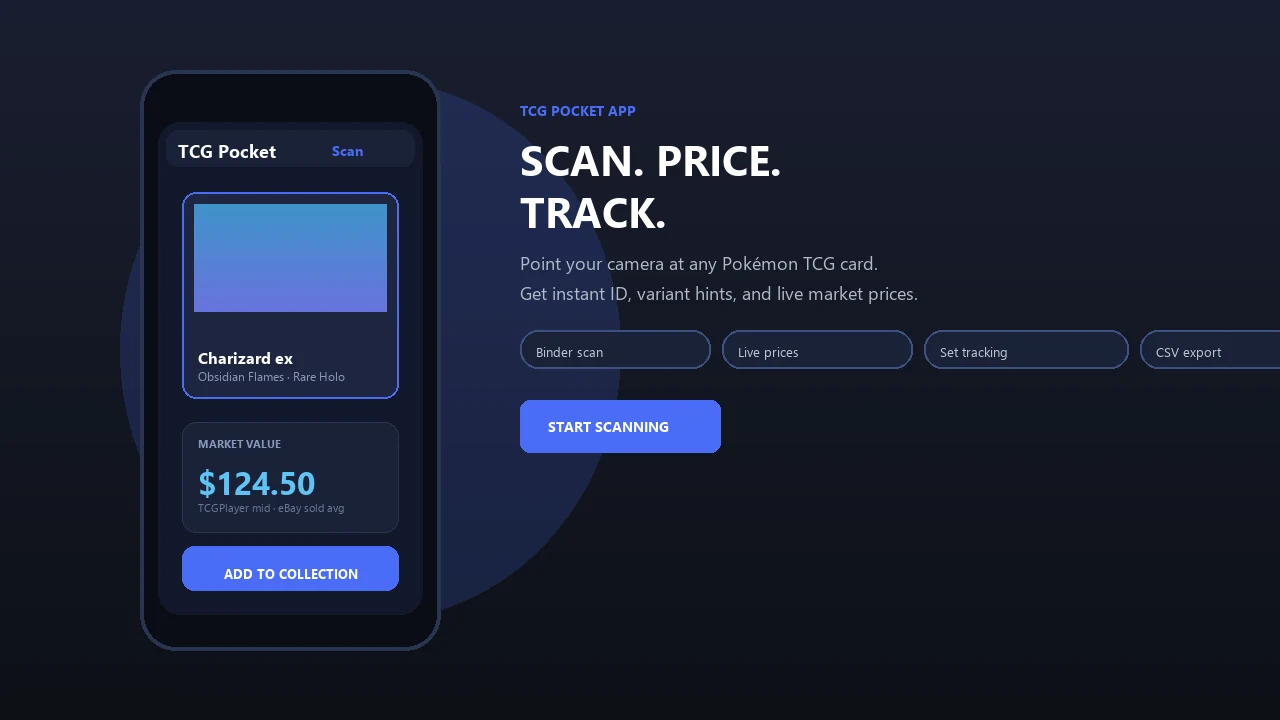
Pokemon Card Scanner favors quick identification and value checks for physical Pokémon cards, while Collectr offers deeper portfolio tools across cards, grades, sealed products, and multiple TCGs. Here is how their scanning and tracking workflows compare.
Pokemon Card Scanner runs on iOS and web. Get pokemon card scanner vs collectr when you are ready to scan.
Pokemon Card Scanner vs Collectr at a glance
Pokemon Card Scanner is a Pokémon-focused tool for identifying physical trading cards and checking their values on iOS and the web. Its card-first approach suits collectors who want to move quickly from a card in hand to a likely match and relevant pricing information.
Collectr is positioned more broadly as a portfolio management platform. According to Collectr’s own product information, collectors can manage raw, graded, and sealed items, monitor market value, review gains or losses, and view price history in a format resembling an investment portfolio.
- Choose Pokemon Card Scanner for a focused scan, identify, and value-check workflow.
- Choose Collectr for deeper portfolio organization and performance tracking.
- Consider Collectr if your collection extends beyond Pokémon into other trading card games.
- Use either tool’s prices as a reference rather than a guaranteed selling price.
Which has better portfolio tracking?
Collectr has the advantage when portfolio tracking is the main requirement. Its product positioning covers raw cards, graded cards, and sealed products, giving collectors a way to organize several types of inventory in one portfolio. It also emphasizes current market values, gains and losses, and historical price movement.
That depth is useful for collectors with large inventories or a mix of Pokémon cards, booster boxes, graded slabs, and products from other TCGs. A dashboard can provide a broad estimate of how the collection has changed over time without requiring each item to be searched individually.
Pokemon Card Scanner is the more direct option when the immediate task is identifying a physical Pokémon card and checking its value. It is not positioned as a replacement for every advanced portfolio feature. Collectors who care more about fast lookups than investment-style reporting may prefer the simpler focus.
Scanning physical Pokémon cards
Both approaches reduce the need to type a complete card name, set, and collector number. Pokemon Card Scanner centers the experience on the physical card, making it suitable for sorting a recent purchase, checking binder cards, or identifying an unfamiliar printing from an iPhone.
Collectr also offers card scanning. Collectr says its scanner can identify a card’s set, number, and variant, then let the user add quantity and condition before placing the card in a portfolio. The company describes this as a three-tap addition process when the automatic match is correct.
The practical difference is what happens after identification. A Pokémon-focused scanner keeps attention on finding and valuing the card, while Collectr directs the result into a broader portfolio dashboard. Whichever tool you use, verify the set symbol, collector number, language, finish, and variant before accepting a match.
iOS experience and everyday workflow
For iPhone collectors, the better user experience depends on the job being done. Pokemon Card Scanner is designed around a short scan, identify, and check-value flow. This can be useful at a card show, local shop, trade night, or sorting table when the collector needs information about one physical Pokémon card at a time.
Collectr’s workflow is more portfolio-oriented. Scanning is an entry point, but the broader purpose is to add items, assign details such as quantity or condition, and monitor the resulting collection. That additional structure is valuable for record keeping, though it may be more than a collector needs for a quick lookup.
Pokemon Card Scanner is available for iOS and the web, allowing users to choose an iPhone camera workflow or browser-based access. This site concerns physical Pokémon trading cards and is separate from the official Pokémon TCG Pocket digital game.
Raw, graded, and sealed collection support
Collectr is the stronger fit if one dashboard must cover several product types. Its published feature descriptions specifically include raw, graded, and sealed cards. That matters when a collection includes individual cards alongside professionally graded slabs, booster boxes, elite trainer boxes, or other unopened products.
For graded Pokémon cards, the grading company and numerical grade are essential parts of the item. PSA, CGC, and BGS copies of the same card can trade differently, and prices can vary significantly by grade. A raw-card price should not be treated as the value of a graded copy.
Pokemon Card Scanner is better framed as a card identification and value-checking tool than as a complete sealed-product portfolio manager. If most of your collection consists of raw Pokémon singles, that focused workflow may be sufficient. If you track sealed inventory, slabs, and multiple TCGs, Collectr’s broader data model is likely more practical.
How to compare card value estimates
No scanner or portfolio tracker can guarantee the amount a card will sell for. Values depend on condition, exact printing, language, rarity, finish, demand, and recent transactions. A near-mint estimate may be misleading if the physical card has whitening, scratches, dents, creases, or surface damage.
Marketplace context also matters. TCGplayer can be useful for marketplace-linked pricing and for collectors actively buying or selling there. eBay sold listings can provide evidence of completed sales, especially for uncommon variants or graded cards. Cardmarket is relevant when evaluating European market pricing.
- Confirm the card’s set and collector number.
- Check whether it is regular, reverse holo, holo, promotional, or another variant.
- Assess condition conservatively under good lighting.
- Compare several recent sales instead of relying on one listing.
- Account for fees, shipping, region, and currency before estimating net value.
Collectr is better for monitoring estimated portfolio movement, while Pokemon Card Scanner is suited to quick card-level checks. Careful verification remains necessary with both.