What App Identifies Japanese Pokémon Cards From Photos?
The best app for identifying Japanese Pokémon cards scans a photo, matches the card image to Pokémon TCG data, and lets collectors save the confirmed result in a digital binder. The key is choosing a Japanese Pokémon card scanner that can recognize artwork and set details, while understanding that Japanese-market prices may still need manual verification.
Definition: A Japanese Pokémon card scanner is a Pokémon card scanner app that identifies cards from photos, checks market-price context, and tracks collections for Pokémon TCG collectors.
TL;DR
- A good Japanese Pokémon card scanner should identify the card from artwork, layout, set marks, and variant clues rather than relying only on readable English text.
- Identification and pricing are different jobs: many apps can recognize a Japanese card, but live prices may come from English-focused marketplaces.
- For rare Japanese promos, older releases, or high-value cards, scan first and then verify the exact print and regional price manually.
Japanese Pokémon Card Scanner Answer in One Minute
Scanner apps can often identify Japanese Pokémon cards from photos by matching the card’s visual features, not by translating every character on the card. A strong Japanese Pokémon card scanner looks at artwork, frame layout, symbols, and collector-number clues before showing a likely match.
Photo-scanner apps are useful for quick scanning, market checks, and collection tracking when you’re sorting a mixed stack and can’t read the Japanese name. Still, the price shown may not equal the true Japanese-market value.
Check the print before trusting the price.
For collectors, photo identification is often faster than manual search because the app can compare the card image against known templates while you confirm the set number and variant.
Before You Scan Japanese Pokémon Cards
Prepare the card and the scene before opening the scanner. A cleaner photo gives the app better edges, fewer false reflections, and more useful set clues.
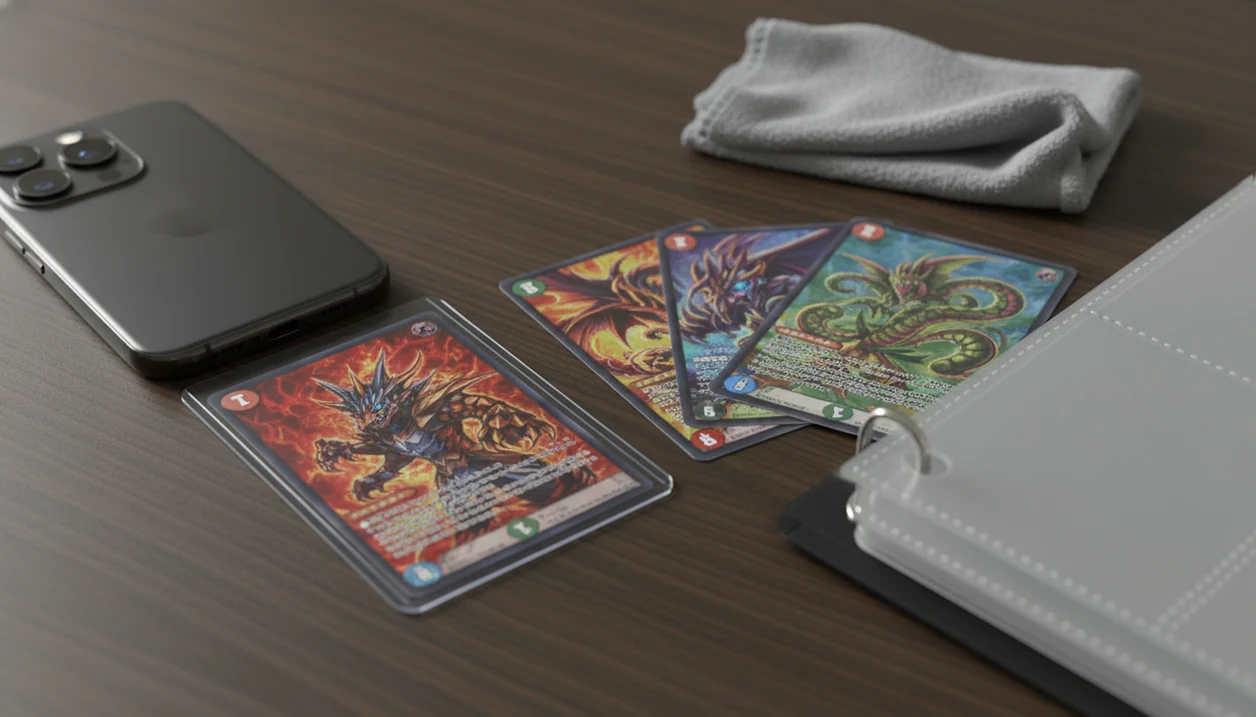
- Remove the card from a binder page if it is safe to handle, especially when plastic glare is covering the artwork, set mark, or lower edge. Keep the card sleeved if the surface is delicate or the value is uncertain.
- Inspect the sleeve, foil surface, corners, and card body for scratches, bends, dust, or strong holo reflections that could confuse the camera.
- Find the details you will need after the scan: set mark, collector number, rarity symbol, and any promo stamp. These small marks often separate a normal set card from a Japanese promo or reprint.
- Place the card on a plain background under even light, with the full border visible so the app can detect the card shape cleanly.
- Decide what the scan is for before you trust the result. Quick binder sorting is different from price research, authentication, or grading prep.
Foreign Pokémon Card Identifier Requirements for Japanese Prints
A foreign Pokémon card identifier should recognize card art, borders, layout, energy symbols, rarity marks, set symbols, collector numbers, and regional print differences before a collector trusts the result.
Getting the card name right is only the first step. Japanese cards may share artwork with English cards, but belong to different sets, promo releases, or timelines. The lower-left collector number and set mark matter more than the translated name in many cases. For manual confirmation, compare the scan against the official Japanese Pokémon Card Game card search database, which indexes Japanese cards by name, expansion, rarity, type, and other filters: https://www.pokemon-card.com/card-search/. If you need a refresher, the process is similar to learning how to identify pokemon card set number.
The risky case is familiar: a scan confuses two similar Pikachu prints until the collector checks the set symbol. That is not a small error if one version is a common set card and the other is a Japanese promo.
Japanese Pokémon Card Scanner Image Recognition Workflow
Japanese Pokémon card scanner apps work by capturing the card image, cropping the card area, extracting visual features, matching those features against a database, scoring confidence, and displaying the closest result. In plain terms, the app compares what the camera sees with known card images.
That workflow can match artwork and templates even when the user cannot read Japanese text. Image embeddings, which are compact visual fingerprints, help the system compare borders, art boxes, energy symbols, and layout patterns.
The plastic crinkle of a binder page is real when you scan without removing a sleeved card. It can still work, but glare may lower confidence.
Price lookup is a separate data layer connected to marketplace feeds, not the same thing as visual recognition.
How to Use a Japanese Pokémon Card Scanner
Use the scan result as a starting point, then confirm the Japanese print before logging value or making a trade. Ring-light glare bouncing off a reverse holo through a nine-pocket binder page can turn a clean scan into a wrong variant match.
- Set the card on a flat surface with even light, away from window glare or harsh reflections.
- Scan the full card from above, keeping the edges, set mark, and collector number visible.
- Review the suggested match, then check the artwork, rarity mark, and lower-left number against the card.
- Compare the result with variant clues, especially foil type, promo stamp, and regional release details.
- Save the confirmed card to your collection only after the set and print look correct.
- Verify rare Japanese promos or expensive cards manually before buying, selling, or grading.
Good ai-powered pokémon tcg card scanner, live market prices, and pocket-sized collection management app features deliver faster sorting and better records, not automatic authentication or guaranteed valuation.
Japanese Pokémon Card Scanner Feature Checklist
The best choice is not just the app that scans fastest, but the one that lets collectors verify regional details after the scan. Speed helps at a card show table, but the set match decides whether the result is usable.
| Feature | Why it matters for Japanese cards |
|---|---|
| Photo scanning | Identifies cards visually when the name is unreadable to the collector. |
| Japanese set support | Reduces mismatches between Japanese prints and English equivalents. |
| Variant detection | Helps separate holo, reverse holo, promo, reprint, and alternate versions. |
| Live price sources | Shows market context, but may lean toward English-language marketplaces. |
| Collection tracking | Saves confirmed cards into a digital binder for set completion and duplicates. |
| Manual correction | Lets collectors fix wrong matches instead of accepting the first result. |
Variant checks get easier when you already understand pokemon card rarity symbols and common foil differences.
Five Facts About Japanese Pokémon Card Prices in Scanner Apps
Identification accuracy and price accuracy are separate. A scanner may name the card correctly while showing a value that fits a different region or print.
- Fact 1: Identification can work even when pricing is incomplete, because visual matching does not require a live sales feed.
- Fact 2: Many pricing feeds are based on English-language markets, including North American or European sources.
- Fact 3: Japanese-exclusive sets, promos, and release timelines can create mismatches with English releases.
- Fact 4: For Japanese-market value, collectors often check Japanese shops or auction results after scanning.
- Fact 5: Live market prices should be treated as a starting point, not a final appraisal.
Mobile collection tools sit inside a large app economy. For context only, Statista estimates global app-store consumer spending reached about $171 billion in 2023 (https://www.statista.com/statistics/269025/worldwide-mobile-app-revenue-forecast/); that mobile-app scale does not prove a scanner’s Japanese-card price accuracy. For price-source caveats, our are pokemon card scanner prices accurate guide goes deeper.
Foreign Pokémon Card Identifier App Myths
Misreading scanner results usually starts with expecting the app to do more than it claims. A foreign Pokémon card identifier can be useful and still require collector judgment.
- Myth: every Pokémon card scanner fully supports Japanese cards. Some apps recognize the artwork but have thin Japanese set metadata.
- Myth: if the name is correct, the Japanese print price is correct. The shown price may reflect an English copy, not the regional Japanese card.
- Myth: AI alone can always separate similar promos, reprints, and variants. Similar artwork can still fool a scan without a set number check.
- Myth: scanner apps automatically translate all rules text perfectly. Many show identity details, not full rules-accurate translation.
At a show, a binder flipped open on a glass case leaves little time for research. Scan quickly, but verify carefully. For variant-heavy cards, pokemon card variant detection is the habit that prevents expensive assumptions.
Limitations
Scanner apps are useful, but Japanese cards expose the weak spots faster than standard English set cards. Treat the app result as a starting point, not the final word.
- Low light can reduce edge detection and make the crop less reliable.
- Glare from foil, reverse holo surfaces, sleeves, or binder pages can distort the image.
- Worn surfaces, scratches, and bowed cards may hide details needed for a confident match.
- Japanese-only promos and older regional releases may be missing or hard to price.
- Similar artwork across reprints can cause wrong set matches.
- English-market prices may not represent Japanese-market value.
- Scanner results are not authentication, grading, or professional appraisal.
- Region-locked availability and differing legality information may not be fully represented.
- Full text translation may be partial, simplified, or absent.
Near-mint in a top loader looks simple until the graded label under a bright lamp changes the comparison. Raw versus graded pricing needs separate research.
FAQ
Can apps scan Japanese Pokémon cards?
Yes, many scanner apps can identify Japanese Pokémon cards visually by matching artwork, layout, and set details. Support quality depends on the app’s database.
Which app scans Japanese Pokémon cards?
Use a Pokémon card scanner with Japanese set recognition, photo matching, manual correction, and collection tracking. Collectors often compare TCGplayer tools, Collectr, PriceCharting, Dragon Shield, and dedicated card-scanner apps before trusting Japanese set and price coverage.
Do scanners translate Japanese card text?
Most scanners identify the card and may show English details. They do not always provide full rules-accurate translation for every Japanese card.
Are Japanese Pokémon card prices in scanner apps accurate?
They can be useful estimates, but accuracy depends on the marketplace data source. A price based on English-market sales may not reflect the exact Japanese print.
Can TCGplayer identify Japanese Pokémon cards?
Some TCGplayer-related tools and other scanners can recognize cards, but collectors should check whether Japanese prints and prices are fully supported. Identification and regional pricing are separate issues.
Why is my Japanese Pokémon card scanner showing the wrong card?
Common causes include similar artwork, glare, missing Japanese metadata, regional release differences, or wrong set matching. Check the set symbol and collector number before saving the result.
How do I price Japanese Pokémon cards after scanning them?
Scan first for identification, then compare Japanese-specific marketplaces, shops, or recent sold listings. The green sold-price filter on eBay is more useful than active asking prices.
Can scanners identify Japanese Pokémon promo cards?
Some Japanese promo cards can be identified by photo. Rare, older, or region-exclusive promos still need manual confirmation before valuation, grading, or sale.
Get started with What App Identifies Japanese Pokemon Cards on iOS.