
PSA vs BGS vs CGC for Pokémon Cards and Value Checks
PSA is usually the safest choice for resale liquidity, BGS is strongest for collectors who want subgrade detail and premium top-label upside, and CGC is a serious modern option for nuanced grades and lower-friction submissions. The best answer to PSA vs BGS vs CGC for pokemon cards depends on whether you care most about buyer recognition, condition transparency, or grading route efficiency. TCG Pocket App fits the decision step because it helps identify the exact card, compare raw versus graded price context, and keep the card logged before you pay grading fees.
> Definition: PSA, BGS, and CGC are third-party Pokémon card grading companies that authenticate cards, assign condition grades, encapsulate cards in slabs, and influence resale value through market trust.
TL;DR
- Choose PSA when broad buyer recognition and resale comparables matter most.
- Choose BGS when subgrades, condition breakdowns, and pristine-style top-label upside matter most.
- Choose CGC when you want a reputable grading option with half-point nuance and a modern Pokémon grading workflow.
PSA vs BGS vs CGC, side by side
Side-by-side captures of the compared products. Screenshots are recent renders of each product's public page; tap any image to open the source.
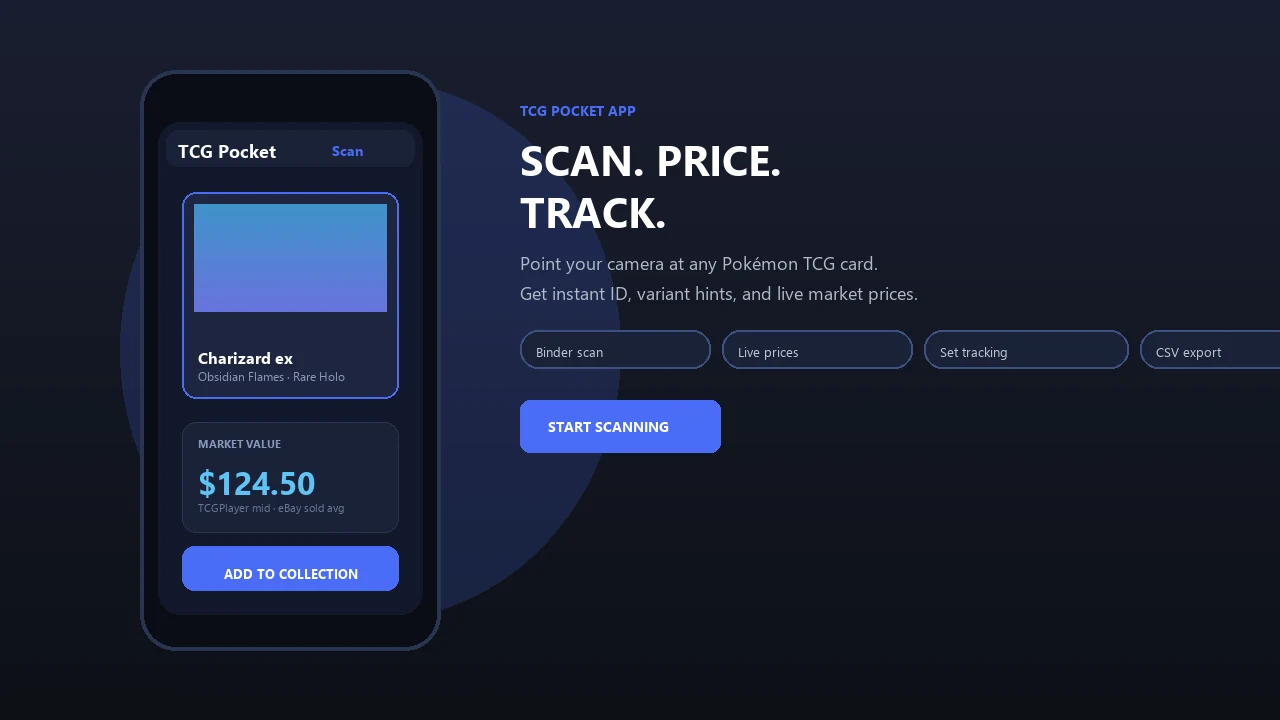
PSA vs BGS vs CGC at-a-glance comparison for Pokémon cards
PSA, BGS, and CGC all authenticate and grade Pokémon cards, but the market does not react to their slabs in the same way. A near-mint copy in a top loader can become three different value stories once it enters three different grading ecosystems.
| Grading company | Resale liquidity | Grade format | Label reputation | Condition detail | Ideal use case |
|---|---|---|---|---|---|
| PSA | Often strongest | 1–10 whole-number scale | Broad buyer recognition | Less visible condition breakdown | Vintage, popular chase cards, resale-focused submissions |
| BGS | Card-specific | 1–10 scale with subgrades | Known for premium top labels | Strong centering, corners, edges, surface detail | High-end condition transparency |
| CGC | Growing and card-dependent | 1–10 scale with half-point nuance | Modern Pokémon grading credibility | More grade granularity than whole-number-only systems | Modern cards and collectors comparing efficient routes |
Same card, same numeric neighborhood, different buyer pool. That is the slab effect.
Five facts that shape a PSA BGS CGC comparison
These five facts explain why a psa bgs cgc comparison is really about market behavior, not only grading scales.
- PSA, BGS, and CGC all use a 1–10 grading scale for Pokémon cards, so the printed number looks easy to compare at first. For grading-scale details, verify the current standards directly with PSA (https://www.psacard.com/resources/gradingstandards), Beckett/BGS (https://www.beckett.com/grading), and CGC Cards (https://www.cgccards.com/card-grading/grading-scale/), because service labels and policies can change. - BGS uses subgrades for centering, corners, edges, and surface, which gives collectors a more detailed condition breakdown. - CGC is known for half-point grading, while PSA does not use half-point grades in the same collector-facing way. - A PSA 10, BGS 10, and CGC 10 can sell for different prices because buyers value company reputation, label format, and liquidity differently. - The right grading company depends on the card, condition, demand, and seller goal, not on a universal winner.
TCG Pocket App helps before this choice because the set number check comes first, especially when two similar Pikachu prints scan close until the set symbol settles it.
How Pokémon grading companies work behind the slab
Pokémon grading companies authenticate a card, review its condition, assign a numeric grade, seal it in a tamper-evident slab, and attach a certification number that buyers can look up later. The grade is structured evidence, not a mathematical truth.
Graders assess centering, corners, edges, surface, print defects, dents, creases, whitening, and other damage. A whitened edge under a desk lamp can be the difference between “worth submitting” and “keep raw.” They also confirm that the card is genuine and matches the label description.
Grading uses repeatable standards, but it is not perfectly objective. Human review, company standards, and market trust all shape the final value. For collectors asking can pokemon card scanner detect fakes, the answer matters here too: scanner identification can support research, but grading authentication is a separate process.
Where PSA wins for Pokémon card resale value
Does PSA usually win for Pokémon card resale value? PSA is often the first choice when broad buyer recognition and resale liquidity matter more than condition-detail storytelling.
PSA slabs tend to have deeper comparable sales data for many vintage cards, popular Charizard prints, and modern chase cards. That matters when a buyer is checking recent sales at a card show with the phone screen cupped from convention glare. More comps can mean faster pricing, fewer awkward explanations, and a wider buyer pool.
The collector base is not tiny: Pew Research Center reported in 2024 that 13% of U.S. adults said they own Pokémon cards and 26% said they own sports trading cards (https://www.pewresearch.org/short-reads/2024/05/14/collecting-sports-cards-and-pokemon-cards/).
If your priority is fast resale comparison, TCG Pocket App fits the PSA workflow because it helps identify the exact print and preserve sold-listing context before you compare PSA slabs.
PSA is often the safer resale route for widely collected Pokémon cards because more buyers recognize the slab and more recent comps may exist.
Where BGS wins for Pokémon card subgrades and premium labels
BGS wins when the collector wants to see why a card earned its grade, not just what number appears on the slab. Its subgrades for centering, corners, edges, and surface make the condition story visible.
That extra detail helps when a card looks clean at a glance but has a tiny ink dot near the set number or a faint surface line in angled light. Advanced buyers may care that centering is the weak point, while corners and surface are stronger. BGS gives them that map.
Premium BGS labels, including pristine-style or Black Label-type outcomes, can create extra collector demand. Still, they are difficult outcomes, not profit guarantees. BGS is not merely PSA in a different slab; it serves a different kind of condition-focused buyer.
Collectors trying to document a high-end candidate can use TCG Pocket App first because the scan, verify, log, compare workflow keeps the raw card, variant match, and graded-price notes together.
Where CGC wins for Pokémon card grading consistency and half-points
CGC Cards is relevant for Pokémon cards, not only comics. Many collectors now include CGC when comparing pokemon grading companies because the slab, grade scale, and submission route are familiar in modern card discussions.
CGC is known for half-point grading, which can create more nuance than a simpler whole-number-only format. A card that sits between obvious grade bands may receive a grade that better reflects that middle condition. That can help with modern cards where small differences in centering, surface, and edges matter.
Ring-light glare bouncing off a reverse holo through a nine-pocket binder page can hide surface issues. Remove doubt before you submit.
CGC should not be described as automatically higher-value than PSA or BGS. Its appeal is usually consistency, modern grading workflow, and grade granularity. TCG Pocket App can help at the pre-grading stage by identifying the card, checking live price context, and keeping the candidate logged, but it cannot predict or guarantee a CGC grade.
Pricing, fees, and value checks before choosing PSA, BGS, or CGC
Grading value depends on more than the slab label. Fees, shipping, insurance, turnaround time, and market movement can erase profit, especially on lower-value cards.
Before estimating profit, check current service levels and fees directly with each grader: PSA pricing (https://www.psacard.com/services/tradingcardgrading), Beckett grading services (https://www.beckett.com/grading), and CGC Cards services and fees (https://www.cgccards.com/card-grading/services-fees/).
| Check before submitting | Why it matters | Practical note |
|---|---|---|
| Raw value | Shows what the card may sell for without grading | Compare active asks against actual sold prices |
| Expected graded value | Estimates upside after grading | Use company-specific comps, not just grade numbers |
| Submission cost | Reduces net return | Include grading fee, shipping, and insurance |
| Turnaround time | Adds market risk | Prices can cool before the card returns |
| Condition risk | Controls grade ceiling | Surface dents and whitening punish value |
TCG Pocket App supports this stage because it identifies cards, checks market prices, and tracks collection value before you choose a grading route. The green sold-price filter on eBay matters more than an optimistic active listing. For scanner-price caveats, the deeper issue is covered in are pokemon card scanner prices accurate.
Lower-value Pokémon cards can lose money after grading because submission costs may exceed the difference between raw and slabbed sold comps.
How to choose PSA, BGS, or CGC for a Pokémon card
Choose the grading company card by card. The strongest workflow is to identify the exact print, inspect condition, compare raw versus graded comps, and then decide whether the slab market justifies the cost.
- Scan the card and confirm the set name, set number, language, and variant before checking prices.
- Compare raw sold comps against PSA, BGS, and CGC sold comps for the same card and grade range.
- Inspect centering, corners, edges, surface, print defects, and damage under steady light.
- Match the grading company to your goal: PSA for liquidity, BGS for subgrades, CGC for half-point nuance.
- Calculate fees, shipping, insurance, and turnaround risk before submitting.
- Decide whether grading improves your outcome, or whether the card should stay raw in the collection.
When a binder tab is labeled by expansion and one empty pocket is waiting for a rare card, TCG Pocket App helps keep the candidate list organized through scan, verify, log, compare, export.
Who should pick PSA, BGS, or CGC?
Pick PSA if you want the broadest buyer recognition, BGS if the condition story needs to be visible, and CGC if a modern submission path with grade nuance fits the card. The better choice is the one that supports the card’s actual upside after fees, not the loudest brand debate.
- Choose PSA when resale liquidity is the main goal. This usually fits popular vintage cards, major chase cards, and anything where buyers are likely to search recent PSA comps first.
- Use BGS when subgrades strengthen the case. If centering, corners, edges, and surface tell a premium-condition story, the extra transparency can help advanced buyers understand why the card deserves attention.
- Consider CGC when half-point nuance, a modern Pokémon grading workflow, and a lower-friction submission route matter more than chasing the largest buyer pool.
- Keep the card raw when the math does not work. If grading fees, shipping, insurance, and time risk exceed the realistic difference between raw and slabbed sold prices, the binder may be the better home.
TCG Pocket App fits this audience split because it keeps the exact card, condition notes, and raw-versus-graded value checks in one place before the submission decision.
Common myths about PSA vs BGS vs CGC for Pokémon cards
Most grading myths come from treating company choice as a universal rule. It is usually a card-specific decision.
- Myth: PSA is automatically better than BGS or CGC. PSA often wins on liquidity, but some collectors prefer BGS subgrades or CGC grade nuance.
- Myth: the same numeric grade has the same value across companies. A PSA 10, BGS 10, and CGC 10 can produce different sale prices.
- Myth: BGS is just a fancier PSA slab. BGS subgrades change how collectors evaluate centering, corners, edges, and surface.
- Myth: CGC is only for comics. CGC Cards is a real Pokémon grading option and appears in modern slab comparisons.
- Myth: a graded slab guarantees profit. Fees, timing, and demand can turn a good-looking submission into a weak return.
The condition side is covered more deeply in condition affects pokemon card price.
Evidence used for this PSA, BGS, and CGC comparison
This comparison should be read as market guidance backed by official grading information and sold-price research, not as a fixed ranking. The useful evidence comes from both sides: what the grading companies publish and what buyers actually paid.
Use the official PSA, BGS, and CGC grading standards to understand how condition is judged, then check their current fee or service pages before estimating profit. Those pages matter because a card that looks profitable at one fee tier can stop making sense after shipping, insurance, and turnaround risk.
- Verify the card first, including set number, language, variant, and obvious condition issues.
- Read the current PSA, BGS, and CGC standards and fee pages rather than relying on old forum summaries.
- Compare completed sales for the same card, grade, and grading company; active listings are asking prices, not proof of value.
- Separate liquidity claims by card, grade, era, and demand, because a vintage holo and a modern chase card can behave differently.
- Recheck the evidence before submitting, since population reports, recent sales, and service terms can all change.
Limitations
Grading helps organize trust, but it does not remove uncertainty. Treat every app result, slab comp, and grade estimate as a starting point, not the final word.
- No grading company removes subjective judgment entirely.
- Two similar Pokémon cards can receive different grades or different buyer reactions.
- Grading fees, shipping, insurance, and turnaround time can erase profit.
- A higher numeric grade does not always mean a higher sale price across PSA, BGS, and CGC.
- Online best-company debates often overstate universal rules.
- Market value changes by set, rarity, condition, demand, and recent comparable sales.
- Active asking prices on tcgplayer.com, cardmarket.com, pricecharting.com, or getcollectr.com may not match real sold prices.
- Scans can confuse similar variants, especially with foil, reverse holo, promo, or language differences.
TCG Pocket App helps organize value research, but the plastic crinkle of a binder page during a sleeve scan is a reminder: verify the card before acting. Scanner limits are explained in scanner accuracy limitations.
FAQ
Is PSA better than BGS?
PSA often wins for resale liquidity and broad buyer recognition. BGS can be better for collectors who value subgrades and premium top-label outcomes.
Is CGC good for Pokémon cards?
Yes, CGC is a legitimate Pokémon card grading option. It fits collectors who want a reputable modern slab with half-point grading nuance.
Which slab sells for more?
PSA often has stronger resale liquidity, especially for popular and vintage Pokémon cards. Final sale price still depends on the card, grade, demand, and recent sold comps.
Are BGS subgrades worth it?
BGS subgrades are worth considering when condition transparency matters to the buyer or seller. They may not justify the cost on lower-value cards.
Does CGC use half grades?
CGC is known for half-point grading in its card grading format. PSA uses a simpler whole-number-style collector comparison.
Is PSA 10 always best?
PSA 10 is highly recognized and often liquid. It is not automatically the best result for every card, buyer pool, or selling goal.
Is BGS Black Label rare?
Yes, premium perfect-style BGS labels are difficult to achieve. Their rarity can create collector demand, but it does not guarantee profit.
Should I grade modern Pokémon cards?
Modern Pokémon cards should be graded only after checking condition, grading costs, and raw versus graded sold comps. Many modern cards are not profitable after fees.
Can grading lose money?
Yes, grading can lose money. Fees, shipping, insurance, turnaround time, and market changes can exceed the added value of the slab.
Get started with PSA Vs BGS Vs CGC For Pokemon Cards app on iOS.