
How Condition Affects Pokémon Card Price Before Selling
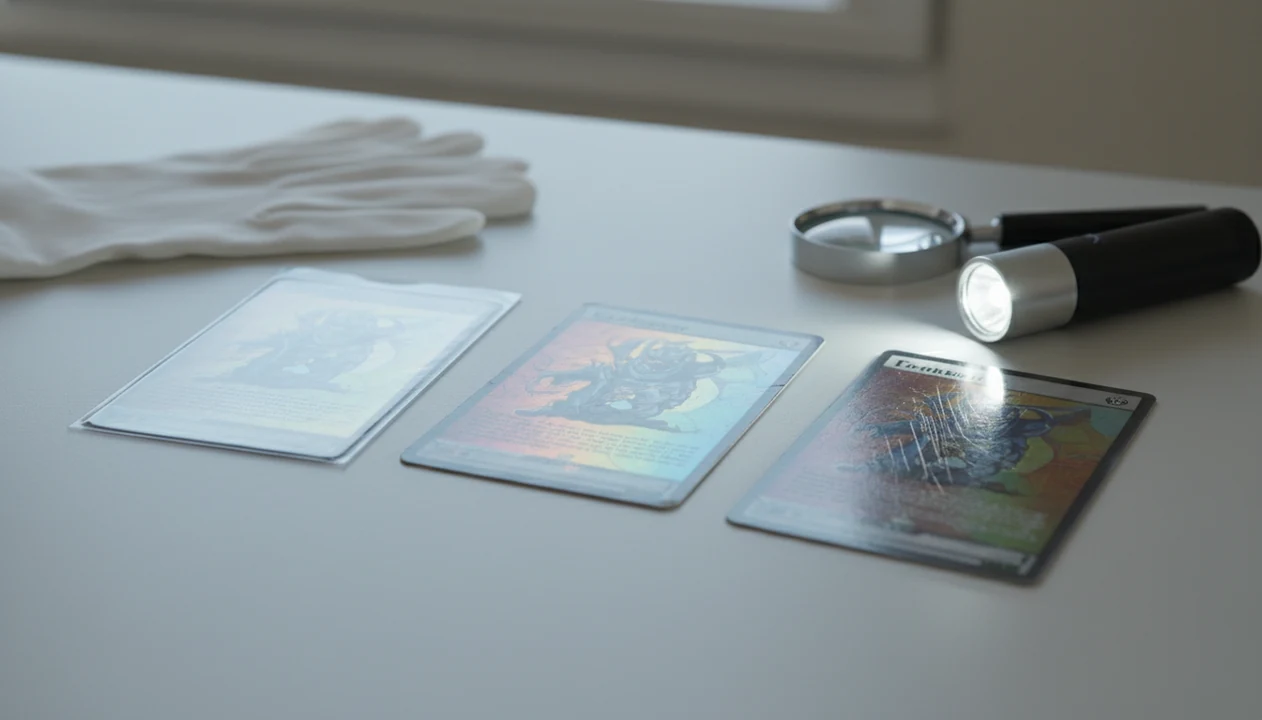
Condition affects pokemon card price because buyers pay more for clean surfaces, sharp corners, strong edges, good centering, and cards without dents, creases, or whitening. Before selling a raw card, inspect it under bright light, assign a conservative condition label, then compare live prices for similar cards in that condition.
TCG Pocket App is a pokemon card scanner app that identifies cards, checks market prices, and tracks collections for Pokémon TCG collectors.
- Near Mint, Lightly Played, Moderately Played, Heavily Played, and Damaged are the common raw card condition labels collectors use before pricing.
- Raw card value condition estimates should always be adjusted for visible flaws such as whitening, scratches, dents, creases, warping, and off-centering.
- Scanner apps can identify the card and show market data quickly, but human inspection is still needed for fine condition issues.
Pokémon Card Condition Guide for Raw Card Price Estimates
A Pokémon card condition guide is a shared language for pricing raw cards. Raw card prices are not meaningful unless the seller says whether the card is Near Mint, Lightly Played, Moderately Played, Heavily Played, or Damaged.
| Condition label | Typical flaw level | Pricing meaning |
|---|---|---|
| Near Mint | Tiny wear only | Clean, but not perfect |
| Lightly Played | Minor edge, corner, or surface wear | Usually below Near Mint |
| Moderately Played | Clear wear, scratches, whitening, or small bends | Discount expected |
| Heavily Played | Heavy wear, stronger whitening, surface issues | Buyer pool shrinks |
| Damaged | Creases, dents, water damage, peeling, writing | Deep condition discount |
Near Mint does not mean flawless. A pack-fresh card can still show factory whitening, off-centering, or a print line crossing a shiny border. Always check the lower-left set number before trusting any price match.
Small flaws travel with the card.
Five Facts About How Condition Affects Pokémon Card Price
- Condition is one of the top Pokémon card price drivers, along with rarity, demand, and authenticity; a large collector survey found card quality among the top purchase factors.
- Each step down from Near Mint usually lowers the realistic selling range, even when the card, set, language, and variant are identical.
- Condition premiums can be large in collectibles, but the exact multiplier varies by card, platform, photo quality, and demand; only quote a multiplier when the study URL is cited inline.
- Graded Gem Mint comparisons should be separated from raw-card pricing because grading certifies both condition and authenticity; cite PSA population data when discussing grade scarcity: https://www.psacard.com/pop.
- Top grades are uncommon for many cards, but population percentages should be checked card-by-card in the PSA Pop Report before claiming a rate: https://www.psacard.com/pop.
For raw Pokémon cards, condition is often easier to price after identity is locked because the comparison set becomes much narrower.
Evidence Behind Condition-Based Pokémon Card Pricing
Condition-based pricing is strongest when the evidence matches the exact decision being made: raw cards need raw condition comparisons, while graded premiums need slab-specific proof. The goal is not to find the highest number; it is to find the most defensible recent sale range.
- Start with marketplace condition language, such as Near Mint, Lightly Played, Moderately Played, Heavily Played, and Damaged, using a published guide like the TCGplayer card condition guide as the shared vocabulary.
- Compare raw copies only against raw copies with the same card, set, language, variant, and visible wear level.
- Use completed-sale data, especially eBay sold listings, because accepted buyer payments are better evidence than active asking prices that may never sell; eBay explains sold and completed filtering in its sold items help page.
- Separate graded-card premiums from raw-card value, since a PSA, BGS, or CGC slab adds authentication, grade confidence, and a different buyer pool.
- Reference PSA population reports only when making grade-scarcity claims, not when estimating an ungraded card’s everyday raw condition price.
How Raw Card Value Condition Checks Work
Raw card value condition checks work by identifying the exact card, inspecting the front and back, finding defects, assigning a condition label, then comparing similar-condition sales. The mechanism is simple: buyers discount uncertainty.
Inspection usually covers centering, corners, edges, surface, dents, creases, gloss, and whitening. Under a desk lamp, a reverse holo can look clean until ring-light glare bounces across it through a nine-pocket binder page. That is when hairline scratches and gloss loss show up.
A good ai-powered pokémon tcg card scanner, live market prices, and pocket-sized collection management app can deliver faster identification and price context, not a final human condition judgment.
Online marketplaces tend to reward clear images and explicit condition descriptions. A weak photo set makes buyers assume hidden wear, especially on expensive chase cards. If you want the deeper scanner side, the limits are covered in scanner accuracy limitations.
Before Pricing a Pokémon Card Condition Estimate
Before pricing a Pokémon card, set up the inspection so the condition estimate is not guesswork. Separate card identification from condition judgment; one answers “what card is this,” and the other answers “how clean is this copy.”
- Bright indirect light: Use daylight near a window or a steady lamp, not harsh glare that hides scratches.
- Clean surface: Lay the card on a dust-free mat, away from food, tape, and rough tables.
- Safe sleeve handling: Remove the penny sleeve only if it slides out easily; never force a snug sleeve.
- Front and back check: Turn the card once, slowly, and inspect edges, corners, surface, and centering.
- No aggressive fixes: Do not rub holo surfaces, flatten bends, or try to clean the card.
Scan the card first with a scanner app to confirm the set, language, number, and variant. A scanner app can help identify the card and show market references quickly, but your eyes still decide the condition caveat.
How to Use Condition to Price Raw Pokémon Cards
Use condition to price raw Pokémon cards by narrowing the match first, then lowering or raising the estimate based on visible flaws. The safer workflow is scan, verify, log, compare, then describe.
- Scan or identify the exact card, set, card number, language, and variant before checking prices.
- Inspect centering, corners, edges, surface, dents, creases, gloss, and whitening on the front and back.
- Assign a conservative condition label, especially if the card has dents, creases, or heavy whitening.
- Compare live prices or recent sold listings for the same card in the same condition range.
- Photograph and describe the flaws before listing, trading, or valuing the card in a collection tracker.
For most sellers, recent sold listings are more useful than active asking prices because they show what buyers actually accepted. The green sold-price filter on eBay tells a different story than a hopeful active listing at checkout.
Condition Flaws That Lower Pokémon Card Price Fastest
Structural damage lowers Pokémon card price faster than light cosmetic wear. Dents and creases can move a card into Damaged even when the front image still looks bright in a binder scan.
| Flaw type | Typical buyer reaction | Why it matters |
|---|---|---|
| Creases | Major discount | Permanent structural damage |
| Dents | Major discount | Often visible under angled light |
| Bends or warping | Moderate to major discount | Raises storage and grading concerns |
| Heavy whitening | Clear discount | Easy to see on card backs |
| Peeling or water damage | Severe discount | Signals instability |
| Scratches or print lines | Depends on visibility | More serious on holos |
Surface, Dents, and Creases
Surface scratches, dents, creases, gloss loss, and peeling matter because they break buyer confidence. A double-sleeved card behind a glossy page can hide a dent until you tilt it.
Edges, Corners, and Whitening
Edges, corners, and whitening are fast condition signals. High-value chase cards are more sensitive to tiny defects than bulk cards because buyers may be thinking about grading later.
Common Pokémon Card Condition Pricing Mistakes
“Does condition really matter if the Pokémon card is rare or old?” Yes. Rare and old cards still lose value when they have creases, dents, heavy whitening, or surface damage.
The most common mistake is calling every clean-looking card Near Mint. That creates disputes when the buyer finds back-edge whitening, holo scratches, or a small indentation. A card show case full of slabs can also distort expectations; graded card prices should not be used for worn raw copies without adjusting for raw versus graded condition.
Grading companies do not repair, clean, flatten, or improve a card. They evaluate the card as submitted. If you are comparing grading paths, the PSA vs BGS vs CGC for pokemon cards debate matters only after the card is honestly inspected.
AI scanner apps also have limits. They cannot reliably judge micro-scratches, gloss loss, pressure marks, or subtle indentations, which is why collectors still ask can AI grade pokemon cards.
How to Verify a Pokémon Card Price Before Selling
Verify a Pokémon card price by comparing same-card, same-set, same-language, same-variant, and similar-condition examples. If one Charizard is Japanese, one is English, and one is reverse holo, those are not clean comparisons.
Recent sold listings are usually better than active asking prices because they show completed buyer behavior. Still, sold-listing context needs careful reading. Check whether the card was raw versus graded, whether shipping was included, and whether photos actually showed the back.
For cross-checking raw prices, compare eBay sold listings, TCGplayer condition-based listings, and PriceCharting raw-versus-graded summaries; do not mix raw sale prices with PSA, BGS, or CGC slab prices.
Clear photos and explicit descriptions can increase sale probability because buyers do not have to guess. Include angled surface shots, back corners, and close-ups of whitening. Conservative condition labeling also reduces return risk.
Scanner software can speed up card identification, market-price checks, and collection tracking without claiming final condition grading. For broader price reliability, the question are pokemon card scanner prices accurate depends on the source, variant match, and condition assumption.
Limitations
Condition estimates are useful, but they are not guaranteed sale prices. Treat the app result as a starting point, not the final word.
- Condition terms vary by seller, buyer, platform, region, and marketplace policy.
- AI card scanner apps cannot reliably detect every fine defect, including faint dents and micro-scratches.
- Raw prices may be distorted by graded sales, Near Mint assumptions, or listings with poor photos.
- Pokémon card markets can move quickly because of hype, reprints, trends, influencer attention, and demand shifts.
- Beginners can mis-grade cards even when using a solid pokemon card condition guide.
- Photos, buyer trust, authenticity concerns, shipping cost, and timing can change the final sale price.
- A card may be accurately described and still sell lower than expected if similar copies flood the market.
- Scanner apps can confuse similar prints, such as two Pikachu variants, until the collector verifies the set symbol.
A conservative condition label usually works better than an optimistic one because it reduces disputes after delivery.
FAQ
How much does condition affect Pokémon card price?
Condition can change Pokémon card value by multiples, especially for rare, older, or high-demand cards. Near Mint copies usually sell above Lightly Played, Moderately Played, Heavily Played, and Damaged copies of the same card.
What is Near Mint condition for a Pokémon card?
Near Mint means the card is very clean with only minimal flaws. It does not mean perfect, and pack-fresh cards can still have factory whitening, print lines, or off-centering.
Is a Lightly Played Pokémon card still valuable?
Yes, a Lightly Played Pokémon card can still be valuable if the card is rare, popular, or hard to find. It usually sells below a comparable Near Mint copy.
What makes a Pokémon card Damaged?
A Pokémon card is usually considered Damaged when it has creases, dents, water damage, peeling, writing, heavy bends, or severe wear. Some dents or creases can place a card in Damaged condition even if the artwork looks clean.
Do scratches lower Pokémon card value?
Yes, scratches can lower value, especially on holo, reverse holo, and high-value cards. The effect depends on scratch depth, visibility, rarity, and buyer expectations.
Does centering affect raw Pokémon cards?
Yes, centering can affect raw Pokémon card price, especially when buyers may grade the card later. Severe off-centering usually lowers buyer confidence.
Can pack-fresh Pokémon cards be flawed?
Yes, pack-fresh Pokémon cards can have factory whitening, print lines, off-centering, roller marks, or edge damage. Fresh from a pack is not the same as gem mint.
Should I grade worn Pokémon cards?
Grading worn Pokémon cards may make sense for very valuable, authentic, or historically important cards. For most lower-value worn cards, grading fees can exceed the condition-adjusted price gain.
Can apps judge Pokémon card condition?
Scanner apps can identify cards and show price references, but fine condition inspection still needs human review. Subtle dents, gloss loss, and micro-scratches are especially hard to judge from a basic scan.