Pokémon TCG Pocket is an official digital collecting and battling game. Pokemon Card Scanner is a tool for identifying, pricing, and organizing physical Pokémon cards. Here is how to choose the right option for what you want to do.
Pokemon Card Scanner runs on iOS and web. Get pokemon tcg pocket vs pokemon card scanner when you are ready to scan.
The difference between Pokémon TCG Pocket and a card scanner
The simplest answer is that Pokémon TCG Pocket is a digital game, while Pokemon Card Scanner is a collector tool for physical trading cards. Cards obtained in Pokémon TCG Pocket exist inside the game and are used for digital collecting and battles. They are not physical cards that can be scanned, graded, traded at a card shop, or sold through a physical-card marketplace.
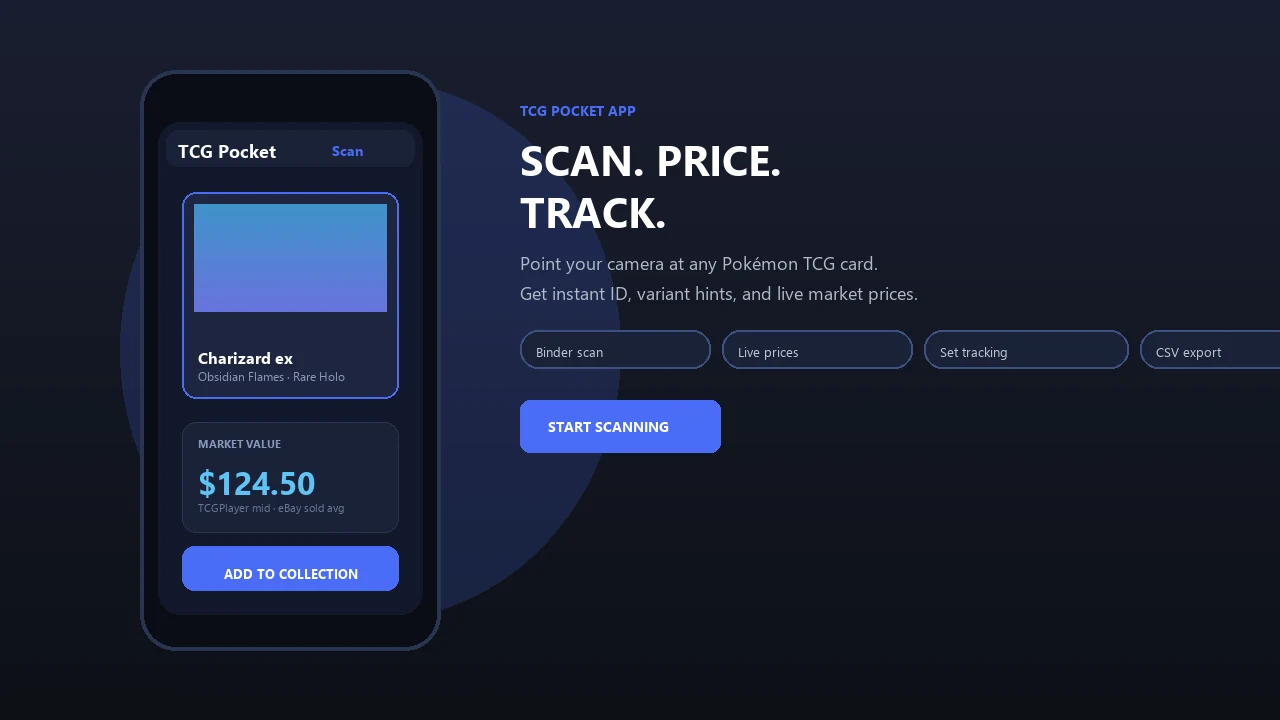
Pokemon Card Scanner uses an image of a real card to help identify its set, card number, rarity, and possible variant. It can then provide market information that supports collecting, trading, selling, and inventory decisions. The scanner is available through iOS and the web, so collectors can check cards from a phone or browser.
If you are comparing pokemon tcg pocket vs pokemon card scanner, first decide whether your collection is digital or physical. That distinction usually answers the question immediately.
What Pokémon TCG Pocket is designed for
Pokémon TCG Pocket is an official Pokémon digital card game centered on opening digital booster packs, building an in-app collection, and playing streamlined battles. It is a good fit when your goal is entertainment, digital collecting, or learning the mechanics available within that specific game.
The artwork and pack-opening experience may resemble physical Pokémon card collecting, but the collections are separate. Owning a digital card in Pokémon TCG Pocket does not mean you own the equivalent printed card. Digital pull rates, card availability, trading features, and game rules also belong to the app rather than the physical resale market.
- Choose it for digital pack opening and collecting.
- Choose it for battles within Pokémon TCG Pocket.
- Do not use it to identify or value physical cards.
- Do not treat in-game rarity as a direct physical market price.
What Pokemon Card Scanner does for physical cards
Pokemon Card Scanner is intended for cards you can hold, store in a binder, submit for grading, trade, or sell. You scan or photograph a physical card, then review the likely match and related card details. Identification can include the Pokémon name, expansion, collector number, rarity, and printing or finish when those details are available.
This is useful because visually similar cards can come from different sets, releases, or variants. A standard card, reverse holo, promotional printing, and special finish may not share the same market value even when they feature similar artwork. Confirming the collector number and set symbol helps avoid comparing the wrong listing.
- Identify physical Pokémon cards from a camera image.
- Review set, rarity, card number, and variant information.
- Check indicative market prices before a trade or sale.
- Keep a more organized record of a physical collection.
- Use the scanner on iOS or access the service on the web.
How physical Pokémon card price estimates work
A scanner price should be treated as an estimate, not a guaranteed sale amount. Physical card prices change with demand, supply, condition, language, printing, and recent transactions. The same card may sell for different amounts depending on whether it is raw, professionally graded, damaged, or listed in a market with limited availability.
Collectors commonly compare several sources. TCGplayer is widely used for U.S. marketplace pricing and listings. eBay sold listings can show realized transaction amounts, which are especially useful for scarce cards and graded slabs. Cardmarket is a common reference for European card pricing. Asking prices alone can be misleading because an unsold listing does not prove that a buyer will pay that amount.
- Confirm the exact set, collector number, and variant.
- Assess corners, edges, surface, and centering.
- Compare recent sales for the same version and condition.
- Account for fees, shipping, language, and regional demand.
- Use multiple relevant comparisons when sales are limited.
Raw cards, graded cards, and condition
Physical condition is one of the biggest reasons a scanner result may differ from an eventual sale. A camera can help identify a card, but it cannot guarantee a professional condition assessment or grading outcome. Scratches, dents, whitening, print lines, creases, and surface wear may be difficult to judge from a single image.
For raw cards, compare sales in a similar condition rather than automatically using a near-mint price. For graded cards, match the grading company and exact grade shown on the slab label. PSA, CGC, and BGS holders should not be treated as interchangeable, and prices can differ between grades from the same company.
Rare graded cards may have few recent sales, so a single transaction can give an incomplete picture. Review several relevant results where possible, note the dates, and separate genuine completed sales from current asking prices. Pokemon Card Scanner can support the research process, but the seller and buyer still need to evaluate the specific card.
Which option should you choose?
Choose Pokémon TCG Pocket if you want a digital card game with in-app collecting and battles. Choose Pokemon Card Scanner if you have physical cards and need help identifying them, checking approximate value, or organizing what you own. Some collectors use both, but they solve different problems and their collections do not transfer between them.
- For digital booster packs: use Pokémon TCG Pocket.
- For digital battles: use Pokémon TCG Pocket.
- For identifying a printed card: use Pokemon Card Scanner.
- For checking physical market comparisons: use Pokemon Card Scanner.
- For recording physical cards: use Pokemon Card Scanner on iOS or web.
Pokémon TCG Live is another separate product. It is the official digital version of the tabletop trading card game, but it is also not a physical-card scanner or resale valuation service. Whether you use Pocket or Live, use a dedicated physical scanner when the question concerns a printed card in your hand.