Download Pokemon Card Value App For Fast Price Checks
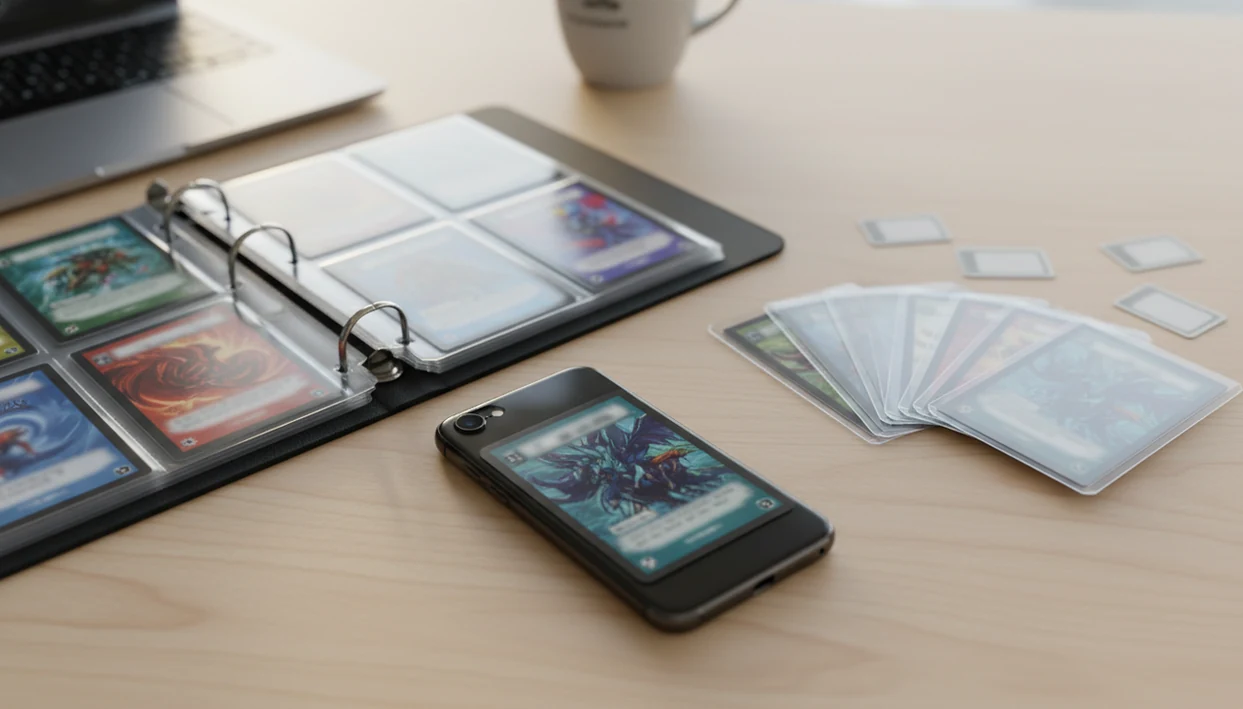
Download pokemon card value app access makes sense if you want to scan Pokémon TCG cards, check current market values, and save priced cards into a mobile collection without typing every card name by hand. TCG Pocket App is built for collectors who need fast binder-friendly scans, live price context, and portable collection tracking.
Definition: TCG Pocket App is a pokemon card scanner app that identifies cards, checks market prices, and tracks collections for Pokémon TCG collectors.
TL;DR
- A strong Pokémon card value app should combine camera scanning, live market price checks, and collection value tracking.
- In-app values are estimates based on marketplace data, not guaranteed sale prices or professional appraisals.
- The best download choice depends on whether you mainly collect, trade, sell, or manage a full binder from your phone.
How the pokemon card value apps look
Side-by-side captures of the compared products. Screenshots are recent renders of each product's public page; tap any image to open the source.
Pokemon Value App Download Must-Haves For Price Checks
A pokemon value app download should put scanning, price comparison, and collection saving into one phone workflow. Most collectors are not opening a laptop at a card show table or typing every set name from a shoebox on the floor.
- AI card recognition: The camera should identify artwork, name, set number, and rarity quickly.
- Market price checks: Values should come from live or frequently updated marketplace data.
- Saved collection value: Scanned cards should roll into a digital binder with total value.
- Duplicate tracking: Extra copies should be visible before trades, sales, or bulk sorting.
- Trend visibility: Rising, falling, and stale prices help separate quick checks from deeper research.
Pew Research Center reported that 85% of U.S. adults owned a smartphone in 2021 (https://www.pewresearch.org/internet/fact-sheet/mobile/), so mobile price tools fit how collectors already behave. A scan-to-save routine fits collectors who want camera identification, value lookup, and collection logging in the same session.
The plastic sleeve crinkles. You still want the scan done.
How A Pokemon Card Value App Download Works Behind The Scan
A pokemon card value app download works by turning a camera image into a card match, then connecting that match to selected marketplace data and a saved collection record. The scanner is fast, but the result still needs a set number check.
Definition: A card value app captures the card image, detects visual card features, matches the likely set and variant, asks for condition context, looks up marketplace pricing, and saves the result to a collection.
AI recognition can read artwork, the name area, set symbol, numbering, rarity markers, and sometimes foil cues. Under the hood, image embeddings help compare the photo against known card records. In plain terms, the software looks for visual fingerprints.
Pricing is not one universal official value. It depends on sources, update frequency, region, raw versus graded status, and whether the displayed number reflects averages, recent sales, active listings, or trend indicators. Good ai-powered pokémon tcg card scanner, live market prices, and pocket-sized collection management app workflows deliver faster lookup and cleaner logs, not guaranteed sale prices.
How To Use A Card Price App Download For Pokemon Cards
Use a card price app download by scanning in steady light, confirming the exact print, and saving the card only after checking condition and price source. This six-step workflow works best when you treat the scan result as a starting point, not the final word.
- Download the app on your phone and allow camera access for scanning.
- Scan the card in bright, even light, avoiding sleeve glare and binder shadows.
- Confirm the exact card variant by checking the set symbol, number, rarity, and foil type.
- Choose the condition honestly, especially for whitening, bends, scratches, or surface dents.
- Review price sources and compare raw, graded, recent-sale, and listing context when available.
- Save the card to your collection so duplicates and total value update.
Ring-light glare can bounce off a reverse holo through a nine-pocket page. Shift the phone a few inches before blaming the scanner.
Collectors who want a scan-first setup can pair this workflow with a dedicated download pokemon card scanner app routine for larger binder checks. The result is a priced collection you can review before trades, sales, purchases, or set completion decisions.
When To Download Pokemon Card Value App For Buying, Selling, And Trading
“Should I download a Pokémon card value app before I buy, sell, or trade?” Yes, if you regularly make decisions away from a desk. A phone-based value check helps before accepting a binder trade, pricing a marketplace listing, sorting a collection, or reacting to a newly opened pull.
Use the app at card shops, trade nights, local conventions, and kitchen-table sorting sessions. A price chart checked before an offer can keep a trade from drifting on memory alone. McKinsey reported that 46% of U.S. adults bought or sold collectibles in 2022, including trading cards (https://www.mckinsey.com/industries/retail/our-insights/sweeping-up-the-collectibles-market), so quick value checks serve a large real market.
When the issue is deciding what to keep, trade, or sell, A value app earns its spot when total collection value and duplicate tracking sit beside individual card prices. For active traders, a saved value history is often more useful than a single lookup because it gives context before the conversation starts.
What The Pokemon Card Value App Looks Like In TCG Pocket App
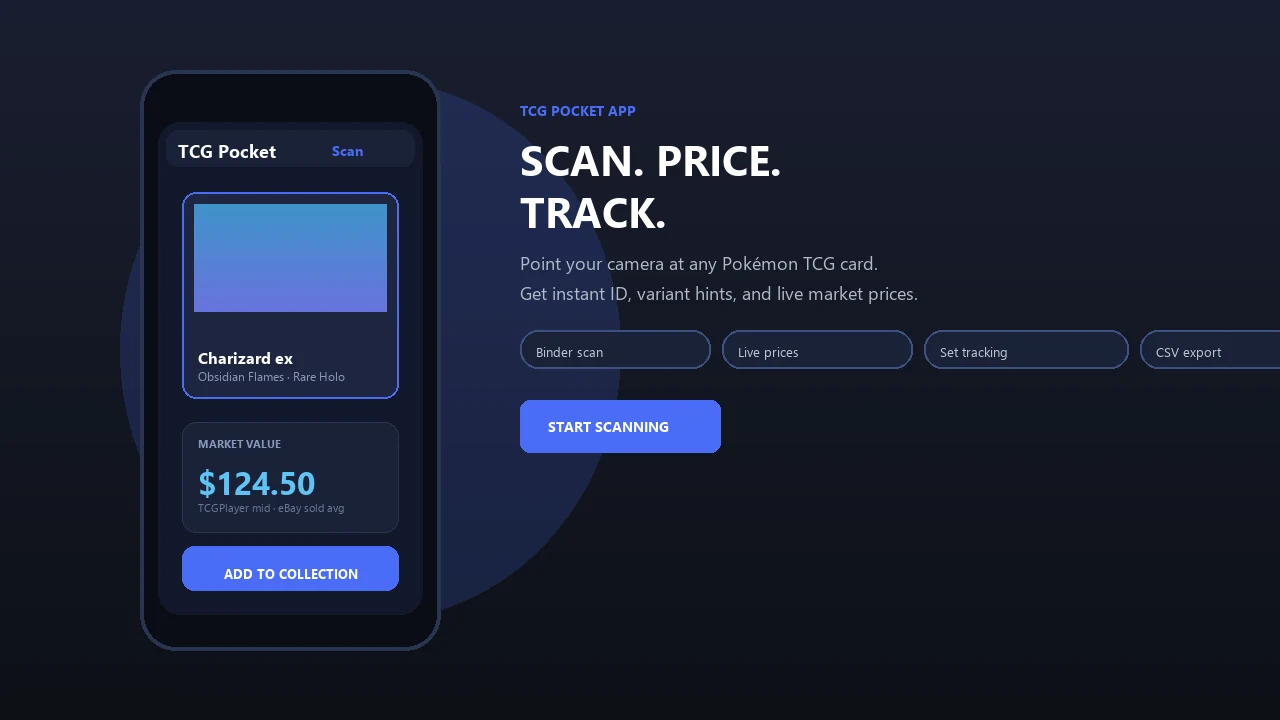
This collector utility is not an official Pokémon product and not a Pokémon TCG Pocket game guide. It is built around the physical-card workflow: scan card, confirm match, view market value, save to a digital binder, then monitor collection value over time.
The useful flow is intentionally plain. Open the camera, scan the card, verify the variant match, check live price context, and log the card. A soft corner visible through plastic can change the condition call, so the saved price should reflect what the card actually looks like.
If your goal is portable collection management, binder-friendly scanning works best when it connects directly to saved cards, duplicates, and collection value. For users focused mainly on portfolio tracking, the related download pokemon collection tracker app workflow covers the collection side in more depth.
Fast matters. Verification matters more.
Card Price App Download Versus Websites, Spreadsheets, And Manual Searches
A card price app download is usually faster than websites, spreadsheets, or manual marketplace searches when you are working through physical cards one by one. The tradeoff is control: manual research can be deeper, but it takes more time.
| Method | Speed | Accuracy control | Collection tracking | Best use case |
|---|---|---|---|---|
| Mobile scanner app | Fast | Medium to high, if variants are verified | Built in | Binder scans, trades, shop checks |
| Price-checking website | Medium | High, if you search carefully | Usually limited | Researching a few specific cards |
| Spreadsheet | Slow | High, but manual | Custom, if maintained | Long-term records and exports |
| Manual marketplace search | Slowest | High, with sold-listing review | None by default | High-value or unusual cards |
For manual checks, compare app values against sources such as TCGplayer (https://www.tcgplayer.com), Cardmarket (https://www.cardmarket.com), PriceCharting (https://www.pricecharting.com), and Pokellector (https://www.pokellector.com). They are slower when a trade binder is balanced on your forearm and the crowd noise makes every quick scan feel rushed.
Spreadsheets offer control, but they go stale fast. For users who mainly need pricing depth, a download pokemon card price checker app workflow can sit between scanner speed and manual research.
Price Accuracy Signals In A Pokemon Value App Download
A trustworthy pokemon value app download should show where prices come from, how often values update, and what condition or variant assumptions affect the number. Price tools help most when collectors still verify the print before trusting the value.
- Marketplace source matters: Recent sales, active listings, and marketplace averages answer different questions.
- Sold-listing context matters: The green sold-price filter on eBay is not the same as an active asking price.
- Exact card match matters: Check print, set, card number, rarity, holo status, reverse holo status, and language.
- Condition selection matters: Raw near mint, played, damaged, PSA, BGS, and CGC prices should not be blended casually.
- Update frequency matters: Daily or frequent updates are more useful than static database values.
Collectors trying to avoid pricing mistakes should confirm the lower-left set number before trusting a match. A scan can confuse two similar Pikachu prints until the set symbol settles the question. Raw, graded, damaged, misprint, and high-end vintage cards deserve extra verification through sold-listing context and grading-specific research.
Limitations
A Pokémon card value app is a speed tool, not an appraisal desk. A scanner can shorten the lookup process, but price-source transparency and collector verification still matter.
- App values are estimates and may not match final sale prices after fees, demand shifts, shipping, or negotiation.
- Scanner misreads can happen with glare, poor lighting, sleeves, binder plastic, damage, foreign-language cards, or obscure promos.
- Most apps do not authenticate cards, grade cards, detect counterfeits, or replace professional appraisal.
- Marketplace feeds can lag, and regional prices may differ from what a local buyer will actually pay.
- Some apps may include ads, paid tiers, export limits, or missing historical trend data.
- Newly released sets, niche promos, stamped variants, and non-English coverage can be incomplete.
- Unofficial apps are not affiliated with The Pokémon Company unless that affiliation is explicitly stated.
- High-end vintage cards should be checked against recent comparable sales, not only a single app value.
For iOS-specific behavior, the iPhone setup notes page is the cleaner reference. Android collectors can review Android setup notes for platform notes.
FAQ
Is there a free Pokemon card scanner app?
Yes, free Pokémon card scanner apps exist, but free tiers may limit scans, ads, saved collection size, exports, or price-history access. Check whether the free version includes current market values before relying on it.
How accurate are Pokemon card scanner app prices?
Pokémon card scanner app prices are estimates based on selected data sources, exact card matching, condition assumptions, and update frequency. Accuracy improves when you verify the set number, variant, language, and raw versus graded status.
Can I download a Pokemon card value app on Android?
Yes, Android users can download card value apps that scan, price, and save Pokémon cards. Most need camera permission and internet access for live market prices.
Can I use a Pokemon card value app on iPhone?
Yes, iPhone users can use a Pokémon card value app to scan cards, check prices, and save cards into a mobile collection. Camera quality and lighting can affect scan accuracy.
Can I use app prices to sell Pokemon cards?
Yes, app prices can guide listing prices, but final sale prices depend on condition, demand, seller fees, shipping, and recent comparable sales. Use sold listings for important cards before setting a firm price.
Can apps price graded Pokemon cards?
Some apps show graded card values, but many focus mainly on raw card pricing. PSA, BGS, and CGC slabs should be checked against recent graded sales before buying or selling.
Do Pokemon card value apps work offline?
Some apps may let you view saved collection data or scan partly offline. Live market prices usually require internet access because current values come from updated marketplace data.